
Introduction
Picture this: Your company invests $2.5 million in a custom enterprise application, only to watch it fail within the first year. Unfortunately, this scenario isn’t uncommon. According to the Consortium for Information and Software Quality, poor software quality costs U.S. companies over $2.08 trillion annually, with enterprise applications accounting for a significant share of that loss.
The global software market is projected to hit $824 billion by 2025. Yet, despite massive investments, many enterprise development projects still face the same core challenges that have plagued the industry for decades. The stakes are higher than ever, and understanding these obstacles isn’t just helpful; survival in today’s hyper-competitive landscape is essential.
Whether you’re a CTO planning a major system overhaul or a development manager tackling complex integrations, this guide breaks down the biggest challenges in enterprise application development. It offers practical, actionable solutions to help you overcome them.
Main Content
Navigating the Enterprise Application Development Landscape
Before diving into specific challenges, it’s essential to understand what makes enterprise application development uniquely complex. Unlike consumer apps designed for individual users, enterprise applications must manage massive datasets, support thousands of concurrent users, integrate with numerous legacy systems, and comply with strict regulatory requirements, all while ensuring 99.9% uptime.
Companies that adopt DevOps practices experience a 46% faster time-to-market and 60% fewer production failures, underscoring the importance of addressing development challenges proactively rather than reactively.
The 8 Most Critical Enterprise Application Development Challenges

1. Complex System Integration and Legacy Modernization
The Challenge: Complex System Integration: Merging new applications with legacy systems and databases remains one of the most significant hurdles. Most enterprises operate on a patchwork of systems developed over decades, each using different technologies, data formats, and communication protocols.
Key Issues:
- Incompatible data formats between old and new systems
- Limited API availability in legacy applications
- Risk of disrupting critical business operations during integration
- High costs associated with complete system overhauls
Practical Solutions:
- API-First Development: Build new applications with robust APIs from the ground up
- Microservices Architecture: Break down monolithic systems into smaller, manageable services
- Data Middleware Solutions: Implement integration platforms that can translate between different data formats
- Gradual Migration Strategy: Phase out legacy systems incrementally rather than attempting complete replacement
2. Scalability and Performance Under Enterprise Loads
The Challenge: Enterprise applications must handle large amounts of data, concurrent users, and high transaction volumes. Ensuring scalability and optimal performance under such demands requires careful design and architecture.
Performance Metrics That Matter:
| Metric | Enterprise Standard | Common Challenges |
| Response Time | <200ms | Database bottlenecks |
| Concurrent Users | 10,000+ | Memory limitations |
| Uptime | 99.9% | Infrastructure failures |
| Data Processing | TB-scale | Storage limitations |
Proven Solutions:
- Load Balancing: Distribute traffic across multiple servers
- Caching Strategies: Implement Redis or Memcached for faster data retrieval
- Database Optimization: Use indexing, partitioning, and query optimization
- Cloud-Native Architecture: Leverage auto-scaling capabilities of cloud platforms
3. Enterprise-Grade Security and Compliance
The Challenge: Implementing resilient cloud in software development can reduce downtime by 57% and 26% of the cost associated with breaches, yet security remains a top concern for enterprise applications handling sensitive data.
Security Requirements Include:
- Data encryption at rest and in transit
- Multi-factor authentication and role-based access control
- Compliance with regulations (GDPR, HIPAA, SOX, etc.)
- Regular security audits and penetration testing
- Secure API endpoints and data transmission
Security Best Practices:
- Zero Trust Architecture: Never trust, always verify every access request
- Regular Security Audits: Conduct quarterly penetration testing
- Automated Vulnerability Scanning: Implement continuous security monitoring
- Employee Training: Regular security awareness programs
4. Resource and Skill Gaps
The Challenge: Resource and skill gaps are significant enterprise app development challenges, as many organizations struggle to find in-house experts who can build and maintain complex applications using emerging technologies or specialized frameworks.
Common Skill Shortages:
- Cloud architecture specialists
- DevOps engineers with enterprise experience
- Cybersecurity experts
- Full-stack developers familiar with enterprise technologies
- Data scientists and AI/ML specialists
Strategic Solutions:
- Partner with Expert Development Companies: Companies like Desol Int provide specialized enterprise development services with proven track records
- Invest in Training Programs: Upskill existing team members.
- Hybrid Development Models: Combine in-house and outsourced expertise
- Long-term Talent Retention: Create competitive compensation packages
5. Data Management and Governance
The Challenge: Unstructured data, such as documents, photos, and audio, poses significant challenges for enterprise applications. The complexity of handling such diverse data types necessitates robust data management strategies.
Data Challenges Include:
- Managing both structured and unstructured data
- Ensuring data quality and consistency across systems
- Implementing proper data governance policies
- Meeting data retention and deletion requirements
- Enabling real-time analytics and reporting
Data Management Solutions:
Data Architecture Framework
| Layer | Purpose | Technologies |
| Data Sources | Raw data collection | APIs, Databases, Files |
| Data Integration | ETL/ELT processes | Apache Kafka, Talend |
| Data Storage | Scalable storage | Data lakes, Warehouses |
| Data Processing | Analytics & ML | Spark, Hadoop, AI platforms |
6. User Adoption and Change Management
The Challenge: Adoption and Usability: Encouraging employees to embrace new enterprise applications often proves more difficult than the technical development itself.
User Adoption Barriers:
- Complex user interfaces that require extensive training
- Resistance to changing established workflows
- Lack of a clear value proposition for end users
- Insufficient training and support resources
- Poor integration with familiar tools
Change Management Strategies:
- User-Centered Design: Involve end users in the design process from day one
- Comprehensive Training Programs: Provide multiple learning formats (video, hands-on, documentation)
- Champion Programs: Identify and train power users to support their colleagues
- Gradual Rollout: Phase implementation to allow for feedback and adjustments
- Continuous Support: Establish a help desk and feedback mechanisms
7. Budget Overruns and ROI Concerns
The Challenge: Low return on investment in enterprise application development can be a serious challenge if the project workflow is not thoroughly planned and developer experience is insufficient. Enterprise application development takes months to complete.
Common Cost Overrun Factors:
- Scope creep during development
- Underestimated integration complexity
- Hidden infrastructure costs
- Extended testing and debugging phases
- Post-launch maintenance and updates
Budget Management Best Practices:
Cost Control Framework
- Detailed Project Planning: Break down all components and timeline
- Regular Budget Reviews: Monthly financial checkpoints
- Risk Assessment: Identify potential cost drivers early
- Value Engineering: Prioritize features based on business impact
- Performance Metrics: Track ROI indicators throughout development
32.23% of companies outsource their software projects rather than hiring in-house in order to cut down the cost, highlighting the importance of choosing the right development approach for your budget constraints.
8. Third-Party Integration Complexity
The Challenge: Third-party integrations: Some enterprise applications don’t play nice with your existing systems. The process of integrating the tool into your organization can be time-consuming and too complex.
Integration Challenges:
- Multiple API standards and protocols
- Version compatibility issues
- Data synchronization problems
- Vendor dependency risks
- Security vulnerabilities in third-party systems
Integration Solutions:
- API Gateway Implementation: Centralize and manage all external integrations
- Standardized Data Formats: Use JSON or XML consistently across integrations
- Integration Testing: Comprehensive testing for all third-party connections
- Vendor Evaluation: Thorough assessment of third-party reliability and security
- Backup Plans: Alternative solutions for critical integrations
How Desol Int Addresses Enterprise Development Challenges
At Desol Int, we understand that enterprise application development isn’t just about writing code, it’s about solving complex business problems while navigating technical constraints and organizational challenges. Our experienced team has successfully delivered enterprise solutions that address each of these critical challenges through:
- Proven Integration Expertise: Our specialists have integrated with over 200 different enterprise systems, ensuring seamless connectivity with your existing infrastructure
- Scalable Architecture Design: We build applications that grow with your business, utilizing cloud-native technologies and microservices architecture
- Security-First Approach: Every application we develop includes enterprise-grade security measures and compliance frameworks from day one
For organizations looking to modernize their enterprise applications or overcome specific development challenges, our Enterprise Web Application Development services provide comprehensive solutions tailored to your unique requirements.
Current Trends Shaping Enterprise Development
Cloud-Native and Microservices Adoption
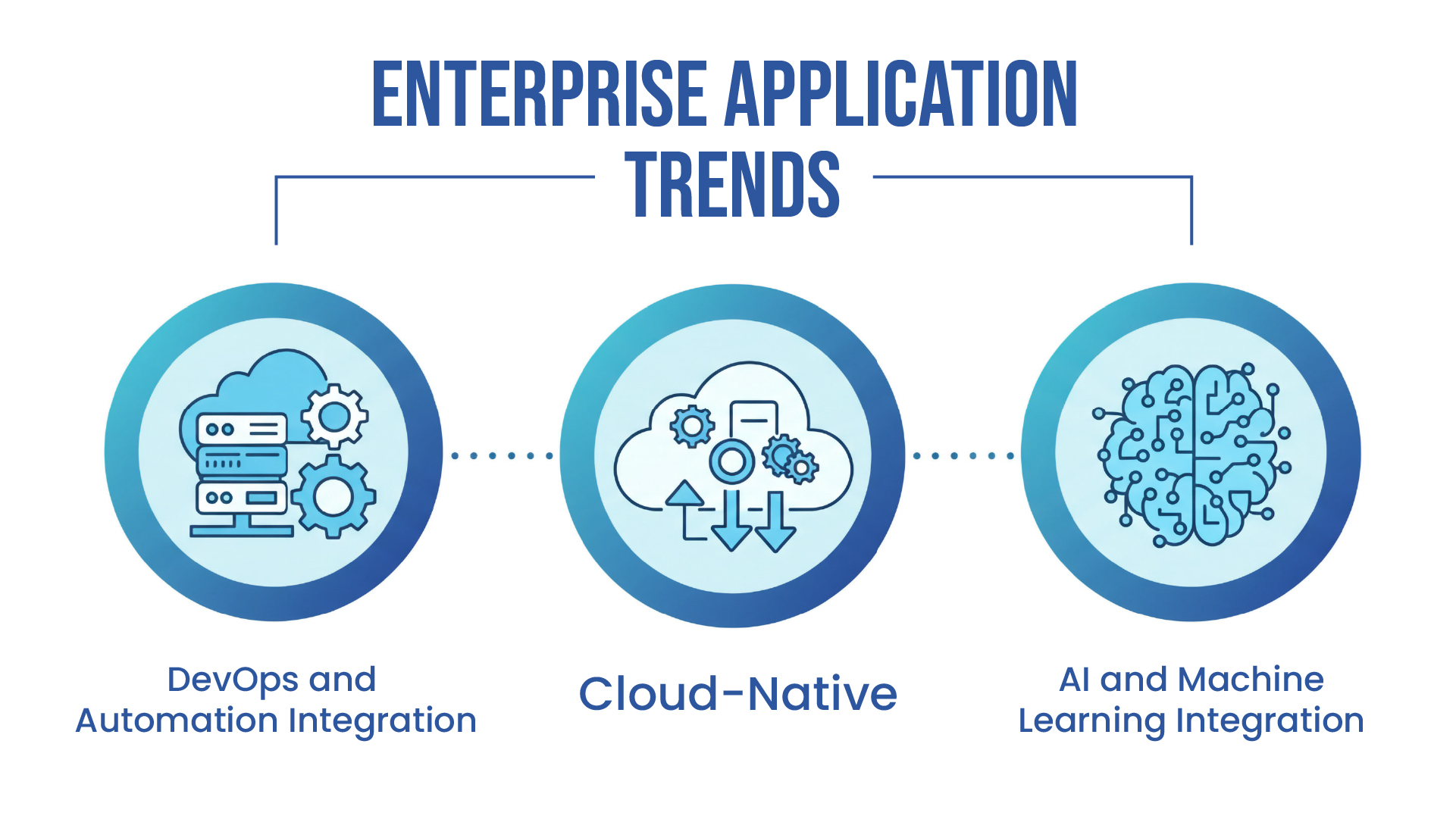
Businesses are rapidly moving away from monolithic, on-premise applications and embracing the agility and scalability of cloud-native development. This approach, built on microservices architecture, containerization, and CI/CD pipelines, revolutionizes how enterprises build and deploy software.
DevOps and Automation Integration
80% of teams have adopted CI/CD pipelines, reducing deployment time by 50% and increasing delivery frequency, demonstrating the critical importance of automated development processes.
AI and Machine Learning Integration
Modern enterprise applications increasingly incorporate AI capabilities for predictive analytics, automated decision-making, and enhanced user experiences. This trend requires new skills and architectural considerations.
Measuring Success: KPIs for Enterprise Applications
Technical Performance Metrics
- System Uptime: Target 99.9% availability
- Response Time: <200ms for critical operations
- Scalability: Handle 3x current load without degradation
- Security Incidents: Zero critical vulnerabilities
Business Impact Metrics
- User Adoption Rate: >80% within 6 months
- Process Efficiency: 30%+ improvement in key workflows
- Cost Savings: ROI positive within 18 months
- Employee Satisfaction: Measurable improvement in user experience scores
Conclusion
Enterprise application development challenges are complex and multifaceted, but they’re not insurmountable. Success requires a combination of technical expertise, strategic planning, and the right development partner. The key is understanding that these challenges are interconnected solving one often helps address others.
Organizations that proactively address these eight critical challenges will position themselves for success in an increasingly digital business environment. Remember, the goal isn’t just to build an application; it’s to create a solution that drives real business value while standing the test of time.
Ready to overcome your enterprise development challenges? Contact Desol Int today to discuss how our proven methodologies and experienced team can help you build robust, scalable enterprise applications that deliver real business results. Our experts are standing by to provide a free consultation and project assessment.
Frequently Asked Questions
Q: What’s the average timeline for enterprise application development?
A: Enterprise applications typically take 6-18 months to develop, depending on complexity, integration requirements, and scope. Projects with extensive legacy system integration or custom features may take longer. Proper planning and experienced development teams can significantly reduce timelines.
Q: How much does enterprise application development cost?
A: Costs vary widely based on complexity, features, and integration requirements. Simple enterprise apps may cost $50,000-$200,000, while complex, fully-integrated solutions can range from $500,000 to several million dollars. The key is focusing on ROI rather than just initial cost.
Q: Should we build in-house or outsource enterprise development?
A: This depends on your internal capabilities, timeline, and budget. In-house development offers more control but requires significant expertise and resources. Outsourcing to experienced firms like Desol Int provides access to specialized skills and proven methodologies, often resulting in faster delivery and lower risk.
Q: What’s the most important factor for enterprise application success?
A: While technical excellence is crucial, user adoption is often the determining factor. Applications that solve real business problems and provide intuitive user experiences have the highest success rates. Change management and training are just as important as the technology itself.
Q: How do we ensure our enterprise application will scale as we grow?
A: Design for scalability from the beginning using cloud-native architectures, microservices, and containerization. Plan for 3-5x your current load, implement proper load balancing, and choose technologies that support horizontal scaling. Regular performance testing and monitoring are essential for maintaining scalability.