
Introduction
Hiring a senior developer in the US costs $150,000 to $180,000 per year. Hiring that same engineer through nearshore staff augmentation in Latin America costs $60,000 to $90,000, with no loss in technical quality. Add a 2- to 4-hour time zone overlap, strong English proficiency, and 2- to 3-week onboarding, and the math becomes hard to ignore.
This is why over 80% of US firms are now exploring nearshore partnerships and why Latin America alone hit $105 billion in software development industry value. Nearshore staff augmentation has moved from a cost-cutting tactic to a core scaling strategy for companies that need specialized talent fast without sacrificing control or collaboration quality.
This guide covers what nearshore staff augmentation actually is, how the process works, which countries lead the market, what it costs, and exactly when this model delivers the strongest return. Real numbers, real trade-offs, no fluff.
What Is Nearshore Staff Augmentation?

Nearshore staff augmentation is a workforce model where you extend your in-house team with skilled professionals from geographically close countries that share similar or overlapping time zones. The external talent works directly under your management, using your tools, following your processes, and participating in your daily stand-ups like any other team member.
The word “nearshore” is defined relative to your location. For a US company, nearshore typically means Latin America (Mexico, Colombia, Argentina, Brazil, Costa Rica). For a Western European company, it means Eastern Europe (Poland, Ukraine, Romania, Portugal). The shared trait is proximity: close enough for real-time collaboration but far enough to access meaningfully lower labor costs.
Unlike traditional outsourcing, you do not hand off a project to a vendor. You keep full ownership of the roadmap, architecture decisions, and daily priorities. The staffing partner handles sourcing, vetting, contracts, payroll, and local compliance. You manage the work. They manage the logistics.
This is the key distinction from offshore models: nearshore engineers are online when your team is online. No 12-hour async gaps. No overnight code reviews. No standups scheduled at 3am for someone’s timezone.
How Does Nearshore Staff Augmentation Work?
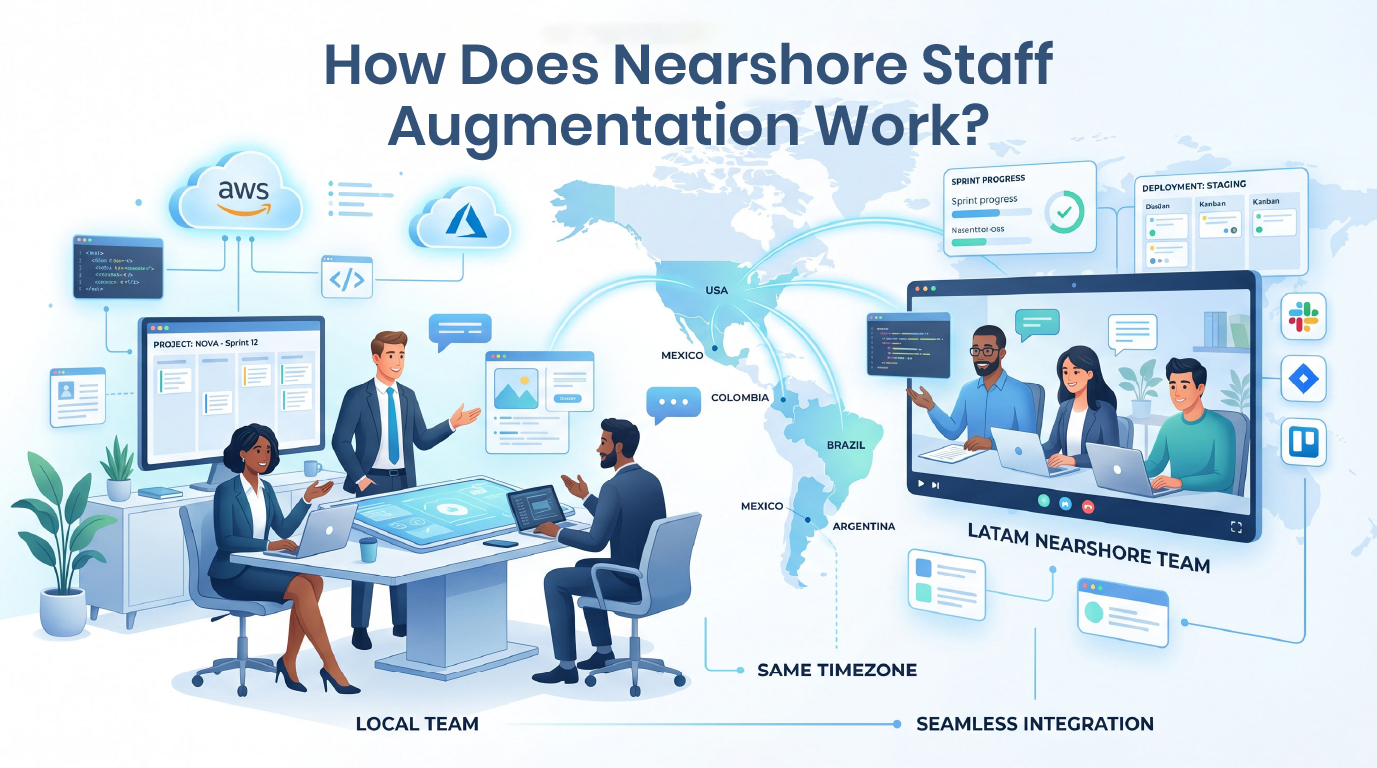
The process follows a structured path that typically moves from first call to onboarded team member in two to four weeks. Here is how it works step by step.
Step 1: Define Your Needs and Skill Gaps
Start with a clear brief. Vague requirements produce mismatched candidates. Specify the technical skills needed, seniority level, project duration, required time zone overlap, English proficiency expectations, and the outcomes you will measure.
A strong brief reads like this: senior backend engineer with Node.js and PostgreSQL experience, 6-month engagement, at least 5 hours overlap with EST, full professional English fluency, delivering the API refactor against defined sprint goals.
Step 2: Choose Your Nearshore Region and Country
Different countries offer different trade-offs. Mexico aligns with US Central and Pacific time and has the region’s second-largest talent pool. Colombia overlaps with Eastern Time and leads in agile methodology adoption. Argentina ranks first in Latin America for English proficiency and excels in complex backend work. Brazil has the largest talent market and strong data and fintech expertise. Costa Rica carries premium rates but delivers exceptional stability and enterprise-grade reliability.
For European companies, Poland offers strong technical depth and mature outsourcing infrastructure, Ukraine delivers competitive rates with deep engineering pools, and Romania brings strong EU compliance alignment.
Step 3: Select a Staffing Partner
Partner quality determines whether augmentation succeeds or fails. Evaluate providers on six criteria: vetting rigor (technical assessments, English screening, and cultural fit evaluation), bench depth (can they deliver shortlists in days, or do they start recruiting after you sign), retention rates (90%+ is strong), pricing transparency (no hidden markups), contract flexibility (replacement policies and conversion options), and industry specialization (sector experience matters).
Ask for three reference calls before signing. Ask how they handle underperformers. Ask what percentage of their bench is already pre-vetted.
Step 4: Source and Interview Candidates
A good provider delivers a shortlist of three to five pre-vetted candidates within a week. Your side owns final selection. Run structured interviews that test both technical depth and communication skills. Include scenario-based questions pulled from your actual challenges. Validate English fluency in a real conversation, not just a resume check.
Skipping this step is where engagements break down. The provider screens for baseline quality. You screen for fit with your specific team, codebase, and culture.
Step 5: Contract, Compliance, and Onboarding
The provider handles local employment contracts, NDAs, payroll, tax compliance, and benefits administration. You handle onboarding. Grant system access before day one (repository permissions, CI/CD access, project tools, Slack channels). Assign an integration buddy from your existing team. Share documentation covering architecture, coding standards, and deployment procedures.
Companies with structured onboarding see roughly 50% higher productivity from new team members versus ad-hoc approaches.
Step 6: Integration and Active Management
Treat nearshore engineers as full team members from day one. Include them in stand-ups, planning sessions, code reviews, retrospectives, and Slack conversations. The us-versus-them dynamic is what kills productivity, not geography. Set clear performance baselines before the engagement starts so you can measure output against defined expectations.
Step 7: Scale, Convert, or Transition
As the project evolves, scale the team up or down based on need. Good providers offer contract flexibility, replacement policies for underperformers, and conversion options if you want to bring augmented staff onto payroll directly. Some providers also offer Build-Operate-Transfer (BOT) models where they run the operation for two to three years then transfer ownership to you.
Nearshore vs Offshore vs Onshore: The Real Differences
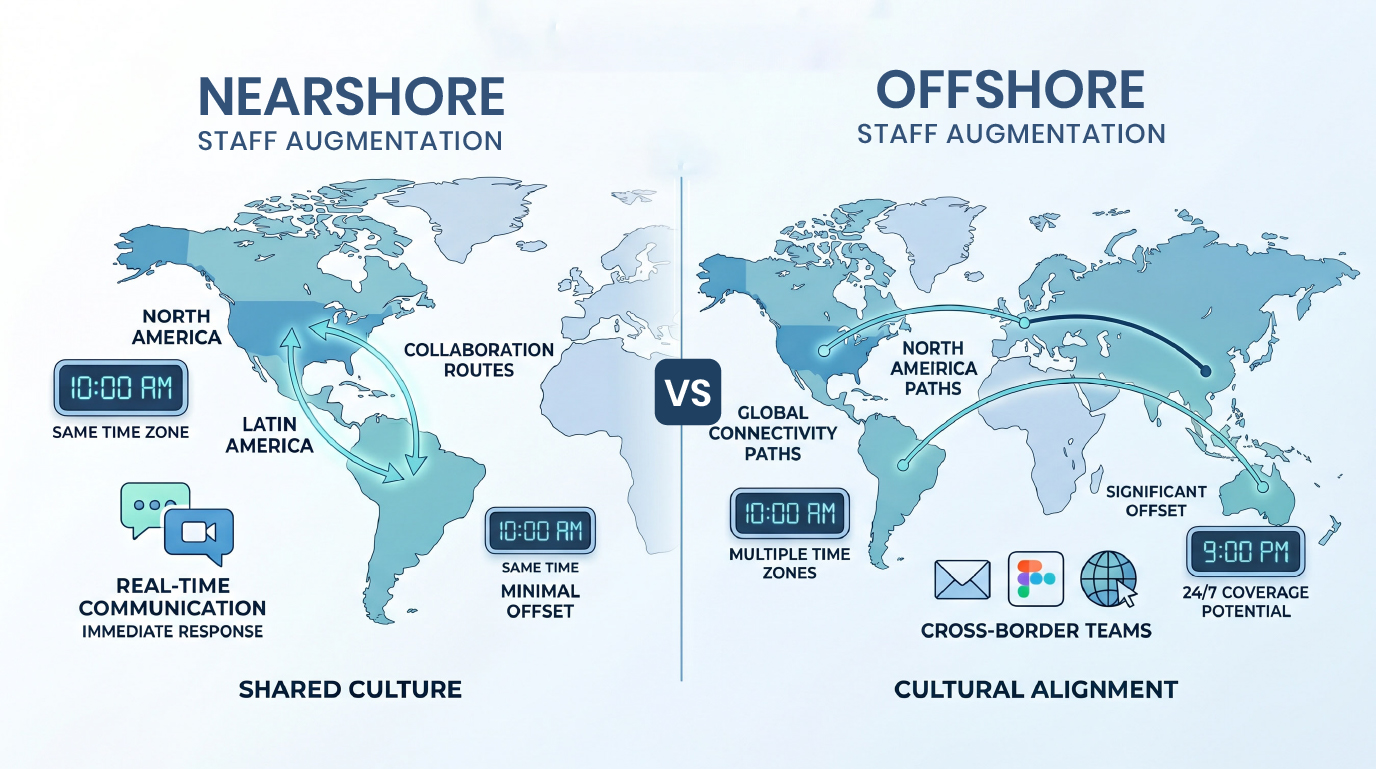
Understanding the three models side by side makes the nearshore case clear.
Onshore means hiring talent within your own country. You get perfect time zone alignment, cultural fit, and zero language barriers. You also pay full market rates, face the longest hiring cycles (45 to 52 days average for technical roles), and compete against every other company for the same talent pool.
Offshore means hiring from distant countries with major time zone gaps (India, Philippines, parts of Southeast Asia). You get the lowest nominal rates and access to massive talent pools. You also face 8 to 12 hour time zone gaps, async-only collaboration, cultural and communication friction, and overnight code review cycles that slow delivery.
Nearshore sits in between. Rates run 30% to 50% below onshore (sometimes up to 60% when factoring total cost of ownership). Time zones overlap with your core business hours. Cultural alignment is high because of shared business norms and proximity. English proficiency is strong in top nearshore hubs. The trade-off: rates are higher than offshore, but the communication efficiency typically more than makes up the difference.
For most US companies scaling engineering teams, nearshore captures most of the cost benefit of offshore while preserving the collaboration quality of onshore. That is the core value proposition.
Top Nearshore Destinations for 2026
Latin America dominates the nearshore conversation for US companies, and the reasons are concrete.
Mexico holds roughly 800,000 IT professionals and aligns with US Central and Mountain time zones. IT staff rates run 2 to 4 times lower than onshore and up to 30% lower than other LATAM hubs. Strong fit for West Coast teams needing real-time collaboration and cross-border operational simplicity.
Colombia overlaps fully with US Eastern Time and offers one of the region’s most agile-ready talent pools. Bogotá and Medellín have become major tech hubs. Strong fit for East Coast teams scaling fast and prioritizing agile workflow alignment.
Argentina ranks number one in Latin America for English proficiency per the EF English Proficiency Index. Known for deep technical expertise, particularly in backend architecture, fintech, and senior-level engineering. Rates are among the most competitive in the region due to favorable exchange conditions.
Brazil has the region’s largest talent market and leads in enterprise-scale work, data engineering, fintech, and AI services. São Paulo operates in BRT (UTC-3), giving solid overlap with US business hours. Larger project capacity than any other single LATAM country.
Costa Rica is a premium destination known for political stability, high English fluency, and experience hosting major enterprise operations (Intel, Amazon). Rates are higher than neighboring countries but the reliability premium justifies it for regulated industries.
Chile offers Latin America’s most stable economy and a tech-savvy workforce strong in fintech, enterprise software, and data science. Rates sit at the higher end for the region. Best fit for mission-critical, technically demanding work.
Peru is an emerging destination with a rapidly expanding Lima tech community. Rates are highly competitive, particularly for backend development and QA roles. Strong value option for teams with tighter budgets.
For European companies, the equivalent hubs are Poland (mature outsourcing ecosystem, strong EU alignment), Ukraine (deep engineering pools, competitive rates), Romania (strong technical universities, EU compliance built in), and Portugal (growing tech hub, Atlantic time zone bridge to the Americas).
Latin America produces over 500,000 engineering graduates annually and has a combined technical workforce exceeding 2 million across LATAM and Central/Eastern Europe combined. The talent pipeline keeps deepening.
What Does Nearshore Staff Augmentation Cost?
Rates vary by country, seniority, and role. Here is the realistic picture for 2026.
US baseline: Senior software engineers cost $150,000 to $180,000 per year in base salary. Add benefits, equipment, and overhead, and all-in cost typically reaches $230,000 to $280,000. Hourly billing through US staffing firms runs $100 to $200 per hour for senior talent.
Nearshore Latin America rates:
- Mid-level developer: $35 to $70 per hour, or roughly $45,000 to $85,000 per year
- Senior developer: $60 to $80 per hour, or roughly $70,000 to $120,000 per year all-in through a staff augmentation partner
- Specialist roles (AI/ML, senior DevOps, cloud architects): $75 to $100 per hour
Country-specific ranges for mid-level developers:
- Argentina: $35 to $55 per hour
- Colombia: $38 to $58 per hour
- Mexico: $40 to $60 per hour
- Brazil: $45 to $65 per hour
- Chile: $50 to $70 per hour
- Costa Rica: $55 to $75 per hour
Total cost of ownership. Budget 1.3 to 1.5 times the base salary for loaded cost (employer contributions, benefits, partner fees). For a mid-level developer through an Employer of Record (EOR), expect all-in monthly costs around $5,900 to $7,150.
Realistic savings. Across common IT roles, nearshore rates run 30% to 60% below US equivalents. On a five-person team over 12 months, that gap produces $300,000 to $600,000 in annual savings before factoring in reduced vendor management overhead. Some companies report total savings reaching 65% to 70% when accounting for eliminated recruiting costs, reduced attrition, and faster time-to-hire.
Key Benefits of Nearshore Staff Augmentation
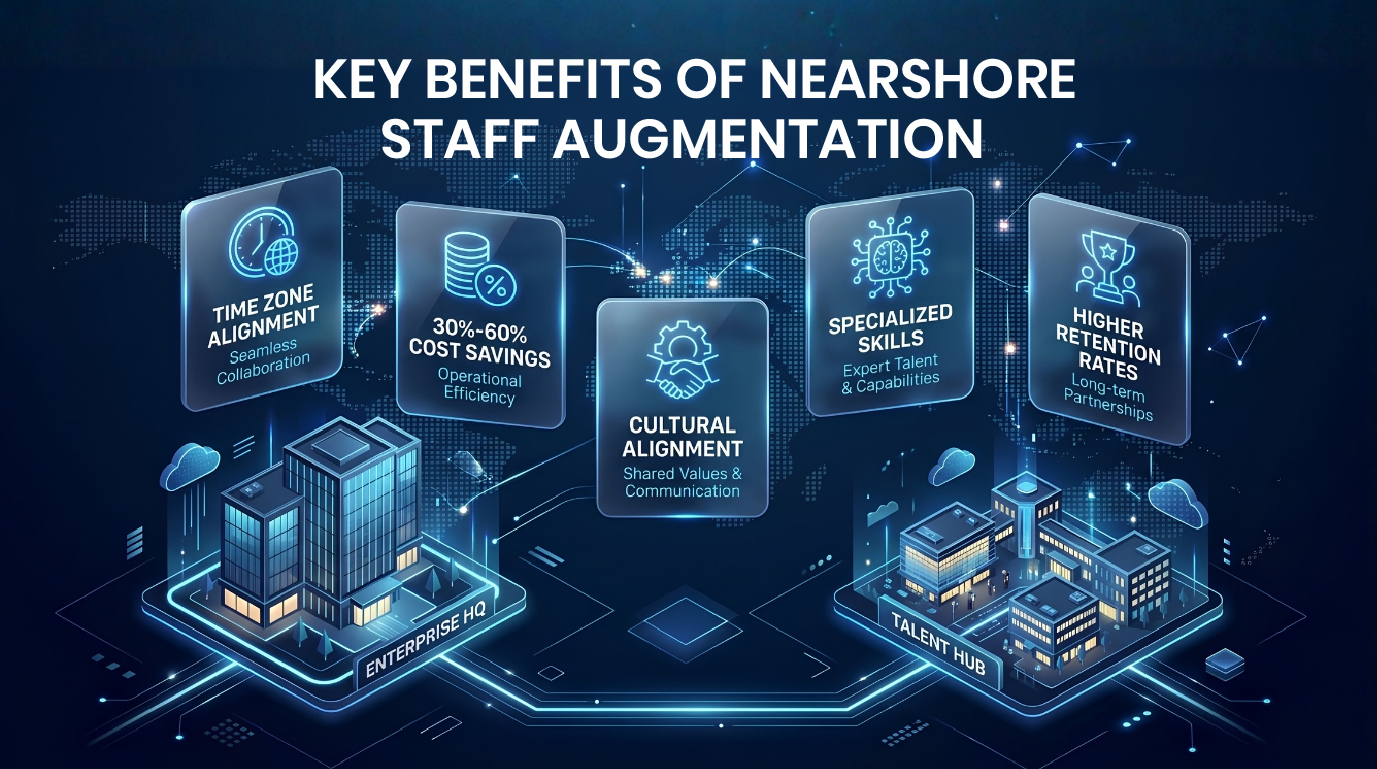
The model delivers on specific, measurable advantages that onshore and offshore cannot match at the same time.
Time zone alignment. Nearshore teams typically work within 1 to 4 hours of your core business hours. That overlap enables real-time standups, same-day code reviews, and immediate issue resolution. No overnight async loops.
Cost savings of 30% to 60% without the quality sacrifice typical of far-offshore arrangements. Same technical skills, different labor market, lower cost of living.
Faster time-to-hire. Structured nearshore platforms deliver candidate shortlists within 72 hours and first hires in as few as 14 days. Traditional US hiring takes 45 to 52 days for technical roles.
Cultural alignment. Shared business norms, similar work ethics, overlapping holidays, and compatible communication styles reduce the friction that plagues offshore engagements. Teams adapt faster and avoid the cultural lag.
Strong English proficiency in top nearshore hubs, particularly Argentina (#1 in LATAM), Costa Rica, and Uruguay. This is a dramatic improvement over the language gaps common in deep offshore markets.
Scalability without commitment. Ramp up for product launches, scale down when projects ship. Contract flexibility is built into the model.
Access to specialized skills. Nearshore hubs have deep talent pools in high-demand areas: AI/LLM capabilities, backend and frontend development, DevOps, data science, QA automation, cloud architecture, and cybersecurity.
Retained control. Unlike project outsourcing, you keep full ownership of architecture, priorities, and technical decisions. The nearshore team integrates into your workflow rather than operating as a separate unit.
Higher retention rates. Top nearshore providers sustain 90%+ retention, reducing the churn and knowledge loss that plague offshore arrangements. Lower attrition means better continuity and lower replacement costs.
When Should You Use Nearshore Staff Augmentation?
This model works best in specific situations:
- Your US hiring pipeline cannot keep up with project demand
- You need senior engineers but local rates are blowing up your budget
- You run agile workflows that require real-time collaboration
- You need specialized skills (AI, cloud, DevOps, QA automation) that are scarce locally
- Your roadmap demands rapid scaling without long-term commitments
- You have existing internal leadership and want to stay close to execution
- You want to avoid the time zone and cultural friction of deep offshore
- You are running SAP, Oracle, or other enterprise implementations that need specialized talent for a defined period
Nearshore is a poor fit when you lack product leadership to direct the work, when budgets are so tight that only deep offshore rates work, or when the project requires years of embedded institutional knowledge that a new team member cannot absorb. In those cases, managed services, project outsourcing, or full offshore may be better choices.
Common Challenges and How to Solve Them
Nearshore staff augmentation is not friction-free. These are the real challenges and how smart teams handle them.
Integration friction. New team members feel like outsiders and miss context. Solution: treat them as full team members with equal access to meetings, documentation, and decisions from day one. Assign an integration buddy for the first 30 days.
Legal and compliance complexity. Cross-border hiring introduces labor law, tax, and IP considerations. Solution: use a provider with local legal entities or an Employer of Record (EOR) arrangement. They handle compliance so you do not have to navigate foreign labor codes.
Cultural alignment, even in nearshore markets. Business norms still differ across countries. Solution: invest in onboarding that explicitly covers communication styles, feedback expectations, and decision-making patterns. Regular video check-ins matter more than chat alone.
Quality variance across providers. Not every staffing firm vets the same way. Solution: test candidates rigorously on your side, start with a small engagement before scaling, and insist on replacement clauses. Psychologist-led assessments are a signal that a provider takes long-term placement quality seriously.
Time zone gaps even within nearshore. Brazil to US Pacific is still a 5-hour gap. Solution: define a minimum overlap window (typically 4 to 5 hours) in the contract, not as an afterthought.
Data security and IP protection. Cross-border collaboration raises concerns, particularly in regulated industries. Solution: strong NDAs, access controls scoped to what each person actually needs, and providers carrying SOC 2, ISO 27001, or equivalent certifications.
Knowledge retention risk when contractors leave. Solution: require documentation as a deliverable, not an afterthought. Architecture decisions, API contracts, and deployment procedures all need to live in your systems.
How to Choose a Nearshore Staff Augmentation Partner
Partner selection is the single most important decision in the process. Focus on these criteria:
Multi-layer vetting. Look for providers who test technical skills, English proficiency, communication style, and cultural fit (not just technical screening). Ask for their exact vetting process in writing.
Documented retention rates. Ask for numbers. 90%+ retention is strong. Below 80% signals deeper problems with how they treat talent.
Transparent pricing. Avoid providers who hide margins or refuse to break down rate cards. Ask for the breakdown between talent compensation and provider fees.
Ramp speed. The best providers deliver shortlists within 72 hours and have first hires working within 2 to 3 weeks. Slow ramp usually means they start recruiting after you sign, not before.
Contract flexibility. Replacement policies for underperformers, notice periods for scaling down, and conversion options for permanent hiring should all be built in.
Compliance coverage. For most US companies, working with a provider who operates local legal entities or offers EOR services eliminates massive administrative overhead.
Third-party validation. Check Clutch ratings, G2 reviews, and verifiable case studies. Ask for three reference calls with clients who hired for similar roles.
Post-placement support. The best providers stay engaged after placement, handling performance issues, scope changes, and transitions. The worst disappear once the contract signs.
Conclusion
Nearshore staff augmentation has become the default scaling strategy for US and European companies that refuse to choose between cost and quality. The math is simple: 30% to 60% savings, 2 to 4 week ramp times, full-day time zone overlap, and talent pools with over 2 million skilled professionals across LATAM and Eastern Europe combined.
The model works when you match it to the right situation. If you have product leadership, agile workflows, and specialized skill gaps, nearshore delivers measurable advantages over both local hiring and deep offshore. If you lack internal direction, need someone to own delivery end-to-end, or run heavily regulated work that requires physical presence, other models fit better.
If you are evaluating nearshore for the first time, start with one engagement. Pick a defined role, a clear 3 to 6 month scope, a reputable partner with documented retention and transparent pricing, and measure the results against specific KPIs: time-to-productivity, output quality, communication effectiveness, and total cost versus an onshore equivalent.
The companies winning in 2026 are not the ones hiring fastest locally. They are the ones building distributed teams that combine the best local talent with carefully selected nearshore specialists, running as one integrated unit across borders. Nearshore staff augmentation is the bridge that makes that possible.
Frequently Asked Questions
How is nearshore staff augmentation different from offshore? Nearshore uses talent in geographically close countries with overlapping time zones (LATAM for US companies, Eastern Europe for Western European companies). Offshore uses distant countries with major time zone gaps. Nearshore trades slightly higher rates for dramatically better collaboration quality.
How quickly can I onboard a nearshore team? With a good partner, expect a shortlist within 72 hours to one week, and a first hire onboarded within 14 to 21 days. Traditional US hiring for the same role typically takes 6 to 8 weeks minimum.
How much can I save with nearshore staff augmentation? Companies typically save 30% to 50% on developer salaries versus US equivalents, with total savings reaching 60% to 65% when accounting for benefits, overhead, and recruiting costs.
Which Latin American country is best for nearshoring? It depends on your priorities. Mexico and Brazil offer the largest talent pools. Argentina leads in English proficiency. Colombia has the strongest US Eastern Time alignment. Costa Rica delivers premium reliability. Chile is strongest for mission-critical enterprise work.
Is nearshore staff augmentation the same as freelancing? No. Freelancers work independently and you manage everything directly. Nearshore augmentation involves a staffing partner who handles vetting, contracts, compliance, and payroll, with professionals typically working full-time hours on your engagement.
Can nearshore engineers be converted to full-time employees? Most providers offer contract-to-hire or conversion options. Some charge zero buyout fees after a minimum engagement period. Others charge 10% to 25% of annual salary for early conversion. Clarify terms before signing.
What roles work best for nearshore augmentation? Any knowledge work role fits, but highest-demand categories in 2026 include full-stack developers, QA and automation engineers, DevOps and cloud engineers, data scientists, AI/ML specialists, backend engineers, and Salesforce specialists. Also strong fits: financial controllers, bookkeepers, CRM administrators, customer success, and technical support.
How do I handle legal and tax compliance? The easiest path is working with a provider who operates local legal entities in the nearshore country or offers Employer of Record services. They become the legal employer in-country, handling payroll, taxes, benefits, and labor law compliance.