
Staff Augmentation vs Outsourcing vs Managed Services: 2026 Decision Framework
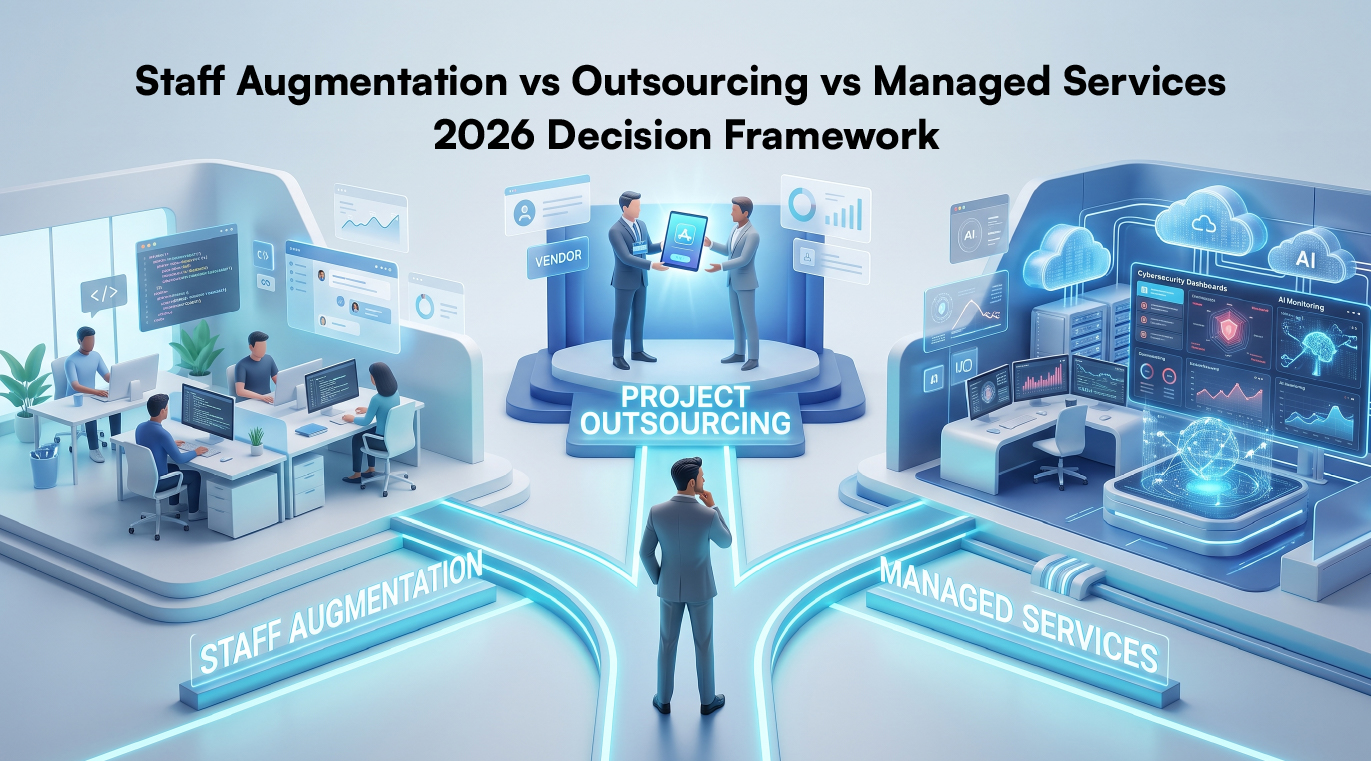 You hit the wall. Your roadmap demands more engineering capacity than your team can ship, and the traditional hiring cycle of 60 to 90 days will sink the quarter. So you start looking outside, and three options stare back at you: staff augmentation, project outsourcing, or managed services. They sound interchangeable. They are not. Pick the wrong model and you burn six figures on a structure that fights the way your work actually flows. Pick the right one and you compress your timeline by months while keeping costs predictable. This guide walks through what each model actually means in 2026, where each one fails in practice, and the exact questions to ask before you sign anything.
The 30-second version
If you have strong technical leadership and your priorities shift often, staff augmentation keeps control inside your team while adding capacity fast. If your scope is locked, your timeline is fixed, and you want a vendor to own delivery end-to-end, project outsourcing removes the management overhead. If you need someone to run an ongoing function (infrastructure, security, support) against agreed service levels for years, not months, managed services transfers operational responsibility entirely. Most growing companies eventually run all three at once. The trick is matching each model to the right kind of work, not picking one and forcing everything into it.
Staff Augmentation: What it actually is
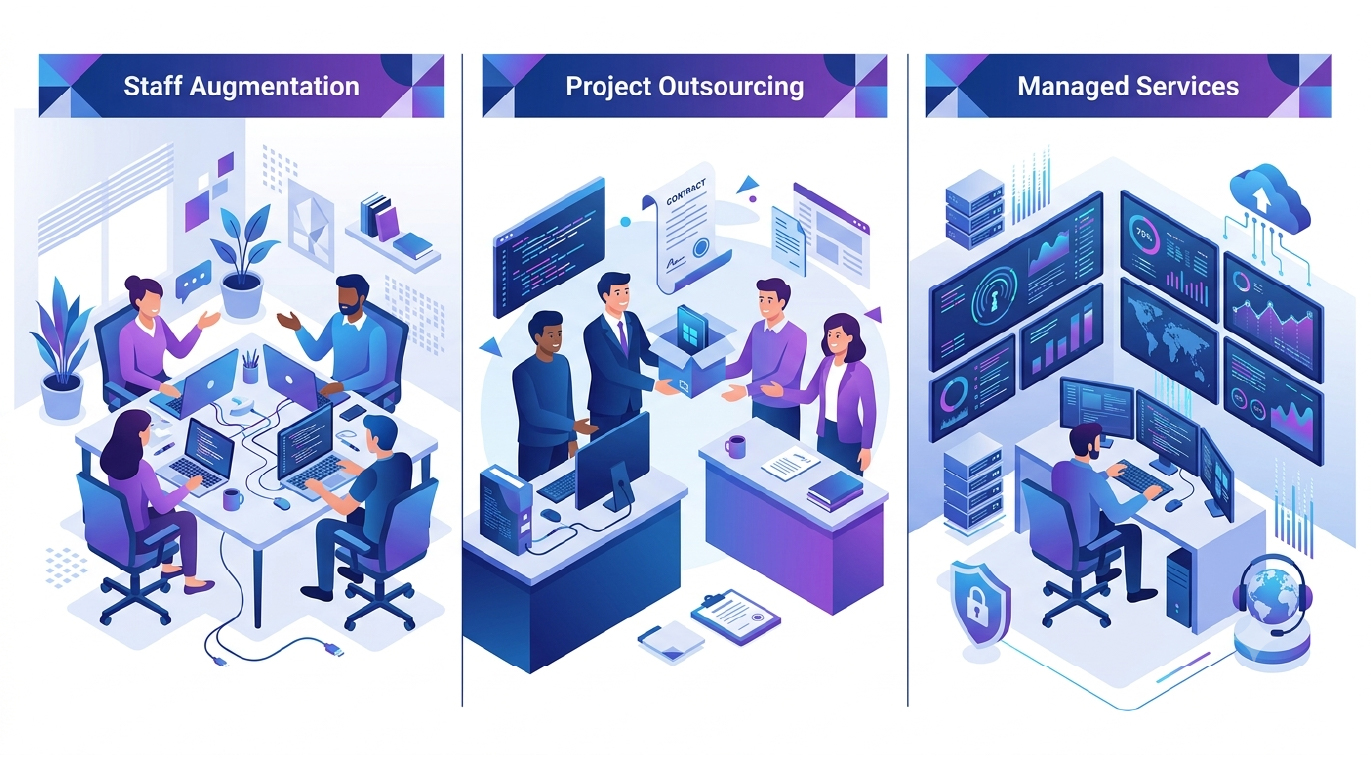
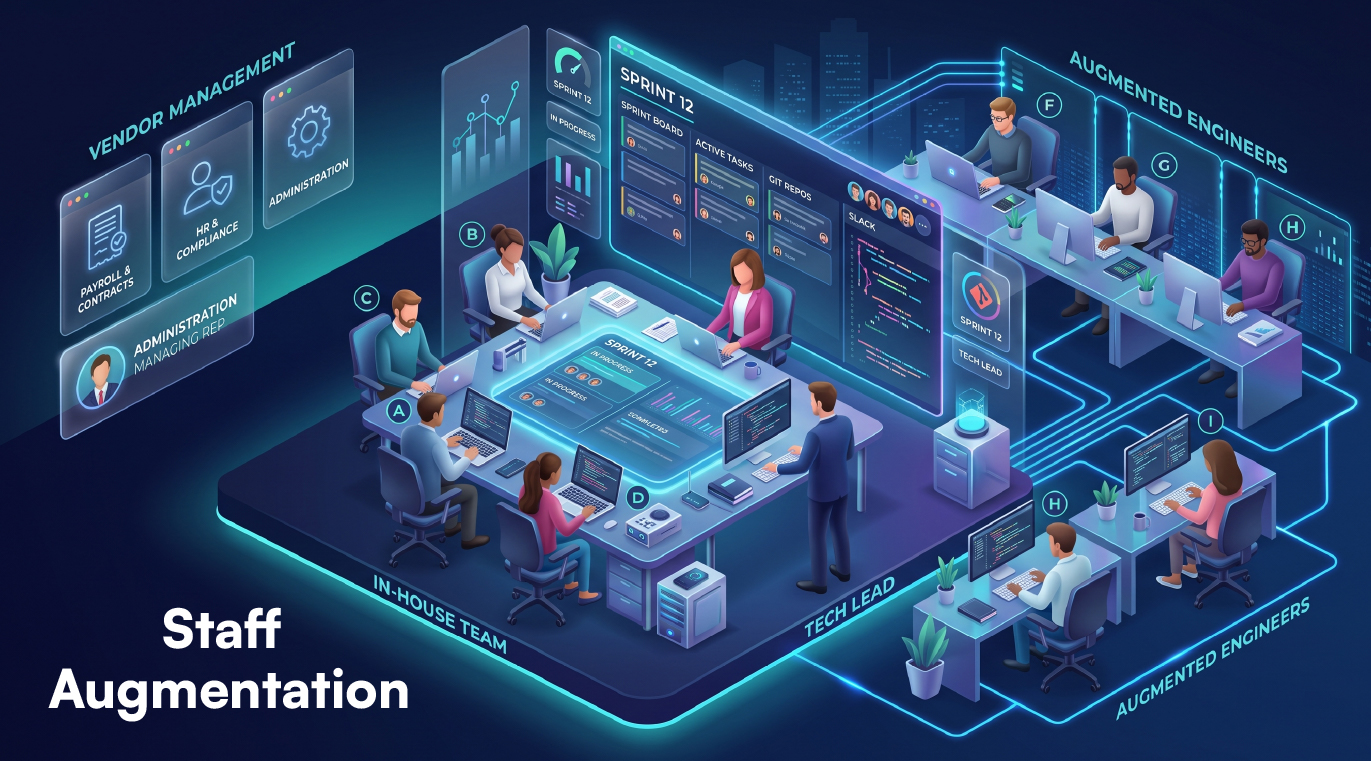 Staff augmentation means you bring external engineers, designers, or specialists onto your existing team. They use your tools, follow your sprint cadence, attend your standups, and report to your tech lead. The vendor handles employment, payroll, taxes, and benefits in their country. You handle the work. The legal employer sits elsewhere. The day-to-day manager is you. A typical example: your team is building a payments module and needs two senior backend engineers with Stripe and PCI experience for nine months. You don’t want to add permanent headcount because the spike ends when the module ships. You sign with an augmentation vendor, interview their shortlisted candidates, and the engineers join your team in two to four weeks. They work the same hours your team works, ship code through your review process, and roll off when the project closes.
When staff augmentation works
You have a competent tech lead or engineering manager who can direct external people without burning out. Your codebase has enough documentation that an experienced engineer can ramp in two to three weeks. Your sprint process is real, not theoretical. You can define what “done” looks like at the ticket level. It works best for ongoing product development, when requirements evolve as you learn from users, and for filling specific skill gaps your permanent team doesn’t have yet. AI/ML engineers, security specialists, and cloud architects fit this pattern well because the work changes constantly and you need decisions made daily, not delivered monthly.
When staff augmentation breaks
The model fails fastest when your internal leadership doesn’t have bandwidth to direct external people. Augmented engineers can write code, but they can’t tell you whether the architecture decision is right for your business. If your CTO is already underwater, adding three engineers under their command makes the bottleneck worse, not better. It also breaks when your codebase has no documentation, your processes only live in your head, or your priorities change weekly without communication. Augmented engineers can absorb chaos, but they bill for the hours they sit confused. Watch the week-12 mark. By then, the honeymoon ends. If your augmented team is still asking the same context questions they asked in week 4, you have an onboarding problem, not a talent problem.
What it costs in 2026
Bill rates vary dramatically by region and seniority. Based on Accelerance and Grand View Research data, you’re looking at roughly:
- US domestic senior engineer: $120 to $200 per hour
- Western/Northern Europe senior: $90 to $150 per hour
- Latin America (nearshore) senior: $65 to $110 per hour
- Eastern Europe senior: $60 to $100 per hour
- South Asia (India, Pakistan, Vietnam) senior: $30 to $65 per hour
Those rates hide a stack. Around 40% of the bill rate covers vendor margin, recruiting cost, infrastructure, account management, and replacement guarantees. The developer sees roughly 60% of what you pay. Add 5% to 8% for your internal management overhead, plus tooling, security reviews, and time spent onboarding. For long-term engagements, monthly fixed-capacity contracts often run 5% to 10% cheaper than pure time-and-materials because the vendor locks in revenue.
Project Outsourcing: What it actually is
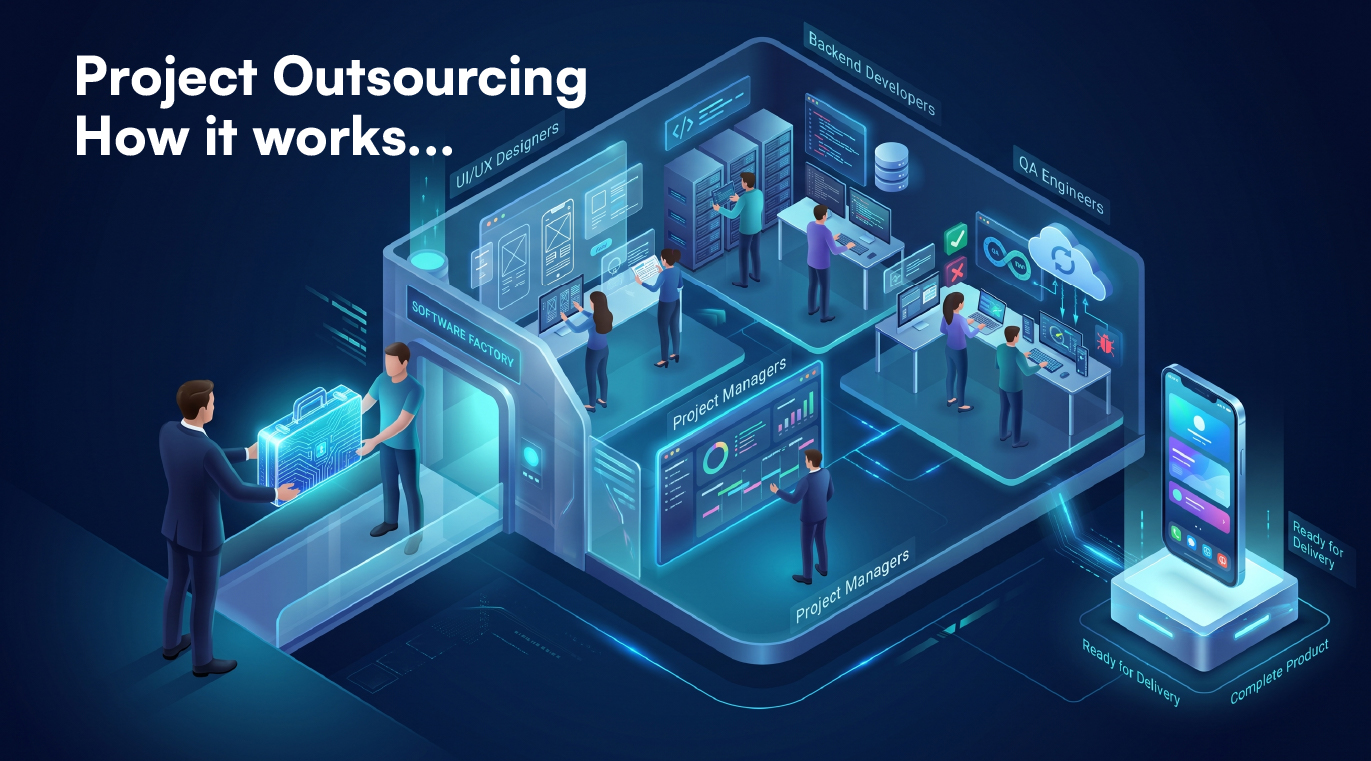 Project outsourcing means you hand a defined scope to a vendor, agree on deliverables, timeline, and price, and step back. The vendor assembles their team, makes their own technical decisions, manages their own delivery process, and hands you the finished product. You are the client. You are not the manager. A typical example: you need a customer-facing mobile app built from scratch, integrating with your existing API. You write a detailed requirements document, get fixed-price bids from three vendors, sign with one for $180,000 across five months, review demos at agreed milestones, and accept delivery at the end. The vendor handles team composition, tooling, deployment, and QA.
When outsourcing works
Your scope is genuinely fixed. You can describe what you want with enough detail that a stranger could build it correctly without daily input from you. The work falls outside your core differentiation, so you don’t need deep internal ownership of the codebase. Your internal team is at capacity and cannot absorb daily coordination meetings with external people. Common fits: internal admin tools, migrations from legacy systems, marketing sites, time-bound integrations, MVP builds where you’ll either rewrite later or pivot, and one-off compliance projects with regulatory deadlines.
When outsourcing breaks
Your scope isn’t actually fixed. You think it is, but six weeks in, you realize the requirements assumed things your customers don’t want. Now every change costs you in change orders, renegotiation, and friction. The other failure mode is silent. The vendor delivers exactly what the spec said, but the spec missed the product intuition. Buttons land in the wrong places. Workflows ignore how your actual users behave. You get a technically correct deliverable that ships poorly and needs another team to fix. Your money is gone, the vendor met their SLA, and you’re back where you started. Knowledge transfer is the other big risk. When the engagement closes, the vendor’s team walks away with everything they learned about your codebase. Your internal team inherits a system they didn’t build. If you didn’t budget two to three weeks of paid overlap for handoff and documentation, you’ll pay for it later in maintenance.
What it costs
Outsourcing is usually quoted as fixed-price or as time-and-materials with a soft cap. Compared to staff augmentation at the same seniority level, outsourcing tends to look 20% to 40% cheaper per hour on paper because the vendor optimizes utilization across multiple clients. That visible saving evaporates fast if rework happens. A fixed-price contract assumes the spec is accurate. Every change order, every clarification round, every “we forgot to mention” moment adds cost and slows delivery. Mature buyers budget a 15% to 25% contingency on top of the quoted price.
Managed Services: What it actually is
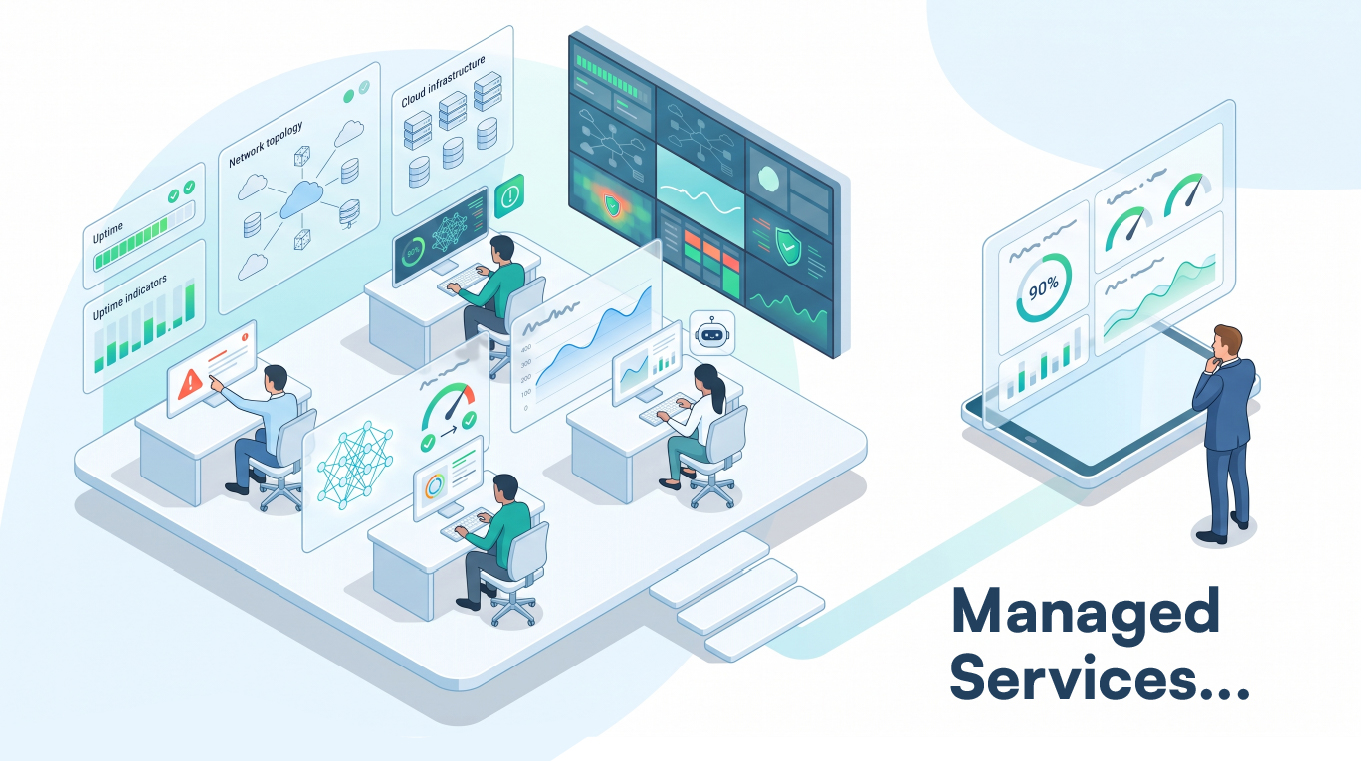 Managed services means you outsource an entire ongoing function under a service level agreement (SLA). The provider runs the function using their own tools, processes, and team. You measure outcomes against contracted SLAs, not against hours worked or features shipped. This is the model you choose when continuity matters more than direct control. Common managed functions in 2026:
- 24/7 infrastructure monitoring and incident response
- Cloud cost optimization and FinOps
- Cybersecurity operations (SOC-as-a-service, MDR, vulnerability management)
- Application support and ongoing maintenance
- Data engineering and pipeline operations
- Help desk and IT support
A typical example: you migrate to AWS, and instead of hiring a five-person cloud ops team internally, you sign a three-year contract with a managed services provider. They guarantee 99.9% uptime, respond to P1 incidents within 15 minutes, patch your systems weekly, and bill you a fixed monthly fee. If they miss SLAs, they pay penalties.
When managed services works
The function is well-defined and runs continuously. You don’t need creative product decisions, you need reliable operations. The cost of an internal team would be hard to justify against the volume of work. You want budget predictability, with one monthly invoice that doesn’t fluctuate based on incident volume. It also works when your internal team is too small to provide 24/7 coverage. Three engineers cannot run a 24-hour rotation without burning out. A managed services provider already has the staff, shifts, and tooling to make it sustainable.
When managed services breaks
The work isn’t actually standardized. Every “incident” is a creative product decision in disguise, and the SLA-driven team can’t make those calls. You end up routing tickets back to your internal team anyway, paying twice for the same work. The bigger long-term risk is institutional knowledge erosion. Five years into a managed services contract, nobody on your team remembers how the system works at a deep level. The provider has all the operational know-how. If you ever want to bring it back in-house or switch providers, the transition costs more than you saved. The Statista forecast puts the managed services market at $28 billion by 2029, with companies reporting 15% to 35% operational cost savings over three-year horizons. Those numbers are real, but they assume you picked the right work to manage and you maintained enough internal knowledge to stay an informed buyer.
Side-by-side comparison
| Factor | Staff Augmentation | Project Outsourcing | Managed Services |
| Who manages the work | You | The vendor | The vendor |
| What you buy | Capacity and skills | A finished deliverable | An ongoing outcome |
| Pricing model | Hourly or monthly per person | Fixed-price or T&M with cap | Monthly retainer with SLA |
| Time to start | 2 to 4 weeks | 4 to 8 weeks | 6 to 12 weeks |
| Best engagement length | 3 months to 2 years | 2 to 9 months | 1 to 5 years |
| Scope flexibility | High | Low without change orders | Defined by SLA |
| Control over execution | Full | Low | Outcome-based only |
| Knowledge stays with | Mostly you | Mostly the vendor | Mostly the vendor |
| Best for | Evolving product work | Fixed-scope builds | Ongoing operations |
| Worst for | Teams without strong leadership | Ambiguous requirements | Creative or strategic work |
The hidden cost picture
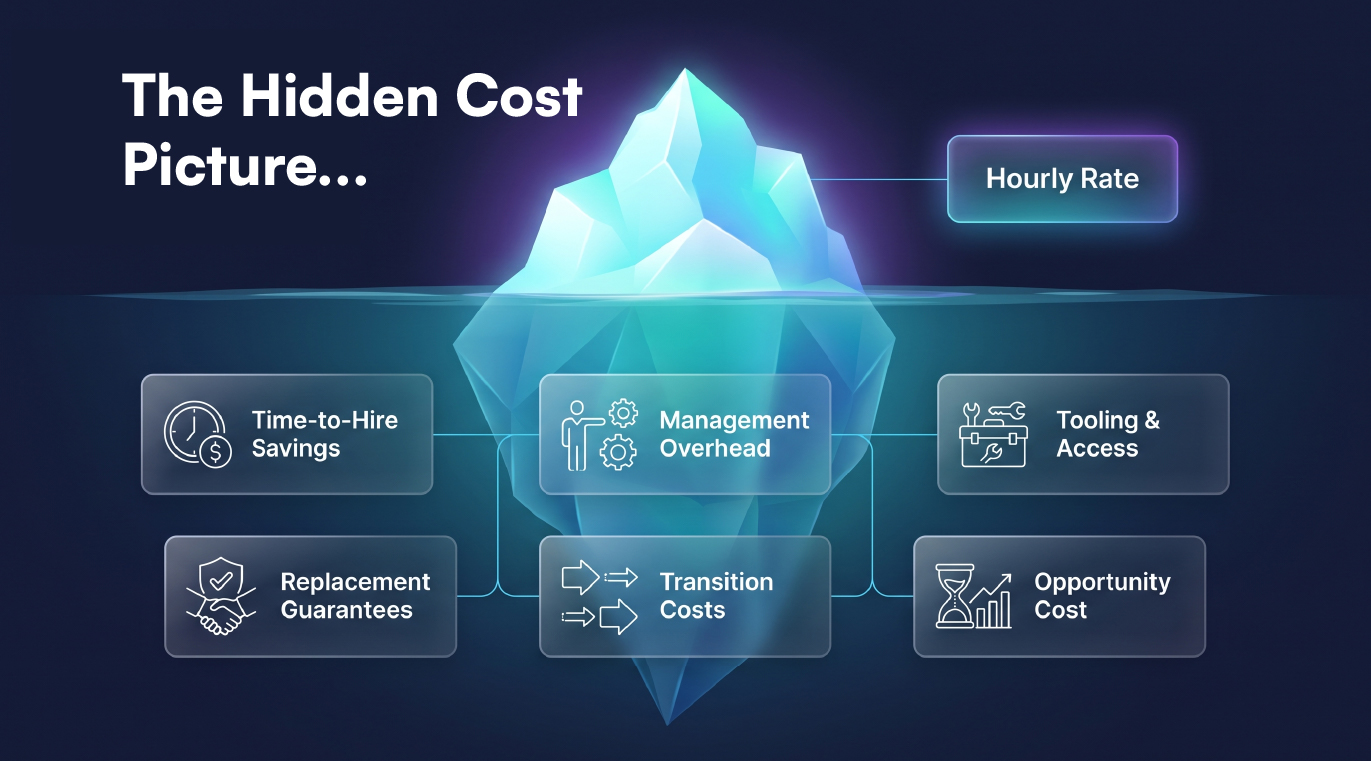
The hourly rate is the easiest number to compare, which is why it gets too much weight. Here’s what actually moves your total cost:
Time-to-hire savings. If staff augmentation fills a critical seat three weeks faster than traditional recruiting, and your team velocity is worth $5,000 per week in shipped value, you saved $15,000 before the engineer wrote a line of code.
Management overhead. Add 5% to 8% on top of staff augmentation costs for the time your existing leaders spend onboarding and directing external people. Outsourcing reduces this overhead. Managed services almost eliminates it for the covered function.
Tooling and access. SSO seats, CI/CD minutes, staging environments, security reviews, MDM enrollment for any hardware. These are small per person, but real. Some vendors include them. Some bill them as pass-through.
Replacement guarantees. Good augmentation vendors offer free replacement if a developer doesn’t work out within 30 days. Cheap vendors don’t. Read the contract.
Transition costs. When any engagement ends, you need overlap for handoff. Budget one to three weeks of paid overlap for non-trivial systems. If you skip this, you pay later in tech debt.
Opportunity cost. Every week your roadmap slips because you picked the wrong model is real money. A SaaS company missing a launch window often loses more in delayed revenue than the engagement cost in the first place.
For nearshore Latin American augmentation versus US domestic, the labor cost savings on a five-person senior team can run $700,000 to $900,000 per year, per Stack Overflow Developer Survey and GitHub Octoverse data. That gap holds up even after you factor in coordination overhead, assuming you picked a vendor with overlapping time zones and English fluency.
What changed in 2026
Three shifts make the 2026 decision different from the 2023 version.
AI coding assistants changed the seniority math. A mid-level engineer with strong AI tool fluency now ships at the pace of what used to be a senior, on routine work. This narrows the price gap between mid-level and senior augmentation, and it makes outsourced project teams more efficient at well-scoped work. The implication: rate cards alone are misleading. Ask vendors what their teams use, how they handle AI-generated code review, and what their policy is on training data exposure.
AI governance moved from policy to contract. Outsourcing agreements in 2026 now need to specify who owns AI-generated outputs, how training data flows, and what happens to your proprietary data once it touches a vendor’s tooling. Morgan Lewis flagged this in their January 2026 outsourcing trends webinar. If your contract doesn’t address AI governance, you’re carrying risk you haven’t priced.
Hybrid is now the default, not the exception. Companies are no longer choosing one model. They run augmentation for evolving product work, outsource fixed-scope builds, and use managed services for ongoing operations. The smart move is planning for hybrid from day one rather than locking yourself into a single vendor relationship.
The talent gap pressure intensified. Around 78% of businesses report a critical shortage of tech talent, per Verified Market Research. This makes external resourcing a necessity, not a preference, and it shifts negotiating leverage toward the vendors with vetted bench strength.
The 2026 Decision Framework
Walk through these questions in order. Each answer narrows your model choice.
- Is the scope fixed or evolving?
Fixed scope with a clear endpoint pushes you toward outsourcing or a defined managed service. Evolving scope where requirements keep shifting pushes you toward staff augmentation.
- Do you need direct control over execution, or only the outcome?
Direct control means staff augmentation. Outcome-only with no daily oversight means outsourcing or managed services.
- How long is the work expected to run?
Under three months: outsourcing usually wins on speed and overhead. Three months to two years: staff augmentation typically delivers better total value for evolving work. Two years and beyond, with stable scope: managed services starts looking right.
- Does your internal team have leadership bandwidth?
If your tech lead or engineering manager has 5 to 15 hours per week to direct external engineers, augmentation works. If they don’t, outsourcing or managed services takes that load off them.
- Is the work core to your product or peripheral?
Core product work that defines your differentiation should stay close, which usually means augmentation. Peripheral work like internal tools, basic infrastructure, or commodity functions can move further out to outsourcing or managed services.
- How important is knowledge retention?
If your team needs to own the codebase long-term, augmentation keeps the knowledge inside. If you’re fine never touching the work again, outsourcing or managed services is acceptable.
- What’s your budget structure?
Variable usage with monthly invoices that flex with team size: augmentation. Fixed project budget approved upfront: outsourcing. Predictable monthly operating expense for years: managed services. If three or more answers point to the same model, you have your fit. If answers are split, you have a hybrid case.
Failure modes to spot early
Each model has signature failure patterns. Knowing the signals lets you correct course before the damage compounds.
Staff augmentation failures
- Augmented engineers still asking foundational questions at week 12
- Your tech lead spending more than 15 hours per week directing external people
- Pull requests sitting in review for days because nobody owns merging
- Augmented engineers being treated as second-class team members in standups
- Vendor unable to replace an underperformer within two weeks
Outsourcing failures
- More than three change orders in the first half of the engagement
- Vendor demos that match the spec but feel wrong when you use the product
- Communication delays of 24+ hours becoming the norm
- “We’ll handle it in the next sprint” answers that never resolve
- No clear handoff or documentation plan in the contract
Managed services failures
- Frequent tickets routed back to your internal team for decisions
- SLA reports that look perfect while actual user experience degrades
- Your internal team losing visibility into how systems actually work
- Provider unwilling to share runbooks or operational documentation
- Renewal pricing that climbs 15% per year with no clear justification
If you see two or more signals in any model, that’s the time to renegotiate or restructure, not the time to wait it out.
The hybrid approach in practice
A SaaS company at series B might run all three models at once:
- Staff augmentation for the AI/ML team building their core recommendation engine, because the work changes weekly and they need to own the IP
- Project outsourcing for a one-time mobile app rebuild, with a fixed scope and a six-month timeline
- Managed services for their cloud infrastructure, security operations, and 24/7 monitoring, freeing their internal team to focus on product
The key is mapping work types to the right structure. The same vendor relationship that fails for core product work might be the right fit for help desk operations. Plan transitions upfront. Many companies start with outsourcing for speed, then move to augmentation when they need more control, then route stable operations into managed services. Building flexibility into your initial contracts (no exclusive vendor lock-ins, clear exit clauses, documented handoff requirements) keeps your options open.
How to evaluate vendors before signing
Rate cards lie. The differences between a $65 per hour engineer and a $90 per hour engineer often have nothing to do with quality, and everything to do with vendor margin structure. Here’s what actually predicts whether a vendor will deliver:
Vetting depth. Ask how they evaluate candidates. Live coding, architecture review, communication assessment, and cultural fit should all be in the process. Vendors with a 90%+ probation pass rate have something real behind that number.
Replacement guarantees. A vendor confident in their bench will guarantee replacement at no cost if a candidate doesn’t work out within 30 to 60 days. Read the contract for the exact terms.
Onboarding playbook. Strong vendors have documented onboarding processes that get engineers productive in 7 to 14 days. Ask to see the playbook. If they don’t have one, your team will be writing it.
References at your stage. Talk to two or three current clients of similar size and complexity. Ask specifically what broke, not just what worked.
Security and compliance. SOC 2, ISO 27001, and clear NDA enforcement are table stakes for any vendor handling code or data. For regulated industries (healthcare, financial services, government), dig deeper into their specific certifications.
Contract red flags. Auto-renewal clauses without 30 days notice, vague IP assignment language, no clear bench policy if your project pauses, opaque pass-through expenses, and no defined replacement process. Any of these signals trouble.
Exit terms. Before you sign, understand how you leave. Knowledge transfer requirements, documentation obligations, transition support, and final invoicing should all be defined in writing.
FAQ
Is staff augmentation cheaper than outsourcing?
On hourly rates, outsourcing usually looks 20% to 40% cheaper. On total cost over the full engagement, the answer depends on scope stability. Stable scope favors outsourcing. Evolving scope favors augmentation because change orders and rework costs in outsourcing eat the savings fast.
Can I convert an augmented engineer to a full-time hire?
Yes. Most augmentation contracts include a conversion clause, typically with a buyout fee of 15% to 25% of the engineer’s first-year salary. Some vendors offer no-fee conversion after 12+ months of engagement. Many companies use augmentation as a low-risk tryout before extending a permanent offer.
What’s the difference between managed services and outsourcing?
Outsourcing delivers a defined project with a clear endpoint. Managed services delivers an ongoing function with no endpoint, governed by SLAs. Outsourcing closes when the deliverable ships. Managed services continues as long as the contract runs.
How fast can I onboard an augmented team?
Quality vendors deliver vetted candidates for interview within 72 hours and onboard accepted engineers within 2 to 4 weeks. Compare that to 42 days for traditional hiring, per SHRM data. Specialized roles (AI/ML, security, niche stacks) sometimes take 4 to 6 weeks.
Should I worry about IP protection with external teams?
Yes, and the answer is in your contract. SOC 2 and ISO 27001 certified vendors, airtight NDAs, restricted system access, and clear IP assignment clauses cover most of the risk. For high-sensitivity work, add code escrow and exclusive-use clauses that prevent the vendor from sharing your engineers with competitors.
Can I mix all three models at once?
Yes, and most growing companies eventually do. The principle is matching each piece of work to the structure that fits it best, then designing your governance to prevent vendor sprawl. Two to four primary partners is usually the right ceiling.
Choosing well in 2026
The companies that get this right share a pattern. They treat external talent as workforce strategy, not procurement. They map each piece of work to the structure that fits how it actually flows. They write contracts that protect them when things change, not just when things go right. They build internal capability to manage external people without burning out their leaders.
The wrong question is “which model is best.” There is no universal answer. The right question is “which model fits this specific piece of work, at this specific stage of my product, with this specific team I have right now.”
Answer that honestly, walk the framework above, and you’ll save yourself a six-figure mistake.