ABOUT
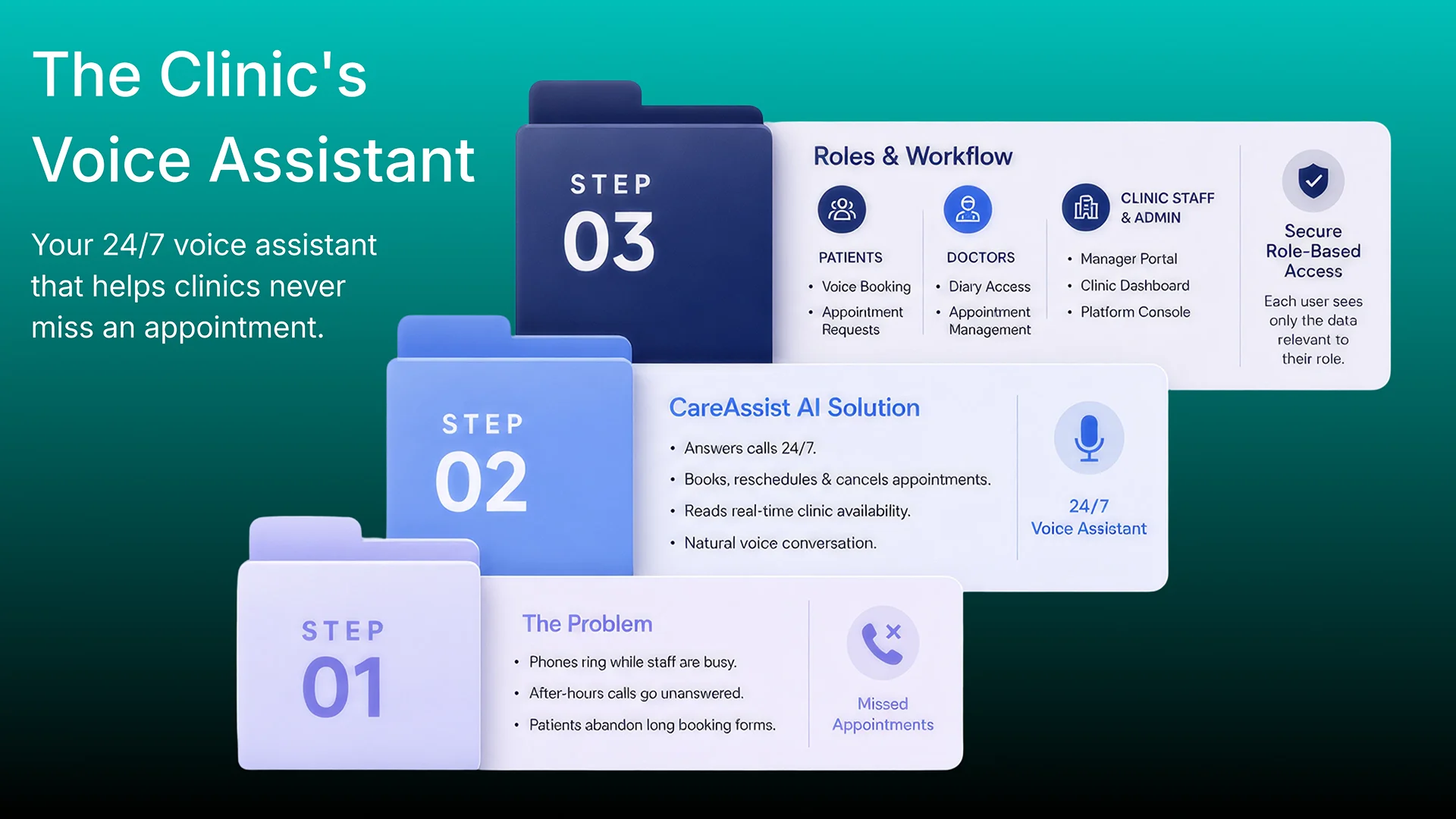
CareAssist AI is a voice receptionist for clinics. A patient opens the clinic’s website, taps a call button, and books an appointment simply by talking — no form, no app and no account. The clinic adds it by pasting one line of code into their site. Behind that button, the assistant reads the clinic’s real schedule, so it only ever offers times a doctor is genuinely free. The product works end to end across an admin console, a clinic portal and a doctor portal.
THE PROBLEM
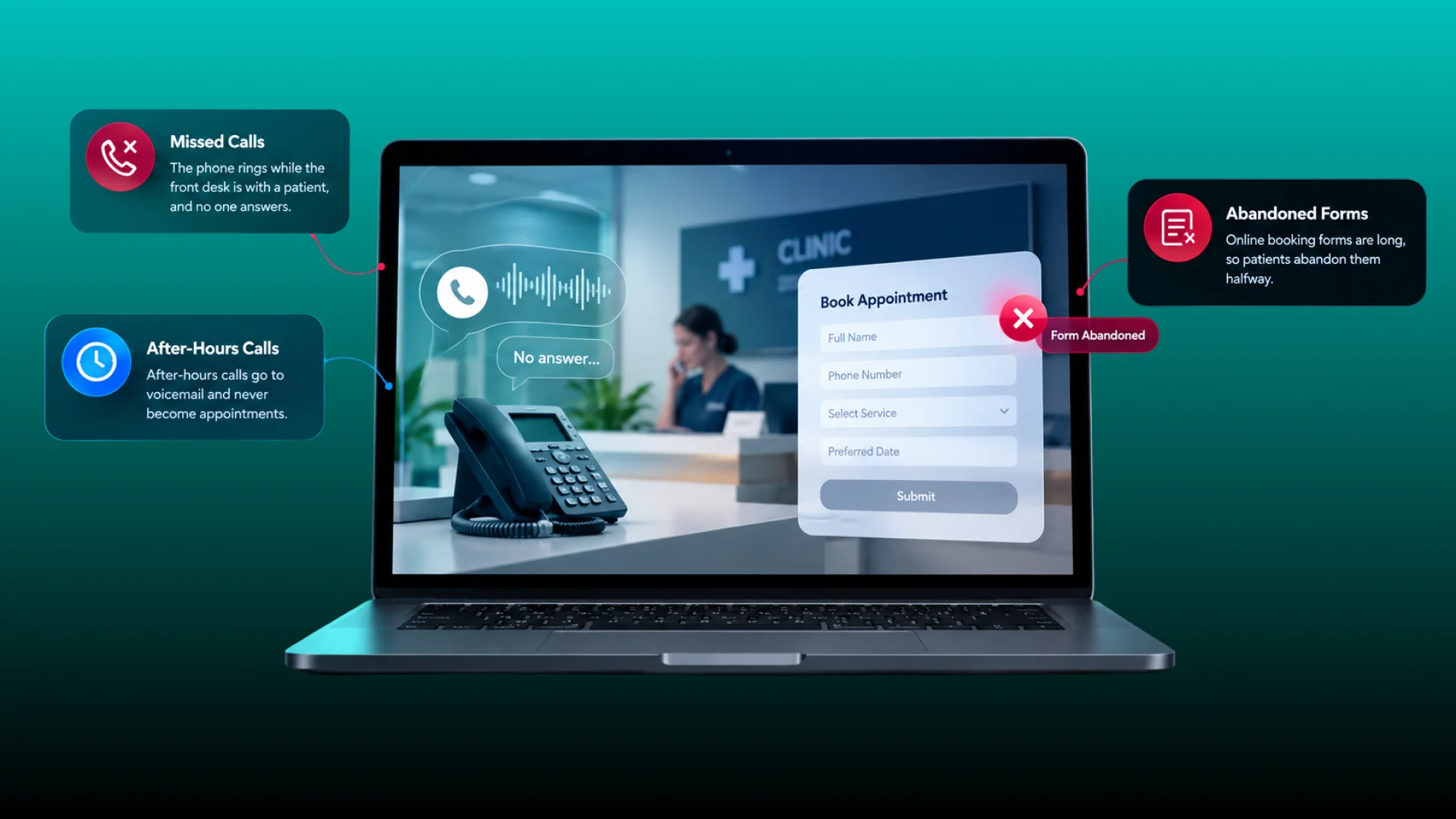
Clinics lose bookings in three familiar ways. The phone rings while the front desk is with a patient and nobody answers. After-hours calls go to voicemail and never become appointments. And online booking forms are long enough that patients abandon them halfway through. The underlying constraint is simple: a receptionist can take one call at a time, during working hours only, so every missed call is usually a lost appointment the clinic never hears about.
Automating the answer is only useful if it is accurate. An assistant that offers a slot which is not actually free creates a worse problem than the one it solves — a patient who arrives to find no doctor available, and staff who have to unwind a booking that should never have been made.
THE SOLUTION
We built CareAssist AI as a conversational assistant grounded in the clinic’s own live schedule rather than in general knowledge.
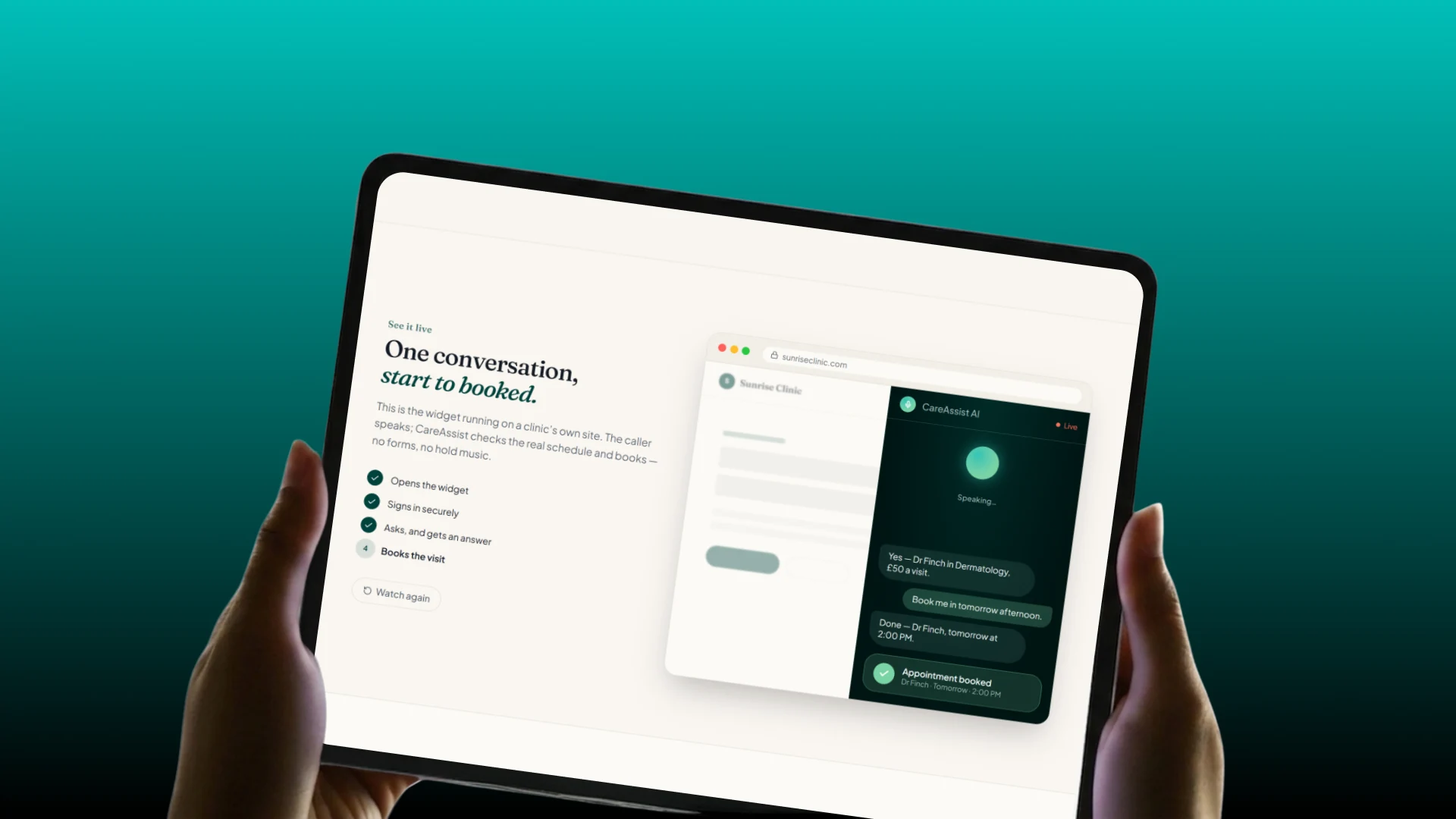
Booking by conversation. The assistant handles booking, rescheduling and cancelling in one natural call, asking one thing at a time. It can also answer questions about the clinic’s doctors, their department, their fee and when they are next free. Patients identify themselves with an email and a one-time code; name and age are asked only on a first visit, and returning patients are recognised and greeted by name.
Availability that comes from data, not from the model. Open slots are computed from each doctor’s weekly schedule, minus their time off, minus appointments already booked. The assistant can only offer what that calculation returns. In a recorded call, asked for a nine o’clock appointment, it answered that the doctor had no nine o’clock opening and offered 9:30 — the real next free slot. Asked later to move to two o’clock, a time already taken, it declined and offered twelve instead. Because a doctor’s time off feeds the same calculation, a holiday never has to be communicated twice.
Confirmation before action. Bookings, moves and cancellations are read back in full and carried out only after a clear yes, so a misheard word cannot silently change a patient’s appointment.
Clear boundaries and separation. The assistant is a receptionist, not a clinician: it does not diagnose, advise on medication or interpret symptoms, and for anything medical it says a clinician will follow up. Identity is confirmed with a one-time code before any appointment history is read out, and each clinic’s identity comes from its embed key, verified on the server rather than trusted from the browser, so one clinic can never reach another’s data.
Setup runs in a fixed order — the platform admin creates the clinic and issues its embed key, clinic staff add doctors, departments, fees and working hours, doctors maintain their own availability, and the clinic pastes the snippet into its site. Clinics that cannot edit their own website can use a hosted booking page instead.
THE OUTCOMES
CareAssist AI answers every call, at any hour, and as many at once as needed. The after-hours calls and the calls that arrive while the desk is busy stop being lost appointments, without adding staff.
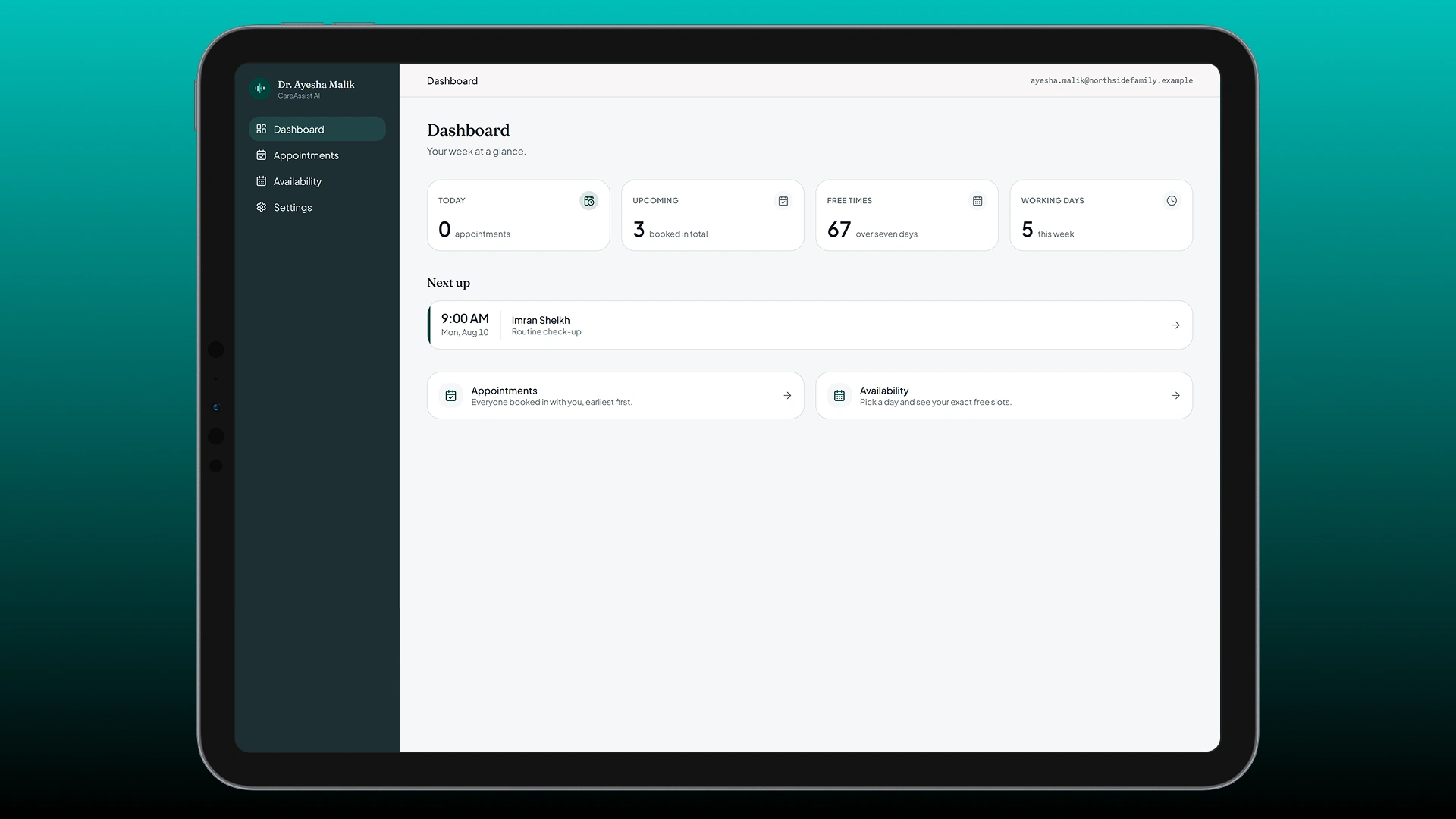
For patients, booking becomes a short conversation instead of a long form, with no account to create. For doctors, appointments booked by the assistant appear in their own diary marked as voice bookings, with no staff involvement in between. Because availability is computed rather than generated, the appointments that arrive are real ones.
The project demonstrates our experience building conversational AI that is tightly grounded in live business data, with confirmation, identity verification and tenant separation designed in rather than added afterwards.