
The math on AI MVPs has changed dramatically. In 2023, building a basic AI product took 6 to 12 months and $150,000 to $400,000. In 2026, founders are shipping functional AI MVPs in 2 to 6 weeks for $5,000 to $80,000, achieving cost savings of up to 85% compared to traditional development. The companies that adopt AI early in their MVP can increase cash flow by 122% versus 10% for late adopters.
But speed cuts both ways. The same tools that let you ship fast also let competitors ship faster. The same APIs that power your AI feature power dozens of similar features in dozens of similar products. Building an AI MVP in 2026 is not about whether you can ship. It is about whether you can ship the right thing, fast enough, with enough validation to know it actually solves a real problem.
This guide walks through the complete 2026 roadmap: how to validate your idea before writing code, what tech stack actually works in production, realistic costs across complexity tiers, the 8-step development process, and the specific mistakes that kill 1 in 5 AI startups in their first year. Whether you are a non-technical founder using no-code tools or a CTO architecting a serious platform, this is the playbook.

An AI MVP is the smallest functional version of your AI-powered product that proves your core hypothesis with real users. It has one central AI feature that delivers measurable value, plus only the minimum supporting features needed to test that core capability.
Critical distinction: an AI MVP is not a traditional app with a chatbot bolted on. A true AI MVP integrates machine learning models, large language models, or neural networks as the primary value driver. The AI is the product, not a feature.
Examples of genuine AI MVPs:
- A document analysis tool where the AI extracts structured data from invoices
- A scheduling assistant where the AI optimizes meeting times across calendars
- A content moderation system where the AI flags policy violations
- A code review tool where the AI identifies security vulnerabilities
- A customer support agent that resolves tier-1 tickets autonomously
What is NOT an AI MVP:
- A blog with an AI-generated FAQ
- A traditional CRM with a “summarize this” button
- A landing page with a basic ChatGPT widget
- An e-commerce site with AI product recommendations as a side feature
The difference matters because it determines what you need to validate. AI MVPs validate whether the AI actually solves the problem well enough that users pay for it. Traditional MVPs with AI features validate something else entirely.
Why Build an AI MVP Instead of a Full Product?
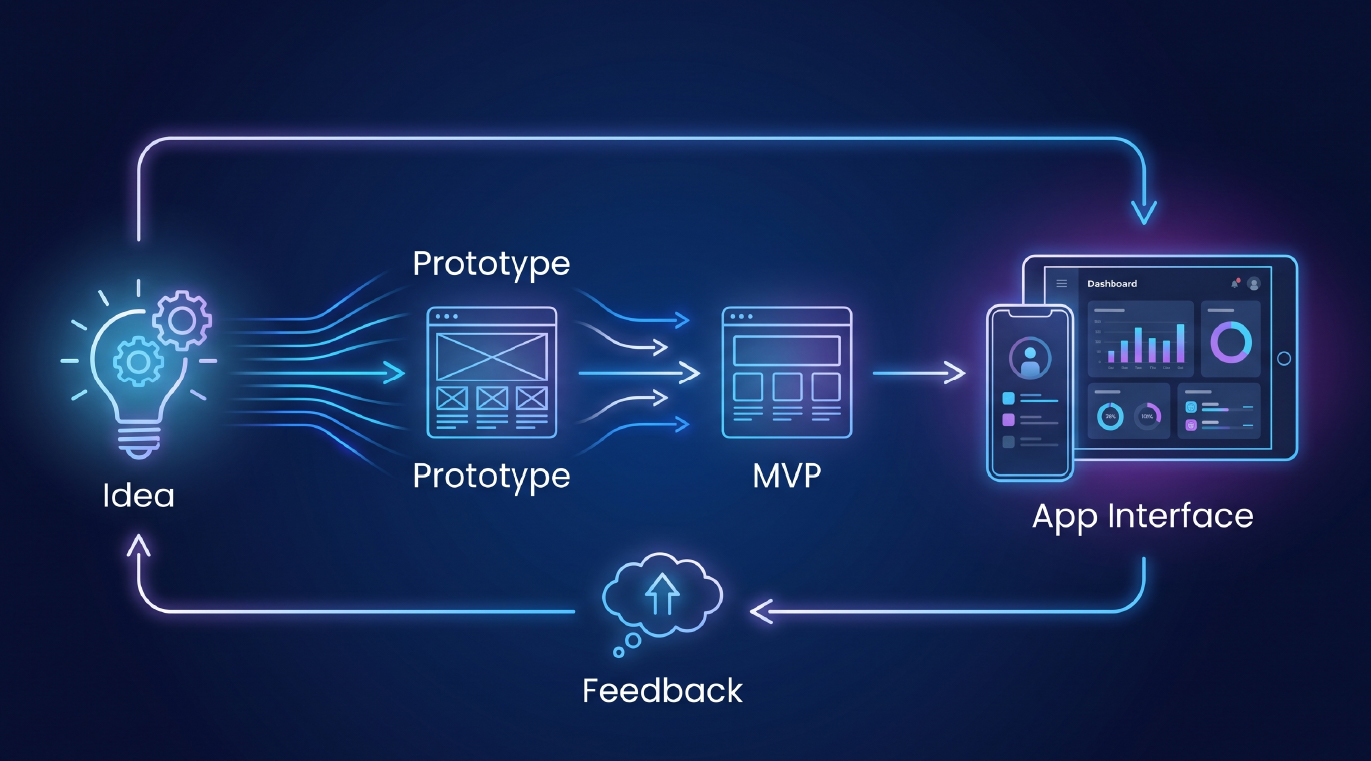
The traditional reasoning for MVPs applies (test before scaling, validate before investing), but AI MVPs add specific reasons that make the case stronger.
AI accuracy is unpredictable until tested with real data. You cannot predict from the lab whether your AI will perform well enough in production. Real users interact with edge cases your training data never covered. The only way to know is to ship and measure.
Model costs are non-trivial and need real usage data to optimize. API costs from OpenAI, Anthropic, or other providers can spike dramatically with real users. Token usage, rate limits, and context window optimization only become clear with production traffic.
User trust in AI is still developing. 1 in 5 startups fails in year one because they build products misaligned with actual customer needs. AI products fail at higher rates because users are still figuring out what they trust AI to do. An MVP gets you direct feedback on trust calibration.
The competitive landscape moves weekly. OpenAI, Anthropic, Google, and others release new models and capabilities monthly. Building for 12 months means launching against capabilities that did not exist when you started. Shipping in 2 to 6 weeks lets you ride the wave instead of chasing it.
Investors fund traction, not ideas. Investors increasingly require proof of concept before funding. A working AI MVP with measurable traction outperforms perfect pitch decks every time.
The 8-Step AI MVP Development Roadmap
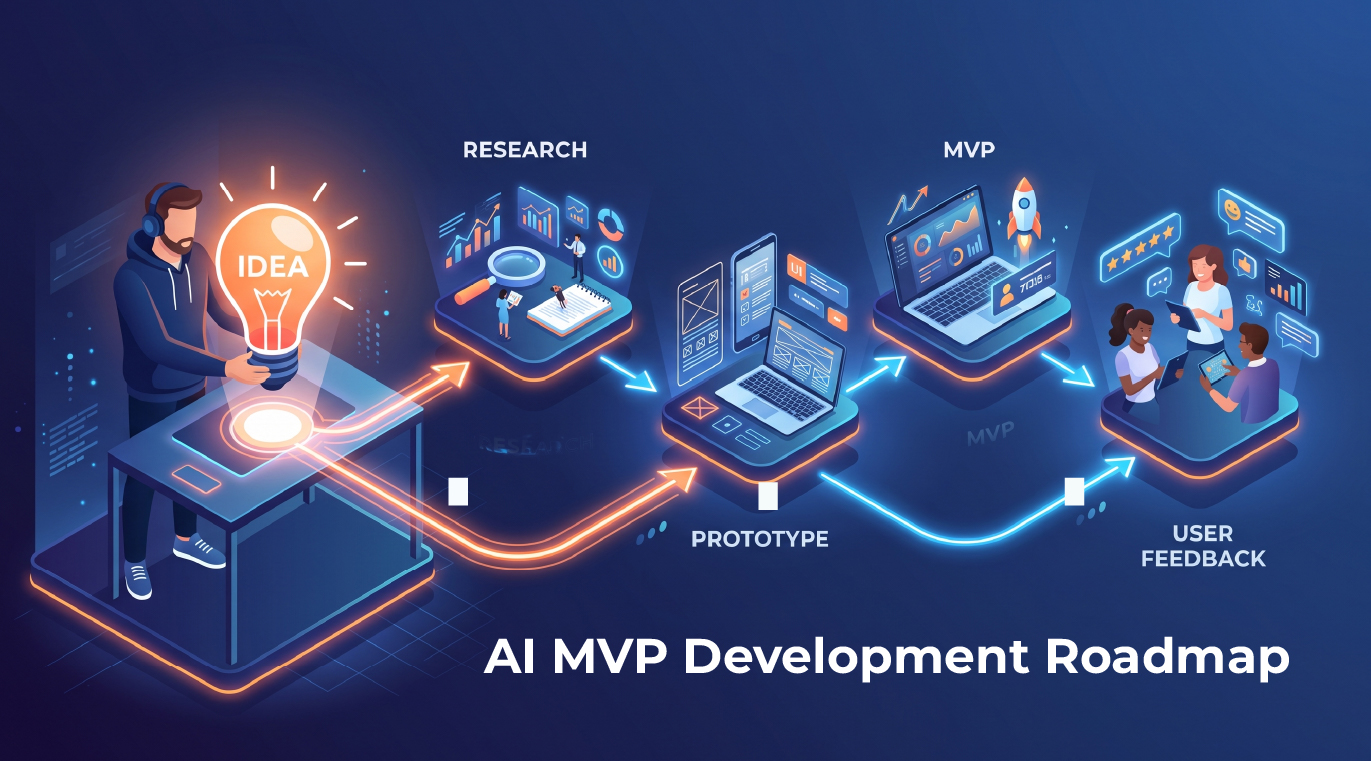
Every successful AI MVP follows roughly the same path. Skipping steps usually costs more than executing them.
Step 1: Define the Problem (Not the AI)
Most failed AI MVPs start with “we want to use AI” and then search for problems to solve. This reverses the correct order. Start with a specific user pain point that AI uniquely solves better than existing alternatives.
A strong problem definition includes:
- Specific user persona: Not “businesses” but “operations managers at logistics companies with 50-500 trucks”
- Observable pain point: Specific behaviors users exhibit because of the problem
- Current workaround: What users do today (manual work, expensive consultants, inadequate tools)
- Measurable outcome: How you will know the AI fixed the problem
- Cost of the problem: What users currently spend in time, money, or opportunity cost
Run 15 to 25 customer discovery interviews before writing a single line of code. If you cannot describe the problem in one sentence after 25 interviews, the problem is not clear enough yet.
Step 2: Pick the Single AI Capability
Resist the urge to build multiple AI features. Pick one core outcome and one AI capability that delivers it. Successful AI MVPs validate one intelligent component, not a portfolio.
Common AI capability categories to choose from:
- Generation: Creating text, images, code, or structured data
- Classification: Categorizing inputs (sentiment, intent, topic, risk)
- Extraction: Pulling structured data from unstructured sources
- Recommendation: Suggesting items, actions, or decisions
- Prediction: Forecasting outcomes from historical data
- Decision automation: Taking actions based on rules and context
- Summarization: Condensing long content into key points
- Search and retrieval: Finding relevant information from large datasets
The smartest 2026 founders pick one feedback loop tied directly to their most critical metric and build it well. One well-built feedback loop teaches you more about users than months of analysis.
Step 3: Validate Demand Before Building
Before any technical work, run cheap validation tests:
Landing page test: Build a landing page describing your AI product. Drive 200 to 500 visitors via paid ads. Measure email signups, demo requests, or pre-orders. If under 2% of traffic converts to interest, your problem-solution fit is weak.
Wizard of Oz test: Manually deliver the AI capability to first users while you charge them and gather feedback. If a user pays $200 for you to manually do what the AI will do, the demand is real. If they balk at the price even with manual delivery, the AI version will struggle.
Concierge MVP: Personally onboard 10 to 20 users with extensive hand-holding. Document every objection, confusion point, and workflow gap. These conversations reveal what your AI actually needs to do.
These approaches cost less than $5,000 and save founders from spending $50,000+ building products nobody wants.
Step 4: Choose Your Tech Stack
The 2026 AI tech stack has stabilized around several proven patterns. Pick based on your team’s expertise, budget, and product needs.
Foundation models (the AI brain):
- Claude (Anthropic): Strong reasoning, long context windows, excellent for complex tasks. Models include Claude Opus 4.7, Claude Sonnet 4.6, Claude Haiku 4.5
- GPT family (OpenAI): Most widely adopted, robust ecosystem, broad capabilities
- Gemini (Google): Strong multimodal, integrated with Google Cloud
- Llama, Mistral, DeepSeek: Open-source options for cost optimization or self-hosting requirements
Backend frameworks:
- Node.js or Python (FastAPI): Most common for AI backends due to extensive library support
- LangChain or LlamaIndex: Orchestration frameworks for complex AI workflows
- Vector databases: Pinecone, Weaviate, Chroma, or pgvector for semantic search and RAG
Frontend frameworks:
- Next.js or React: Standard choices for AI product UIs
- Streamlit or Gradio: Rapid prototyping for technical users
- Vercel AI SDK: Streamlines AI integration patterns
No-code AI tools (for non-technical founders):
- Lovable, Bolt, v0: Convert plain-language prompts into functional code
- Bubble + AI plugins: Visual app builder with AI integrations
- Make or n8n: Workflow automation with AI nodes
- FlutterFlow: Mobile app builder with AI capabilities
Coding assistants (10x your team’s velocity):
- GitHub Copilot: 20+ million users by early 2025, $19/user/month
- Cursor: AI-native IDE growing rapidly
- Tabnine: Enterprise-focused with on-premises deployment
- Claude Code: Terminal-based agentic coding from Anthropic
Most successful 2026 AI MVPs use foundation model APIs rather than training custom models. Building a custom model from scratch can drive costs to $150,000+ before you have any users. Pre-trained models with fine-tuning or RAG (retrieval-augmented generation) deliver 80% of the value at 5% of the cost.
Step 5: Design the Minimum Viable Architecture
Resist over-engineering. Your architecture should support 1,000 users, not 10 million. Most successful 2026 AI MVPs use a simple stack:
Frontend: Next.js or React on Vercel Backend: Node.js or Python serverless functions Database: Postgres (Supabase or Neon for hosted) AI layer: Direct API calls to Claude, GPT, or Gemini Vector store: pgvector extension on Postgres (avoid separate vector DB until needed) Auth: Clerk, Auth0, or Supabase Auth Payments: Stripe Hosting: Vercel, Render, or Railway
This stack supports 1,000+ daily active users for under $200/month in infrastructure costs. Time to deploy: 1 to 2 weeks for a competent developer.
Avoid these architecture mistakes early founders make:
- Setting up Kubernetes for an MVP (you do not need it)
- Building a microservices architecture before reaching 10,000 users
- Self-hosting open-source models without GPU infrastructure expertise
- Building elaborate caching layers before measuring actual latency
- Adding Redis or message queues before they are demonstrably needed
The goal is shipping, not architecting. Ship simple, scale when forced to.
Step 6: Prepare Your Data
AI is only as good as the data you feed it. This step often gets underestimated and causes the most delays.
For RAG-based MVPs:
- Identify the knowledge base your AI needs (documents, FAQs, product data)
- Clean, structure, and chunk the content appropriately
- Embed using OpenAI, Cohere, or Voyage embeddings
- Test retrieval quality with realistic queries before building the UI
For classification or prediction MVPs:
- Gather labeled training data (200 to 1,000 examples minimum)
- Validate label quality with multiple reviewers
- Split into training, validation, and test sets
- Use few-shot prompting before fine-tuning
For agent-based MVPs:
- Define the tools the agent can use (function calling)
- Document edge cases and failure modes
- Build evaluation datasets for success and failure scenarios
- Implement safety guardrails before exposing to users
Compliance considerations: if you handle EU user data, host on EU datacenters and implement GDPR-compliant data export and deletion. If you handle health data, ensure HIPAA compliance from day one. If you handle financial data, implement PCI DSS controls. Adding compliance after launch costs 5 to 10 times more than building it in.
Step 7: Build, Test, and Iterate
The actual building happens here. With a good tech stack, AI coding assistants, and disciplined scope, an AI MVP build takes 2 to 8 weeks.
Week 1-2: Core AI loop. Build the single core feature end-to-end. User input → AI processing → response. No auth, no payments, no polish. Just the AI working in a basic interface.
Week 3-4: User accounts and persistence. Add authentication, user data storage, conversation history, and basic admin views. Real users now have a reason to come back.
Week 5-6: Polish and payments. Improve UI, add error handling, implement payments, build onboarding flows. The product feels real.
Week 7-8: Testing and launch prep. Run usability tests with 10 to 20 target users. Fix critical issues. Prepare launch infrastructure (analytics, error monitoring, customer support tools).
Testing is where AI MVPs differ most from traditional MVPs. Per Prismetric’s 2026 AI testing guide, over 77% of QA teams now adopt AI-first quality engineering practices because traditional testing matrices inadequately address probabilistic AI behaviors. Teams implementing structured evaluation frameworks report up to 60% fewer production failures and deploy 5 times faster.
Critical AI testing components:
- Golden dataset: 50 to 200 representative inputs with expected outputs
- Regression testing: Run golden dataset against new model versions before deployment
- Edge case library: Common failure modes (gibberish input, prompt injection, harmful content)
- Hallucination detection: Tests that catch the AI making up facts
- Latency benchmarking: Track p50, p95, p99 response times
- Cost monitoring: Track tokens used per interaction and trends over time
- Error rate alerts: Notify when failure rates exceed thresholds
Launch quietly to a beta cohort first. 50 to 200 friendly users provide better feedback than a public launch with thousands of strangers.
Step 8: Launch, Measure, Iterate
Your launch is the beginning, not the end. The first 30 days post-launch determine whether you have product-market fit or need to pivot.
Critical metrics to track from day one:
- Activation rate: Percentage of signups who complete the core action
- Retention rate: Daily, weekly, and monthly active users
- AI quality metrics: User-reported satisfaction with AI outputs
- Task completion rate: Did the AI actually solve the user’s problem?
- Cost per active user: Total infrastructure and API costs / active users
- Conversion rate: Free to paid conversion percentage
- Net Promoter Score: How likely users are to recommend the product
Iteration cadence: ship improvements weekly minimum. AI products require continuous monitoring for model drift and performance degradation. The model that performed well at launch may drift as user behavior evolves or as foundation model providers update their APIs.
Build a feedback loop directly into the product. Thumbs up/down on AI responses, comment fields, and easy bug reporting. The fastest path to product-market fit is hearing from users constantly.
Real AI MVP Costs in 2026
Cost transparency separates viable initiatives from budget overruns that kill promising ideas. Per current 2026 data, AI MVP costs span three distinct tiers.
Tier 1: Simple AI MVPs ($5,000 – $15,000)
What you get: A focused AI tool with one capability, basic UI, payments, and authentication. Examples: a writing assistant, a single-purpose chatbot, a document analyzer.
- Timeline: 2 to 4 weeks
- Team: 1 senior full-stack developer with AI coding assistants
- Tech stack: Next.js + foundation model APIs + Supabase
- Best for: Solo founders or bootstrapped startups validating an idea quickly
Typical cost breakdown:
- Development: $4,000 – $10,000
- Design: $500 – $2,000
- Infrastructure (3 months): $300 – $900
- API costs (3 months): $500 – $2,000
- Marketing/landing page: $500 – $1,500
Tier 2: Multi-Agent or Complex AI Systems ($30,000 – $80,000)
What you get: Sophisticated AI workflows, multiple AI capabilities working together, RAG implementation, integrations with external systems, more polished UX. Examples: AI customer support agents, sales automation tools, research assistants.
- Timeline: 2 to 4 weeks
- Team: 1 senior full-stack developer with AI coding assistants
- Tech stack: Next.js + foundation model APIs + Supabase
- Best for: Solo founders or bootstrapped startups validating an idea quickly
Typical cost breakdown:
- Development: $20,000 – $55,000
- Design and UX: $3,000 – $8,000
- Data preparation: $2,000 – $8,000
- Infrastructure (6 months): $1,500 – $5,000
- API costs (6 months): $2,000 – $8,000
- Testing and QA: $1,500 – $6,000
Tier 3: Full AI Products ($80,000 – $250,000+)
What you get: Production-grade AI platforms with custom model components, sophisticated infrastructure, enterprise-grade security and compliance, advanced features. Examples: Industry-specific AI platforms, regulated industry solutions, agentic systems with complex tool use.
- Timeline: 2 to 4 weeks
- Team: 1 senior full-stack developer with AI coding assistants
- Tech stack: Next.js + foundation model APIs + Supabase
- Best for: Solo founders or bootstrapped startups validating an idea quickly
Typical cost breakdown:
- Development: $50,000 – $160,000
- AI/ML engineering: $15,000 – $40,000
- Design and UX: $8,000 – $25,000
- Data and training: $5,000 – $25,000
- Infrastructure (12 months): $5,000 – $20,000
- API costs (12 months): $5,000 – $30,000
- Compliance and security: $5,000 – $20,000
The hidden cost most founders miss: total cost of ownership is typically 30% to 40% higher than initial development. Plan for ongoing model monitoring, data infrastructure, post-launch iteration, and continuous improvement when budgeting.
The 7 Mistakes That Kill AI MVPs
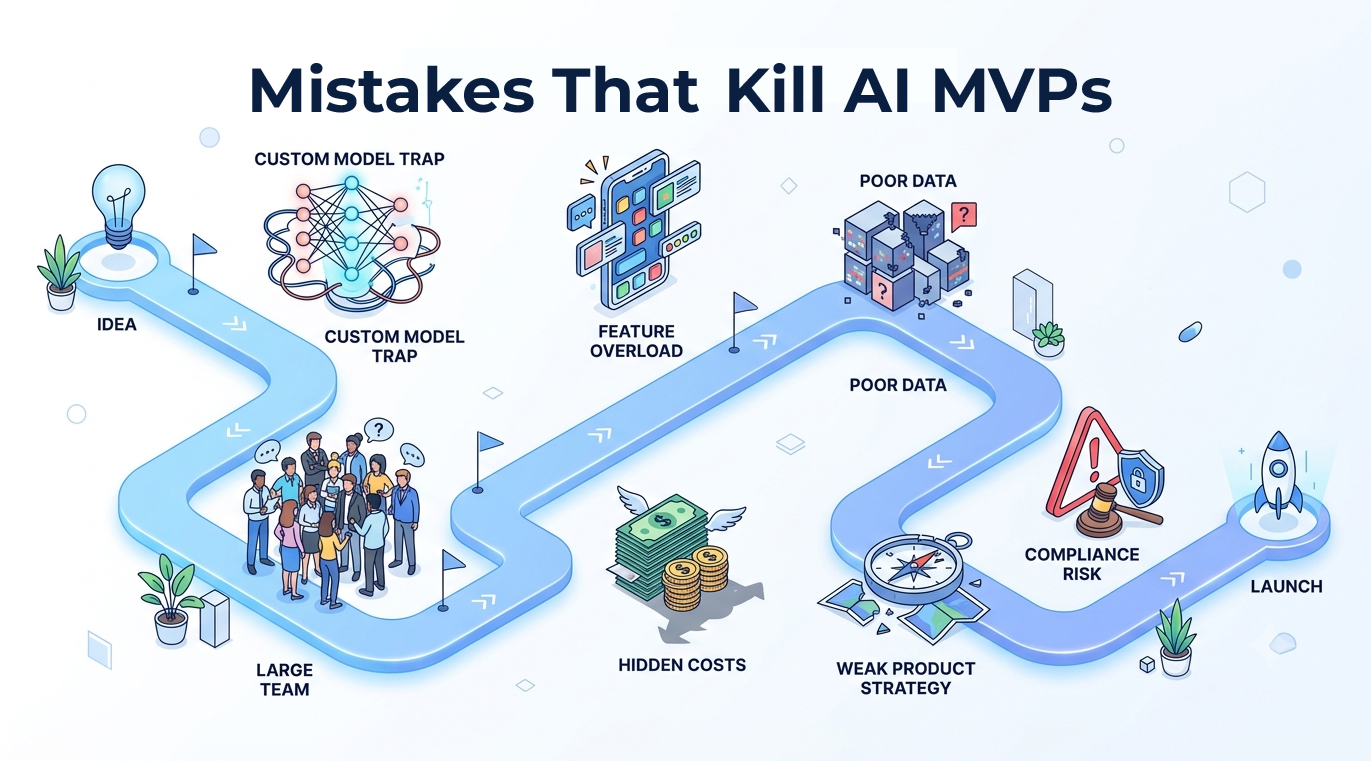
These patterns repeat across failed AI startups. Avoid them.
1. Building a Custom AI Model Too Early
Custom model training costs $50,000 to $500,000 and takes months. For 95% of AI MVPs, foundation models with fine-tuning, RAG, or prompt engineering deliver 80% of the value at 5% of the cost. Use OpenAI, Anthropic, or Google APIs first. Move to custom only when you have proven users, repeatable demand, and specific limitations of foundation models.
2. Adding Too Many AI Features
Founders convinced AI is the future try to put AI everywhere in their MVP. Then they cannot get any single feature working well. Pick one AI capability. Make it excellent. Add others only after the first proves value.
3. Skipping Data Preparation
A good AI model requires clean, well-structured data. Founders who rush past data work end up with hallucinations, poor accuracy, and frustrated users. Budget 20% to 40% of your project time and budget for data work.
4. Hiring a Big Team Too Soon
Most successful 2026 MVPs are built by teams of 3 to 5 people. A senior full-stack developer with AI coding assistants matches the productivity of three traditional developers. Bigger teams move slower, not faster, until you have product-market fit and a clear roadmap.
5. Ignoring Post-Launch Costs
AI products require continuous monitoring, model updates, prompt iteration, and infrastructure scaling. Real-world data changes over time. Models degrade if you do not maintain them. Budget for at least 12 months of post-launch operational costs before launching.
6. Pretending AI Will Replace Product Thinking
Founders sometimes believe sophisticated AI will compensate for poor UX, weak positioning, or unclear value propositions. It will not. The startups winning in 2026 are not the ones cramming AI into every feature. They are the ones using AI strategically to solve real problems in efficient ways.
7. Not Planning for Compliance and Trust
AI products handle user data, generate content that affects user decisions, and increasingly face regulatory scrutiny. Building compliance retroactively costs 5 to 10 times more than building it in from day one. Address GDPR, CCPA, HIPAA, or industry-specific requirements based on your target market before launch.
How to Validate Your AI MVP Has Product-Market Fit
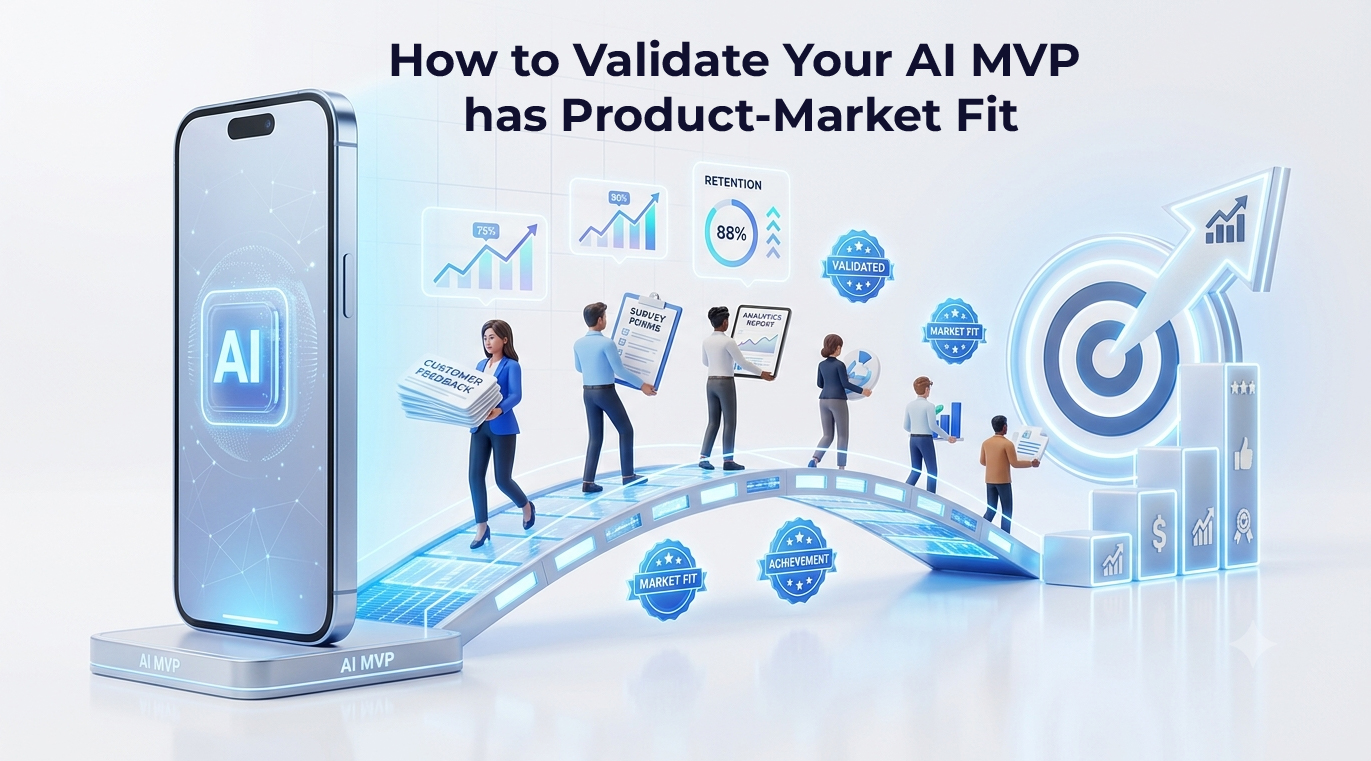
Building the MVP is half the work. Validating that it solves a real problem well enough that users pay determines whether you scale or pivot.
Strong product-market fit signals:
- 40%+ of free users would be “very disappointed” if the product disappeared (Sean Ellis test)
- Day-7 retention above 30% for habitual-use products
- Word-of-mouth signups exceeding 30% of new user acquisition
- Net Promoter Score above 30
- Free-to-paid conversion above 3%
- Negative churn (existing customers expanding usage)
- Inbound investor interest before you start fundraising
Weak signals that suggest pivot or kill:
- Users sign up and never return after first session
- Activation rate below 20%
- High API costs per user with no path to profitable unit economics
- Frequent complaints about AI accuracy or reliability
- Users describe what they want differently than your positioning
- Competitors with similar capability launch and get traction faster
If your AI MVP shows weak signals across multiple metrics for 90+ days post-launch, the most expensive thing you can do is keep building. Either pivot meaningfully (different market, different problem, different AI capability) or kill the project and try something else.
Frequently Asked Questions
How long does it take to build an AI MVP in 2026? Simple AI MVPs ship in 2 to 4 weeks. Mid-complexity multi-agent systems take 6 to 12 weeks. Full AI products take 4 to 8 months. The 2026 average across all AI MVPs is roughly 6 weeks, dramatically faster than the 6+ month traditional development cycle.
Can a non-technical founder build an AI MVP alone? Yes. 2026 tools like Lovable, Bolt, v0, Bubble, and FlutterFlow translate natural language prompts into functional code. Non-technical founders regularly ship working AI MVPs in 2 to 6 weeks using these tools. By end of 2026, Gartner projects 230 million people will use no-code AI platforms.
Should I use a pre-trained model or build my own? Use pre-trained models for 95% of MVPs. Foundation models from OpenAI, Anthropic, and Google provide excellent capability for most use cases. Custom training costs $50,000 to $500,000 and rarely makes sense before you have proven users and identified specific limitations of foundation models.
What is the cheapest way to build an AI MVP? Use no-code tools like Lovable or Bolt for the frontend, OpenAI or Claude APIs for the AI capability, and Supabase for the database. A non-technical founder can ship a basic AI MVP for $1,500 to $5,000 in tools and API costs.
How much does it cost to run an AI MVP in production? For a small AI MVP with 100 to 500 active users, expect $200 to $1,500 per month in combined hosting, database, and AI API costs. Costs scale roughly linearly with usage. Watch token usage carefully because API costs can spike unexpectedly with viral growth.
What AI tools should I use for my MVP in 2026? Foundation models: Claude (Anthropic), GPT (OpenAI), or Gemini (Google). Coding assistants: GitHub Copilot, Cursor, or Claude Code. No-code platforms: Lovable, Bolt, or v0. Vector DB: pgvector on Postgres for most cases. Hosting: Vercel for frontend, Render or Railway for backend.
Should I hire an agency or build with a solo developer? A senior full-stack developer using AI coding assistants matches the productivity of a traditional team of three. For most simple to mid-complexity MVPs, a single excellent developer or a small specialized team of 2 to 3 outperforms larger agency teams. Hire agencies for complex builds requiring specialized AI/ML expertise or compliance work.
What if my AI MVP doesn’t get traction? Build the smallest possible iteration loop. Test 3 to 5 different positioning angles before assuming the product itself is wrong. Talk to 20 to 30 users who signed up but did not convert. The fastest path to product-market fit is often a positioning pivot rather than a product pivot.
Do I need to worry about AI regulations for my MVP? Depends on your market and use case. Consumer AI products in the US face minimal regulation currently. EU markets require GDPR compliance and increasingly AI Act compliance for higher-risk applications. Healthcare, financial services, and legal industries have specific requirements. Address compliance before launch, not after.
How do I handle AI hallucinations in my MVP? Three approaches: (1) RAG implementations that ground responses in verified data, (2) confidence scoring that warns users when AI output may be unreliable, and (3) human-in-the-loop verification for high-stakes outputs. Most successful AI MVPs use combinations of all three based on the use case’s risk profile.
Conclusion
Building an AI MVP in 2026 is dramatically easier and cheaper than it was even 18 months ago. The tools have matured. The foundation models are powerful. The frameworks are stable. A founder with clear product thinking and disciplined scope can ship a functional AI MVP in 2 to 6 weeks for $5,000 to $80,000.
The challenge is no longer technical execution. It is product discipline. The founders who win in 2026 are not the ones with the most advanced AI. They are the ones who pick the right problem, validate before building, ship the smallest viable version, measure ruthlessly, and iterate based on real user behavior.
If you are starting an AI MVP today, the playbook is clear:
Start with the problem, not the technology. Run customer interviews before writing code. Pick one AI capability that delivers measurable value. Validate demand with cheap landing page tests and Wizard of Oz experiments. Choose pre-trained foundation models over custom training. Use no-code tools or AI coding assistants to ship faster. Build the minimum viable architecture, not enterprise infrastructure. Test rigorously with golden datasets and structured evaluation. Launch quietly to a beta cohort. Measure everything. Iterate weekly.
The companies that will dominate the next decade are being built right now, often by teams of 2 to 5 people, shipping AI MVPs that solve specific problems exceptionally well. The barrier to entry has never been lower. The bar for product quality has never been higher. Speed and discipline both matter, and you cannot have one without the other.
Your idea is worth less than your execution. Pick something you can build in 6 weeks. Ship it. Talk to users. Improve it. The AI MVPs that fail in 2026 are the ones that took 8 months to build something users did not want. The ones that succeed shipped fast, learned faster, and built exactly what users actually pay for. That is the entire game.