
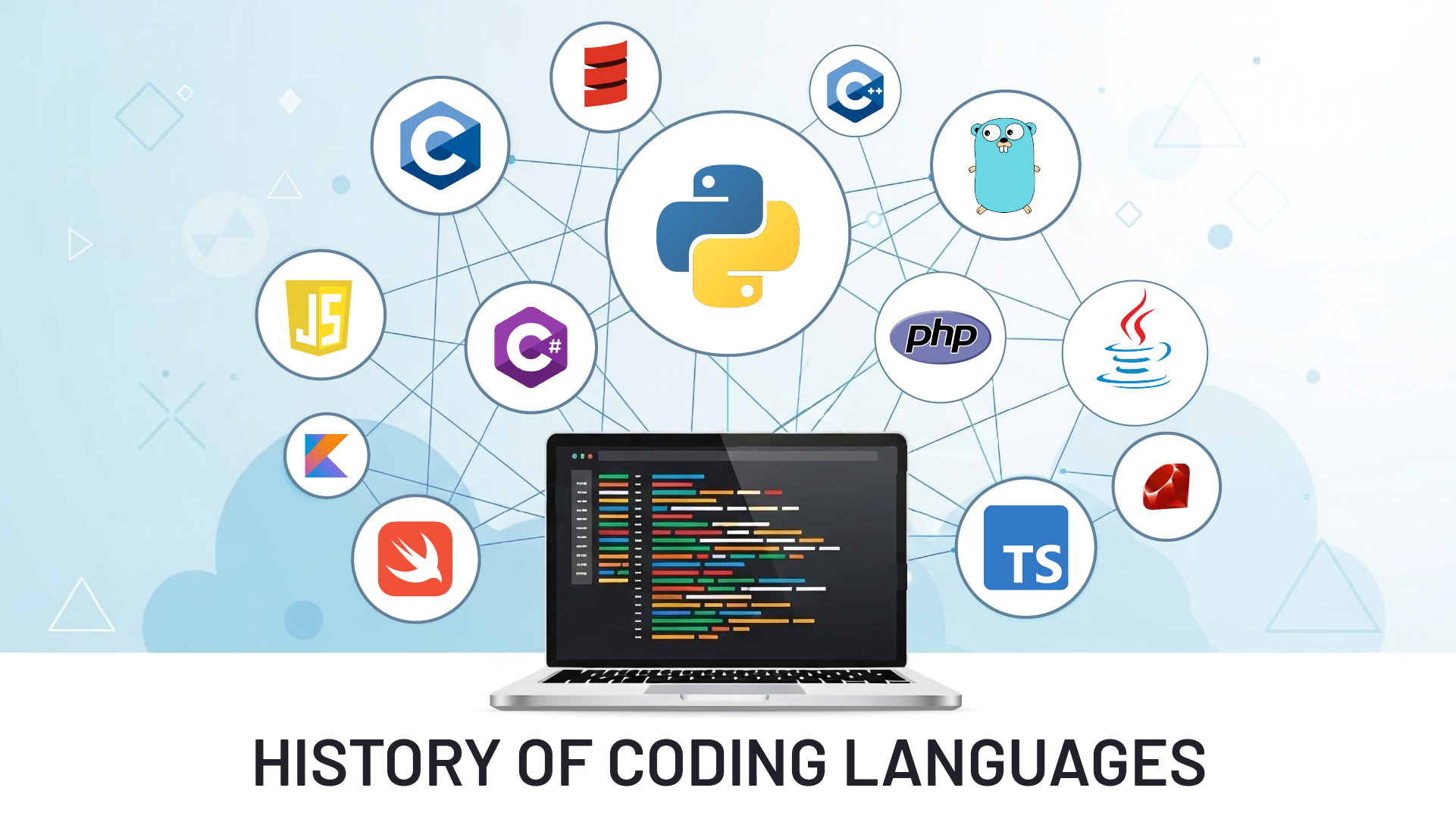
Introduction
Did you know that in 2024, Python surpassed JavaScript as the most popular language on GitHub for the first time? This milestone represents just the latest chapter in a remarkable 75-year journey that began with punch cards and evolved into the sophisticated programming ecosystems we use today.
A McKinsey study estimates that the global software industry generated $1.8 trillion, and at the heart of this massive industry lies the evolution of programming languages. From the first high-level language in 1949 to today’s AI-powered development tools, programming languages have continuously adapted to meet changing technological demands and developer needs.
Whether you’re a seasoned developer or just starting your coding journey, understanding this evolution provides crucial context for making informed decisions about which languages to learn and use. Let’s explore how we went from binary babble to the elegant, powerful languages that power our digital world.
The Dawn of Programming Languages (1940s-1960s)

Before Programming Languages: The Machine Code Era
In the early days of computing, programmers worked directly with machine code – sequences of 0s and 1s that computers could understand. This process was incredibly tedious, error-prone, and required intimate knowledge of the computer’s hardware architecture.
The First Breakthrough: Assembly Language
Assembly language emerged as the first abstraction layer above machine code. Instead of binary numbers, programmers could use mnemonic codes like “ADD” and “SUB,” which were then translated into machine code by an assembler.
Revolutionary High-Level Languages
John Mauchly’s Short Code, proposed in 1949, was one of the first high-level languages ever developed for an electronic computer. This marked the beginning of a new era where programmers could write instructions that resembled human language rather than machine instructions.
Key Languages of This Era:
| Language | Year | Primary Use | Legacy |
| Short Code | 1949 | General computing | First high-level language |
| FORTRAN | 1957 | Scientific computing | Still used in high-performance computing |
| LISP | 1958 | Artificial intelligence | Functional programming paradigm |
| COBOL | 1959 | Business applications | Enterprise systems |
| ALGOL | 1960 | Algorithm description | Influenced many modern languages |
The Structured Programming Revolution (1970s-1980s)
The Software Crisis and Structured Solutions
The 1970s brought what became known as the “software crisis” – projects were increasingly complex, over budget, and unreliable. This led to the development of structured programming principles and languages that supported them.
C Language: The Game Changer
Developed by Dennis Ritchie at Bell Labs in 1972, C combined the efficiency of assembly language with the readability of high-level languages. Its influence cannot be overstated – many modern languages, including C++, Java, and JavaScript, trace their syntax back to C.
Object-Oriented Programming Emerges
The concept of object-oriented programming (OOP) began taking shape with languages like Smalltalk (1972) and later C++ (1985). This paradigm organized code around objects rather than functions, making large programs more manageable and reusable.
The Internet Age and Language Diversification (1990s-2000s)
The Web Changes Everything
The emergence of the World Wide Web created entirely new categories of programming needs:
Web-Specific Languages:
- HTML (1993): Markup language for web structure
- JavaScript (1995): Client-side scripting for interactive web pages
- PHP (1995): Server-side web development
- CSS (1996): Styling and layout for web pages
Enterprise and Cross-Platform Solutions
Java: Write Once, Run Anywhere
Released in 1995, Java introduced the concept of “write once, run anywhere” through its virtual machine architecture. This made it incredibly popular for enterprise applications and web backends.
Python: Simplicity and Readability
Python, created by Guido van Rossum in 1991, emphasized code readability and simplicity. Its philosophy of “there should be one obvious way to do it” made it accessible to beginners while remaining powerful for experts.
The Modern Era: Speed, Scale, and Specialization (2010s-2024)
Current Language Popularity Statistics
As of 2024, JavaScript and HTML/CSS were the most commonly used programming languages among software developers around the world, with more than 62 percent of respondents stating that they used JavaScript and just around 53 percent using HTML/CSS.
Top Programming Languages in 2024:
- Python (29.03% popularity score)
- JavaScript (24.01% popularity score)
- Java (18.53% popularity score)
- TypeScript (Growing rapidly)
- C++ (Stable presence)
Specialized Languages for Modern Challenges
Systems Programming Revival:
- Rust (2010): Memory safety without garbage collection
- Go (2009): Concurrency and cloud-native applications
Mobile Development:
- Swift (2014): iOS development
- Kotlin (2011): Android development
Data Science and AI:
- R: Statistical computing
- Julia: High-performance numerical computing
- Python: Machine learning and AI (with libraries like TensorFlow and PyTorch)
How Desol Int. Leverages Programming Language Evolution
At Desol Int. we understand that choosing the right programming language can make or break a project. Our experienced development team stays current with language trends and selects technologies based on your specific business needs, not just what’s popular.
Whether you need a robust enterprise application built with Java, a modern web application using JavaScript and Python, or a high-performance system using Rust or Go, our developers have the expertise to deliver. We’ve successfully implemented projects across dozens of programming languages, ensuring your solution is built with the most appropriate technology stack.
Learn more about our custom web application development services and how we can help you navigate the complex world of programming languages.
The Future of Programming Languages (2024 and Beyond)
Emerging Trends Shaping Language Development

- AI-Assisted Programming Languages are evolving to better integrate with AI tools. GitHub Copilot and similar tools are changing how we think about code generation and completion.
- WebAssembly Integration Languages are adding WebAssembly support, allowing high-performance applications to run in browsers.
- Quantum Computing Languages New languages like Q# and Qiskit are emerging to handle quantum computing challenges.
Predictions for the Next Decade
- Increased Focus on Security: Languages with built-in security features will gain popularity
- Better Concurrency Models: As multi-core systems become standard, languages with superior concurrency will thrive
- Domain-Specific Languages: More specialized languages for specific industries and use cases
- Environmental Considerations: Energy-efficient languages may gain importance as sustainability becomes crucial
Key Lessons from Programming Language Evolution
What Drives Language Success
- Solving Real Problems: Successful languages address genuine developer pain points
- Strong Community: Active communities drive adoption and ecosystem growth
- Corporate Backing: Support from major tech companies provides stability
- Learning Curve: Languages that balance power with accessibility tend to succeed
- Timing: Emerging at the right technological moment is crucial
Choosing Languages for Your Projects
When selecting a programming language for your next project, consider:
- Team Expertise: What languages does your team know well?
- Project Requirements: Performance, scalability, maintenance needs
- Ecosystem Maturity: Available libraries, tools, and community support
- Long-term Viability: Is the language actively maintained and growing?
Conclusion
The history of programming languages is a testament to human ingenuity and the relentless pursuit of better ways to communicate with machines. Programming languages have evolved significantly over the decades, influenced by advancements in hardware, software development paradigms, and industry demands.
From the punch cards of the 1940s to today’s AI-assisted development environments, each evolution has made programming more accessible, powerful, and efficient. Understanding this history helps us make better decisions about which technologies to adopt and invest in.
Ready to harness the power of modern programming languages for your business? Contact Desol Int. And let our expert developers help you choose and implement the perfect technology stack for your unique needs. With our deep understanding of language evolution and modern development practices, we’ll ensure your project is built for success.
Frequently Asked Questions
Q1: What was the first programming language ever created?
Answer: John Mauchly’s Short Code, proposed in 1949, was one of the first high-level languages ever developed for an electronic computer. However, assembly language predates this as the first step above machine code. The definition of “first” depends on whether you consider assembly languages or high-level languages, but Short Code is generally recognized as the first high-level programming language.
Q2: Why are there so many programming languages?
Answer: Different programming languages exist because they solve different problems and optimize for different priorities. Some focus on speed (like C++), others on simplicity (like Python), and others on specific domains (like R for statistics). The evolution of programming languages has been driven by the need for increased productivity, improved code readability, and the desire to make programming accessible to a broader audience.
Q3: Which programming language should I learn first in 2024?
Answer: For beginners in 2024, Python is often recommended due to its simple syntax and versatility. Python continues to cement its overall dominance, buoyed by things like popular libraries for hot fields such as AI. However, the best choice depends on your goals: JavaScript for web development, Java for enterprise applications, or C++ for systems programming.
Q4: How has artificial intelligence affected programming languages?
Answer: AI has significantly impacted programming languages in two ways: first, languages like Python have become more popular due to their extensive AI and machine learning libraries. Second, AI tools are now assisting in code generation and completion, changing how developers interact with programming languages and potentially influencing future language design.
Q5: Will new programming languages continue to emerge?
Answer: Yes, new programming languages will continue to emerge as technology evolves. Current trends show languages being developed for quantum computing, improved security, better concurrency, and domain-specific applications. The trends in programming languages continue to evolve with innovations like cross-platform development, the rise of modern frameworks, and increased demand for real-time applications.