

Introduction
The economics of web application breaches have become brutal. The average data breach now costs $4.88 million globally and $9.36 million in the United States. 95% of cybersecurity incidents trace back to known vulnerabilities that someone failed to patch. The OWASP Top 10 for 2025, compiled from analysis of over 175,000 CVE records, reveals that the same wounds keep showing up across applications: broken access control, security misconfiguration, supply chain failures, and authentication weaknesses.
Most of these vulnerabilities are not exotic zero-day exploits. They are well-documented, fixable, and often present because someone shipped fast and forgot to come back. A senior developer with a security checklist can find and fix 90% of them in a few weeks. The 5% of incidents that involve sophisticated attacks dominate news coverage. The 95% that involve “we forgot to update a library” make up the actual breach landscape.
This guide walks through the 15 vulnerabilities you should fix today, including all 10 categories from the OWASP Top 10 for 2025 plus 5 additional critical web app security issues most teams miss. Each section covers what the vulnerability is, how attackers exploit it, real-world impact, and the specific fixes that work in production.
Why This List Matters Right Now
The OWASP Top 10 for 2025 introduced two entirely new categories (Software Supply Chain Failures and Mishandling of Exceptional Conditions) that did not exist in previous versions. Security Misconfiguration jumped from #5 in 2021 to #2 in 2025, now affecting 3% of tested applications. Broken Access Control remained #1 with 3.73% of all tested applications affected, the highest rate of any category.
The shift from 2021 to 2025 represents more than minor adjustments. It is a fundamental shift in how attackers target applications. Modern attacks increasingly exploit the ecosystem around your code (dependencies, build tools, CI/CD pipelines) rather than just the code itself. Your application can be perfectly written and still get breached through a compromised npm package or misconfigured cloud service.
Fix these 15 vulnerabilities, and you eliminate the vast majority of attack surface that attackers actually exploit in production.
1. Broken Access Control (OWASP #1)
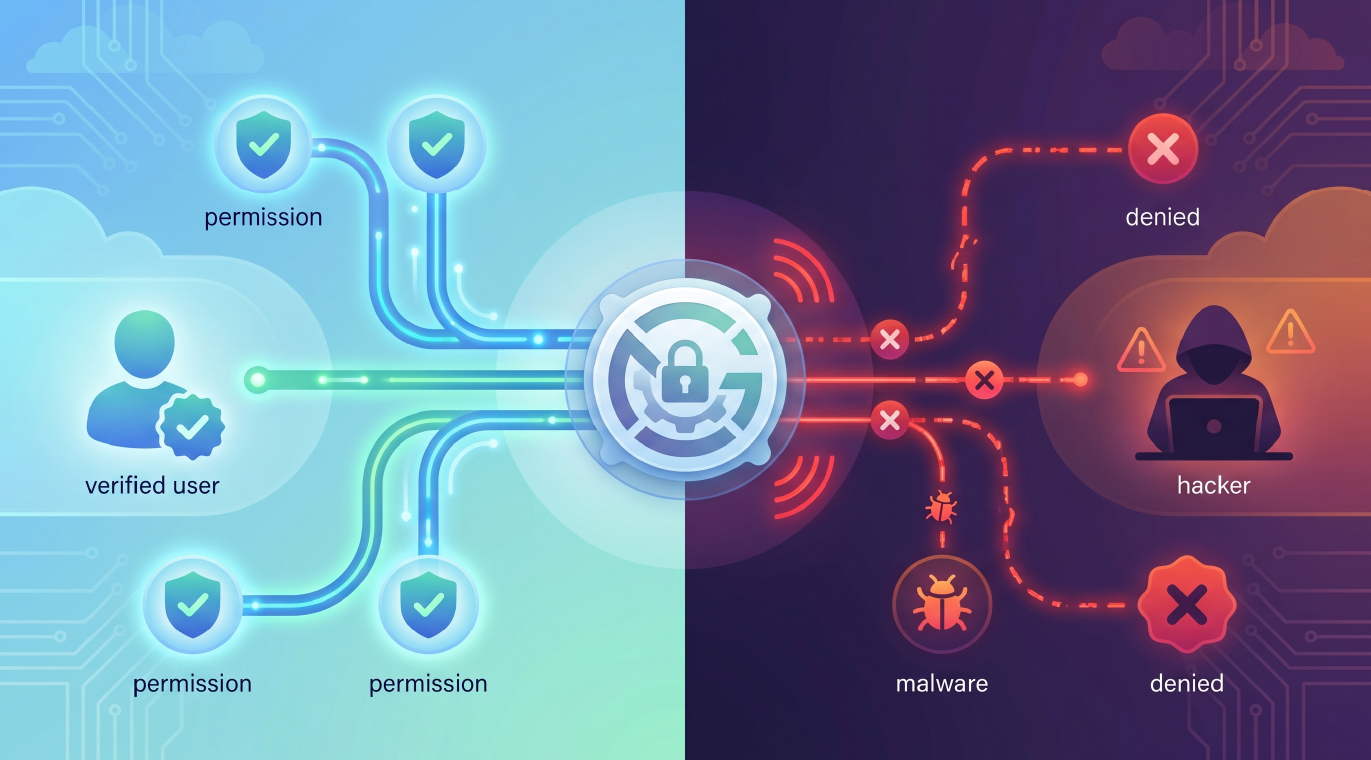
The vulnerability: Users can access resources, data, or functionality they should not be able to access. This is the highest-incidence category in the OWASP Top 10, affecting 3.73% of all tested applications. It now officially includes Server-Side Request Forgery (SSRF).
How attackers exploit it: Modifying URLs to access other users’ data (changing /user/123 to /user/124), bypassing authorization checks by manipulating tokens or cookies, accessing admin pages without proper role verification, exploiting insecure direct object references (IDOR), and using SSRF to access internal services from the application server.
Real impact: The 2019 Capital One breach exposed 100 million customer records through an SSRF vulnerability. IDOR vulnerabilities have caused breaches at Facebook, Shopify, and dozens of other major platforms.
The fix:
- Implement deny-by-default authorization at every endpoint
- Use centralized authorization middleware rather than per-route checks
- Validate user permissions on every API request, not just at login
- Implement role-based access control (RBAC) or attribute-based access control (ABAC)
- For SSRF: validate and sanitize all URLs the server fetches, use allowlists for permitted destinations, block requests to private IP ranges (10.x, 192.168.x, 169.254.x)
- Log all access control failures and alert on patterns
2. Security Misconfiguration (OWASP #2)

The vulnerability: Insecure default settings, incomplete hardening, misconfigured HTTP headers, exposed cloud services, verbose error messages that leak system information, and unnecessary features left enabled. Surged from #5 in 2021 to #2 in 2025.
How attackers exploit it: Default admin credentials still in place, debug endpoints exposed in production, S3 buckets configured for public access, cloud databases with no authentication, error messages revealing stack traces, missing security headers (HSTS, CSP, X-Frame-Options).
Real impact: The Capital One breach involved a misconfigured firewall. The Equifax breach exploited a missing patch. Tens of thousands of MongoDB instances have been ransomed because they were left with no authentication enabled.
The fix:
- Implement infrastructure as code (IaC) with security baselines
- Run automated configuration scanners (Checkov, tfsec, Snyk IaC) in CI/CD
- Configure security headers: Content-Security-Policy, Strict-Transport-Security, X-Content-Type-Options, X-Frame-Options, Referrer-Policy
- Disable directory listing and unused HTTP methods
- Replace verbose error messages with generic responses for users, detailed logs for developers
- Use the principle of least privilege for cloud IAM roles
- Conduct security reviews after every infrastructure change
3. Software Supply Chain Failures (OWASP #3, NEW)
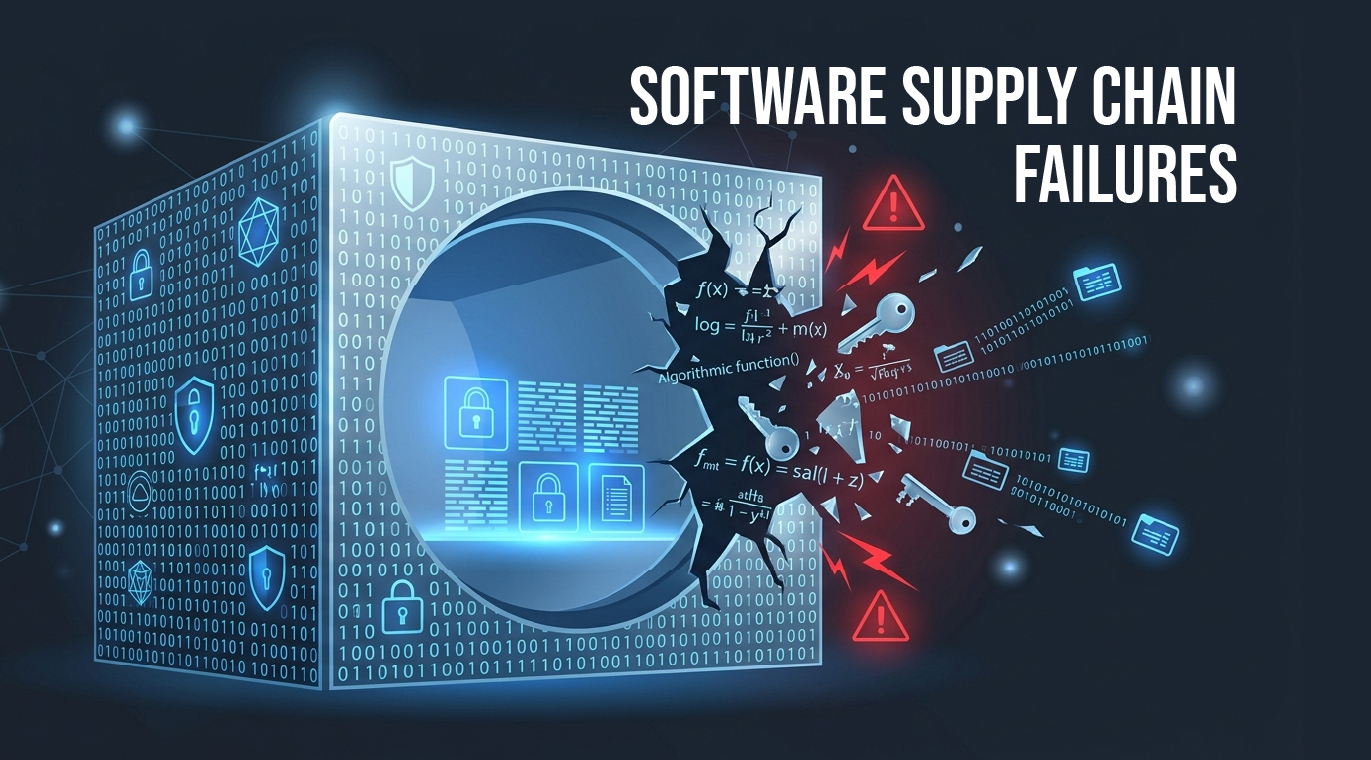
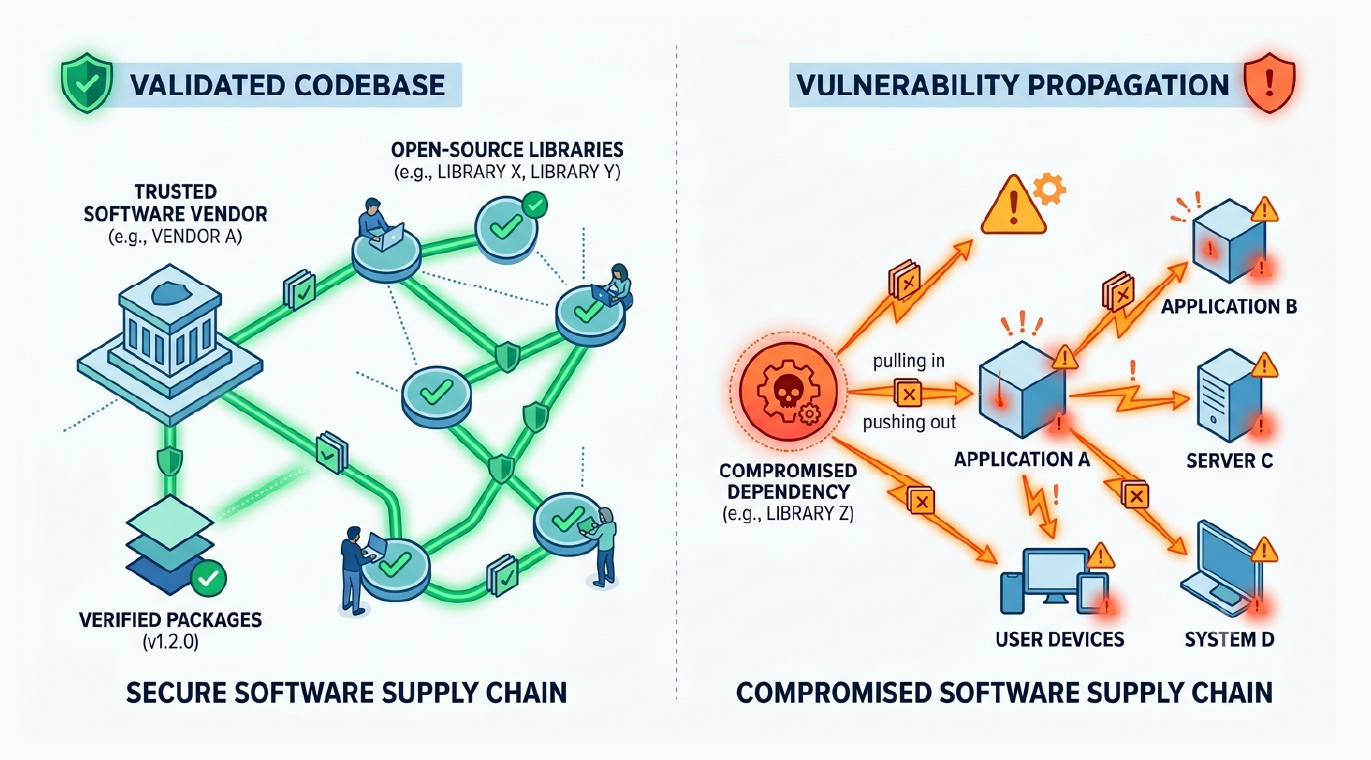
The vulnerability: Compromises occurring within or across the entire ecosystem of software dependencies, build systems, and distribution infrastructure. This new 2025 category has the highest average exploit and impact scores from CVEs despite limited testing data.
How attackers exploit it: Typosquatting attacks where malicious packages mimic legitimate ones (express vs. expres), compromised package maintainer accounts pushing malicious updates, dependency confusion attacks targeting internal package names, vulnerable transitive dependencies multiple levels deep, and malicious code in build tools or CI/CD systems.
Real impact: The SolarWinds breach affected 18,000 organizations through a compromised software update. The event-stream npm package incident in 2018 affected millions of installations. Log4Shell in 2021 affected nearly every Java application worldwide.
The fix:
- Use a Software Bill of Materials (SBOM) for every application
- Implement automated dependency scanning (Dependabot, Snyk, GitHub Advanced Security)
- Pin dependency versions in production rather than using semver ranges
- Verify package signatures and use private package registries for internal dependencies
- Audit transitive dependencies, not just direct ones
- Subscribe to vulnerability databases for your tech stack (NVD, GitHub Security Advisories)
- Test dependency updates in staging before promoting to production
- Use lockfiles (package-lock.json, yarn.lock, composer.lock) and commit them to version control
4. Cryptographic Failures (OWASP #4)
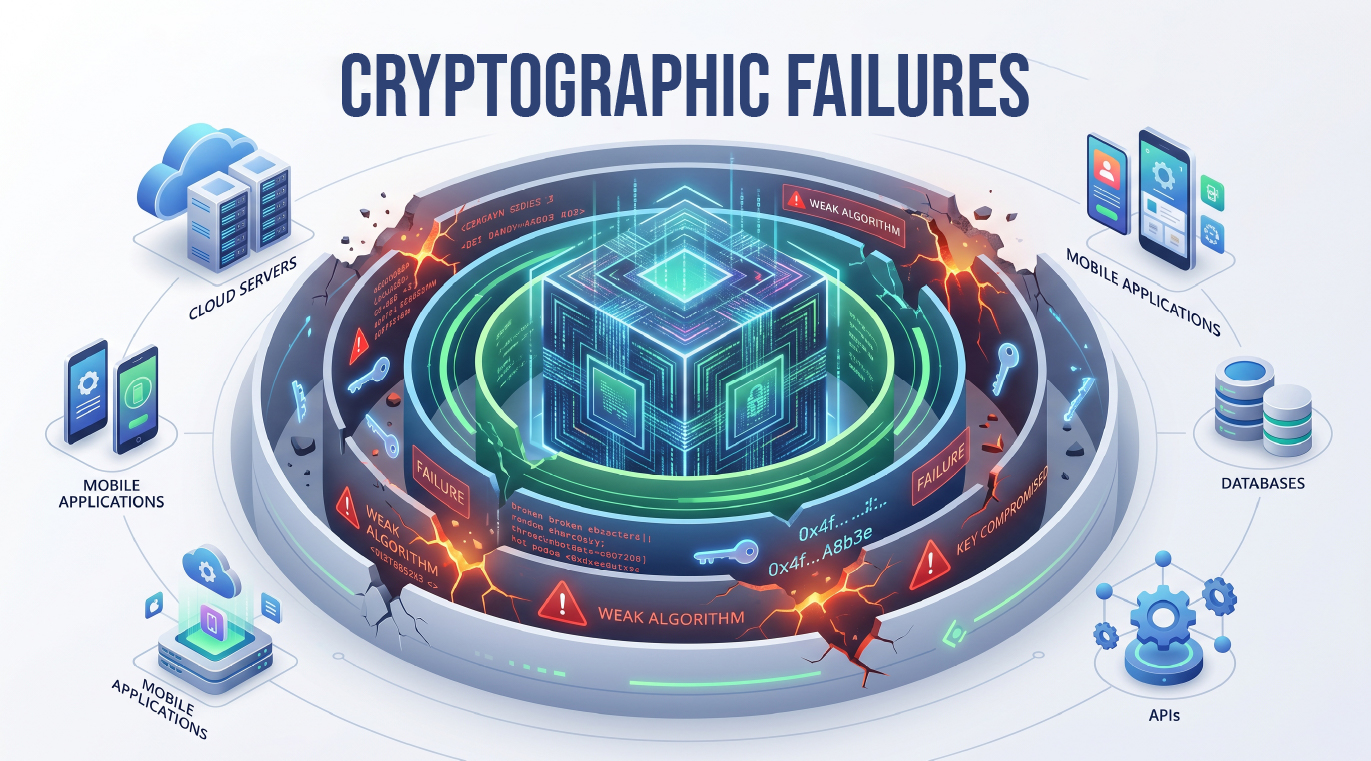
The vulnerability: Weak encryption, improperly stored credentials, exposed sensitive data, and broken cryptographic implementations. On average, 3.80% of applications have one or more cryptographic failures. Often leads to sensitive data exposure or system compromise.
How attackers exploit it: Intercepting unencrypted traffic to steal credentials, cracking weakly-hashed passwords (MD5, SHA1), exploiting outdated TLS versions, accessing data stored in plaintext databases, decrypting data using weak keys or hardcoded secrets.
Real impact: The Yahoo breach exposed 3 billion accounts partially because of weak password hashing (MD5). Many modern breaches reveal that “encrypted” data was actually using deprecated algorithms.
The fix:
- Use TLS 1.3 (or minimum TLS 1.2) for all connections, redirect HTTP to HTTPS
- Hash passwords with Argon2id, bcrypt, or scrypt with appropriate work factors
- Encrypt sensitive data at rest using AES-256-GCM or equivalent modern algorithms
- Never roll your own crypto; use established libraries (libsodium, AWS KMS, Google Cloud KMS)
- Rotate encryption keys regularly using key management services
- Use HSTS headers to prevent SSL stripping attacks
- Implement certificate pinning for mobile apps
- Audit all data fields for sensitivity classification and apply encryption accordingly
- Never log sensitive data (passwords, tokens, credit cards, SSNs)
5. Injection (OWASP #5)
The vulnerability: Untrusted user input passed to interpreters as part of commands or queries. Includes SQL injection, NoSQL injection, OS command injection, LDAP injection, and Cross-site Scripting (XSS). Has the greatest number of CVEs associated with the 38 CWEs in this category.
How attackers exploit it: SQL injection by inserting malicious SQL into form fields, XSS by injecting JavaScript that executes in other users’ browsers, command injection by including shell metacharacters in user input, NoSQL injection by manipulating MongoDB queries with operator injection.
Real impact: SQL injection has been at or near the top of OWASP lists since 2003. The 2014 Yahoo breach involved SQL injection. XSS vulnerabilities have caused account takeovers at Twitter, eBay, and many other major platforms.
The fix:
- Use parameterized queries (prepared statements) for all database operations
- Use ORMs like Prisma, TypeORM, Sequelize, Entity Framework, or Hibernate that handle parameterization automatically
- Validate and sanitize all user input at the application boundary
- For XSS prevention: encode output based on context (HTML, JavaScript, CSS, URL), use Content-Security-Policy headers, set HttpOnly and Secure flags on cookies
- For command injection: avoid shell command execution with user input; if unavoidable, use allowlists and proper escaping
- Use safe APIs that avoid the interpreter entirely when possible
- Implement input validation on both client and server (server validation is mandatory; client validation is convenience only)
6. Insecure Design (OWASP #6)
The vulnerability: Flaws in architecture or business logic rather than implementation mistakes. Weak password reset flows, missing authorization steps in workflows, lack of threat modeling, and insecure-by-design features.
How attackers exploit it: Bypassing security questions where multiple people know the answer, exploiting business logic to perform unauthorized actions (transferring negative amounts, ordering with manipulated prices), abusing rate limiting absences to enumerate accounts, exploiting race conditions in financial transactions.
Real impact: Cinema chain breaches where attackers bought tickets at $0 by manipulating cart totals. Banking app vulnerabilities where users could transfer money to themselves repeatedly. Account takeovers through insecure password recovery flows.
The fix:
- Conduct threat modeling during design (STRIDE, PASTA, or Attack Trees methodologies)
- Use security design patterns like defense in depth, fail securely, principle of least privilege
- Implement secure software development lifecycle (SSDLC) practices
- Review business logic for ways it can be abused, not just for functional correctness
- Add explicit authorization checks at every workflow step, not just at login
- Use rate limiting, CAPTCHAs, and account lockouts on sensitive operations
- Test edge cases: negative numbers, extremely large values, unicode, injection patterns
7. Authentication Failures (OWASP #7)
The vulnerability: Weak authentication implementation, including credential stuffing vulnerabilities, weak password policies, missing multi-factor authentication, session fixation, and insecure password recovery. Renamed from “Identification and Authentication Failures” in 2025.
How attackers exploit it: Credential stuffing using leaked password databases, brute-forcing weak passwords, exploiting session timeouts that never expire, taking over accounts through weak password reset flows, exploiting JWT implementation flaws.
Real impact: The 2012 LinkedIn breach exposed 167 million credentials, then those credentials were used in credential stuffing attacks against dozens of other services for years. Disney+ accounts were hijacked at launch through credential stuffing.
The fix:
- Require strong passwords (minimum 12 characters, NIST SP 800-63B guidelines)
- Implement multi-factor authentication (MFA) with TOTP, WebAuthn, or push notifications
- Use rate limiting and CAPTCHA on login endpoints (5 failures per IP per minute)
- Check passwords against breached password databases (haveibeenpwned API)
- Implement secure session management: random session IDs, secure cookie flags, idle and absolute timeouts
- For JWT: use strong signing algorithms (RS256, ES256), validate all claims, implement token rotation
- Send notifications on password changes, MFA changes, and suspicious logins
- Implement account lockout after 10 failed attempts with progressive delays
8. Software and Data Integrity Failures (OWASP #8)
The vulnerability: Code and infrastructure that does not protect against integrity violations, including auto-updates without verification, deserializing untrusted data, and CI/CD pipelines without integrity checks.
How attackers exploit it: Compromising auto-update mechanisms to push malicious code, exploiting insecure deserialization to execute arbitrary code, modifying CI/CD pipelines to inject backdoors, manipulating data without detection.
Real impact: The SolarWinds attack exploited an auto-update mechanism. The Codecov breach affected over 29,000 customers through a compromised CI/CD tool. Java deserialization vulnerabilities have caused widespread RCE incidents.
The fix:
- Verify digital signatures on all auto-updates
- Use repositories that require signed commits
- Implement code signing for all production artifacts
- Avoid deserializing untrusted data; use safer formats like JSON instead of Java serialization, Pickle, or PHP serialize
- Add integrity verification (SRI tags) for all external scripts and stylesheets
- Use CI/CD platforms with hardened security: SLSA framework, sigstore, signed builds
- Review and audit access to CI/CD pipelines as carefully as production access
- Implement separation of duties: code authors cannot approve their own deployments
9. Security Logging and Alerting Failures (OWASP #9)
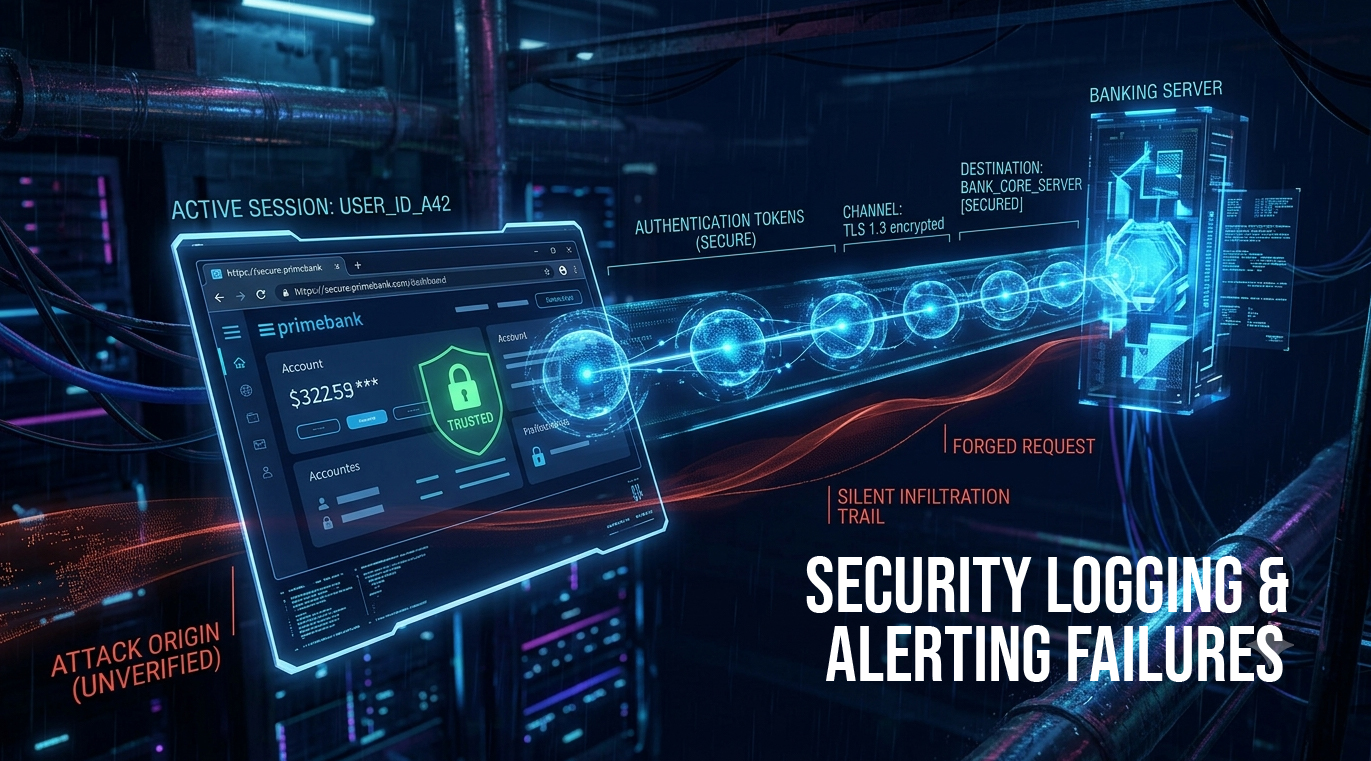
The vulnerability: Insufficient logging, missing alerts, inadequate monitoring, or logs that do not contain enough information to detect or investigate breaches.
How attackers exploit it: Operating undetected for months because no one is watching the logs, deleting their tracks because logs are not protected, exploiting the gap between breach and detection (industry average: 277 days).
Real impact: Most major breaches share a common characteristic: attackers were inside for months before detection. The Marriott breach lasted 4 years before discovery. Equifax attackers had access for 76 days.
The fix:
- Log authentication events: successes, failures, password changes, MFA changes
- Log authorization failures and access control violations
- Log input validation failures (often indicate attack probing)
- Log all privileged operations and admin actions
- Centralize logs to a SIEM (Splunk, ELK, Datadog, Sumo Logic)
- Set up alerts for suspicious patterns: many failed logins, privilege escalation, unusual data access
- Protect logs from tampering: append-only storage, separate log infrastructure
- Retain logs for at least 90 days, ideally 1+ year for compliance
- Test alerting regularly with simulated attacks
10. Mishandling of Exceptional Conditions (OWASP #10, NEW)
The vulnerability: Improper error handling, logical errors, fail-open scenarios, and other resilience failures. New 2025 category. 50% of OWASP survey respondents ranked these as their #1 emerging concern.
How attackers exploit it: Triggering exceptions to bypass security controls (fail-open authentication), reading sensitive data from leaked stack traces, causing denial of service through unhandled errors, exploiting null pointer exceptions or race conditions during error states.
Real impact: Banking apps that fail open during database errors and grant access without verification. APIs that leak database schema in error responses. Authentication services that log users in if the verification service times out.
The fix:
- Define secure failure modes: fail closed and deny access on error
- Use consistent error-handling frameworks throughout the application
- Log error details internally; return generic error messages externally
- Never expose stack traces, database errors, or internal paths to users
- Test error paths as thoroughly as success paths
- Implement circuit breakers and graceful degradation for external services
- Run chaos engineering tests to verify behavior under failure conditions
- Handle null values, timeouts, and resource exhaustion explicitly
11. Cross-Site Request Forgery (CSRF)
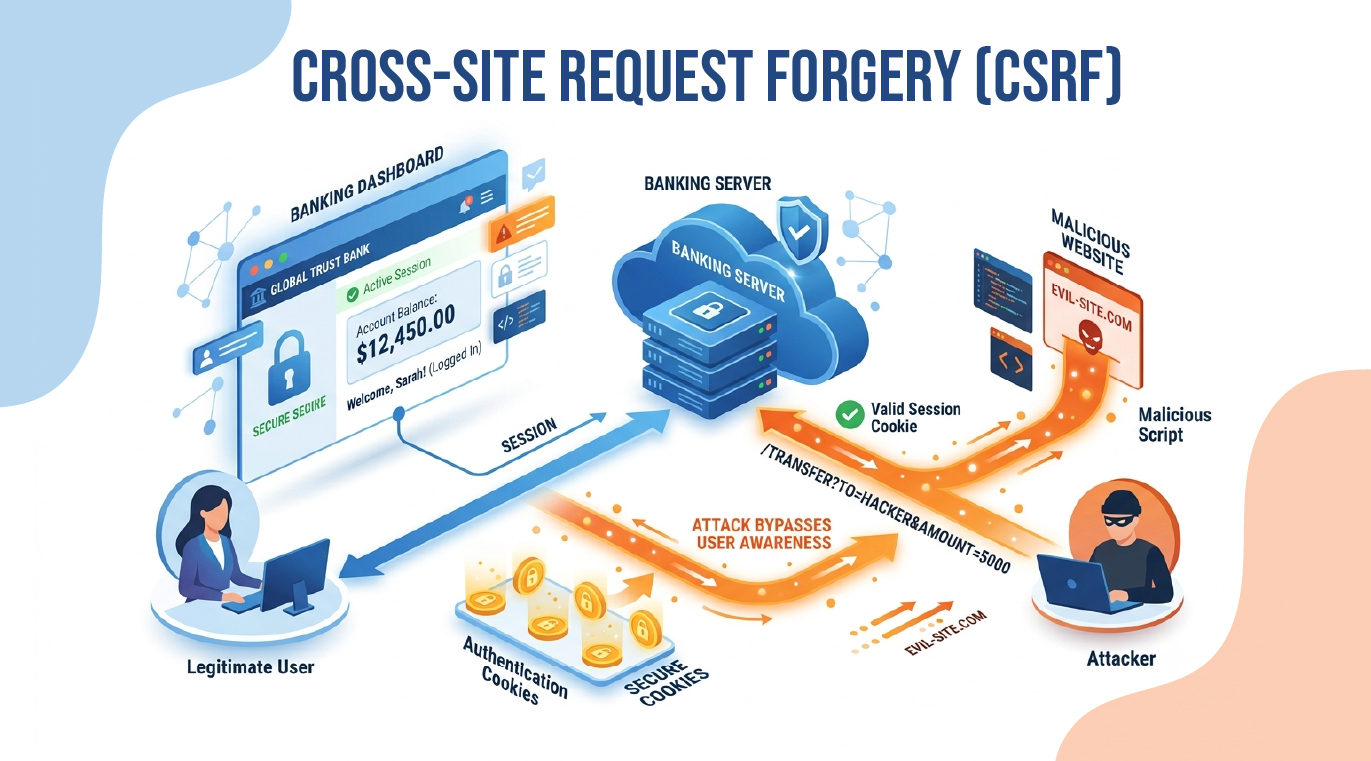
The vulnerability: Tricking authenticated users into making unwanted requests to your application. Not in the OWASP Top 10 anymore but still common and high-impact.
How attackers exploit it: Hosting a malicious page that submits forms to your application using the user’s existing session, embedding image tags or iframes that trigger state-changing requests, or exploiting users who are logged into your app while browsing elsewhere.
Real impact: CSRF has caused account takeovers, unauthorized fund transfers, password changes, and email modifications in dozens of major applications.
The fix:
- Implement CSRF tokens for all state-changing requests (POST, PUT, DELETE, PATCH)
- Use SameSite=Strict or SameSite=Lax cookie attributes
- Verify Origin and Referer headers for sensitive operations
- Require re-authentication for high-risk actions (password change, fund transfer)
- Use anti-CSRF libraries built into your framework (Django, Rails, Laravel, Express)
- Test CSRF protection in QA, including bypass techniques
12. Server-Side Request Forgery (SSRF)
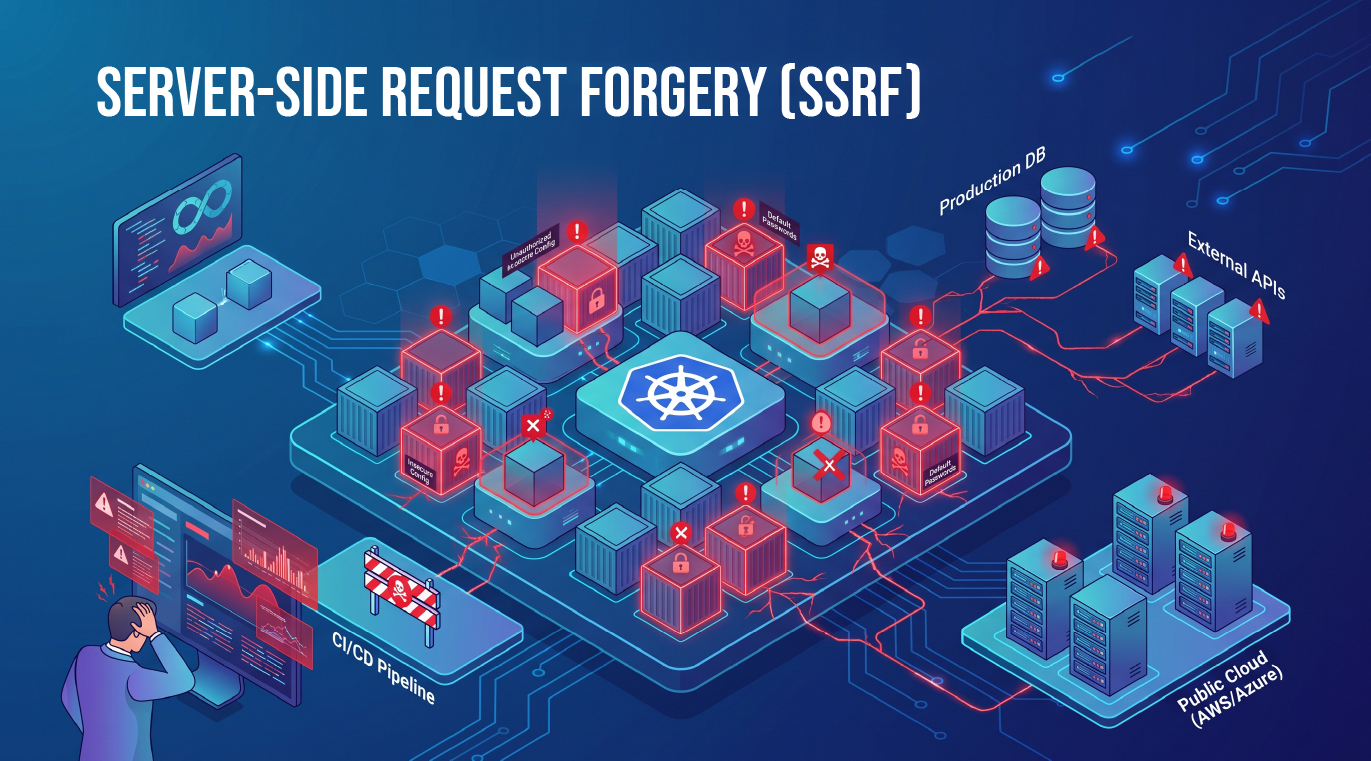
The vulnerability: Tricking the server into making requests to internal or unintended destinations. Now consolidated under Broken Access Control in OWASP 2025 but still warrants specific attention.
How attackers exploit it: Submitting URLs that point to internal services (cloud metadata endpoints like 169.254.169.254 on AWS), accessing admin panels on internal IPs, exfiltrating data through DNS queries, scanning internal networks via the application server.
Real impact: The Capital One breach exploited SSRF to access AWS instance metadata and steal credentials, exposing 100 million customer records.
The fix:
- Validate and sanitize all URLs that the server will fetch
- Use allowlists for permitted destinations, not blocklists
- Block requests to private IP ranges (10.x, 172.16-31.x, 192.168.x, 169.254.x, 127.x)
- Disable redirects in HTTP libraries that fetch user-supplied URLs
- Use IMDSv2 on AWS to require token-based access to instance metadata
- Run application servers with restricted egress firewall rules
- Use separate networks for application and internal services
13. XML External Entities (XXE) and File Upload Vulnerabilities
The vulnerability: Improperly configured XML parsers and unsafe file upload handling. Often consolidated under other OWASP categories but worth specific mention.
How attackers exploit it: Submitting malicious XML that includes external entity references to read local files, exfiltrate data, or cause denial of service. Uploading files that execute server-side (PHP, JSP, ASP) or contain malware. Exploiting file path traversal to write files outside intended directories.
Real impact: The Facebook XXE vulnerability allowed attackers to read arbitrary files. Numerous WordPress plugins have suffered from file upload RCE vulnerabilities.
The fix:
- Disable external entity processing in XML parsers (use libraries like defusedxml in Python)
- Prefer JSON over XML when possible for simpler attack surface
- For file uploads: validate file types using magic bytes, not just extensions
- Store uploaded files outside the web root
- Rename files to random identifiers, never trust user-provided filenames
- Scan uploaded files with antivirus (ClamAV, VirusTotal API)
- Set strict file size limits and timeout limits
- Serve uploaded files from a separate domain to prevent cookie theft via uploaded HTML
14. Insecure API Design and Endpoint Exposure

The vulnerability: APIs without proper authentication, authorization, rate limiting, or input validation. APIs handle most modern application traffic but receive less security attention than UIs.
How attackers exploit it: Calling internal APIs directly without UI-imposed restrictions, scraping data through unrate-limited endpoints, exploiting GraphQL queries to extract massive datasets, finding undocumented endpoints through reconnaissance.
Real impact: Many recent breaches have been API-driven: unprotected GraphQL endpoints leaking data, internal APIs accessible from the internet, mobile app APIs without server-side authorization checks.
The fix:
- Authenticate every API endpoint with bearer tokens, API keys, or OAuth
- Implement authorization checks on every endpoint, not just at the gateway
- Apply rate limiting per user, per endpoint, and per IP
- Use API gateways (Kong, AWS API Gateway, Tyk) for centralized security
- Document all APIs and audit for unintended exposure
- For GraphQL: implement query depth limits, query complexity analysis, and persistent queries
- Implement tiered rate limiting (more restrictive for unauthenticated traffic)
- Monitor API traffic for anomalies (sudden spikes, unusual patterns)
- Follow the OWASP API Security Top 10 for API-specific guidance
15. Insufficient Container and Infrastructure Security

The vulnerability: Misconfigured containers, exposed secrets in images, vulnerable base images, and infrastructure that does not enforce security boundaries.
How attackers exploit it: Pulling secrets from Docker images that included environment files, exploiting outdated base images with known CVEs, escaping containers through misconfigured runtimes, accessing Kubernetes API servers without proper RBAC.
Real impact: Numerous breaches have involved attackers finding AWS keys committed to public Docker images. Kubernetes clusters have been mined for cryptocurrency through exposed dashboards.
The fix:
- Use minimal base images (distroless, Alpine) and update them regularly
- Scan container images for vulnerabilities (Trivy, Grype, Snyk Container)
- Never embed secrets in Docker images; use secret managers (AWS Secrets Manager, Vault, Kubernetes Secrets)
- Run containers as non-root users
- Use read-only filesystems where possible
- Implement network policies to restrict container-to-container traffic
- Enable Pod Security Standards in Kubernetes (or equivalent admission controllers)
- Audit RBAC permissions regularly; follow least privilege
- Encrypt secrets at rest with KMS keys
- Implement runtime security monitoring (Falco, Sysdig)
How to Prioritize These 15 Fixes
Fixing all 15 vulnerabilities at once is unrealistic for most teams. Use this prioritization framework based on severity, exploitability, and effort.
Fix this week (high severity, low effort):
- Add security headers (HSTS, CSP, X-Frame-Options) – 1-2 hours
- Implement rate limiting on login endpoints – 4-8 hours
- Update all dependencies and run vulnerability scans – 1 day
- Audit and remove unused npm/pip/gem packages – 4 hours
- Configure SameSite cookies and secure flags – 2 hours
Fix this month (high severity, medium effort):
- Implement parameterized queries everywhere (audit existing code) – 1-2 weeks
- Add MFA support for user accounts – 1 week
- Implement centralized authorization middleware – 1-2 weeks
- Set up centralized logging and alerting – 1-2 weeks
- Conduct dependency audit and pin versions – 3-5 days
Fix this quarter (medium severity or high effort):
- Implement comprehensive threat modeling for major features – 2-4 weeks
- Migrate to modern password hashing (Argon2id) – 1-3 weeks depending on user count
- Build SBOM and SLSA-compliant build pipeline – 4-6 weeks
- Implement secrets management with rotation – 4-8 weeks
- Conduct penetration test with remediation – 4-8 weeks
Continuous improvements:
- Security training for developers (quarterly)
- Automated security scanning in CI/CD (ongoing)
- Code reviews with security checklist (every PR)
- Tabletop incident response exercises (quarterly)
- Bug bounty program (ongoing if mature enough)
How to Build Security into Your Development Process
The most secure applications are not the ones that hire the most pentesters. They are the ones that bake security into how they build software. Use these practices to make security continuous rather than reactive.
Shift left with secure coding training. Developers who understand security build secure software. Quarterly training on OWASP Top 10, secure coding patterns, and recent breaches dramatically reduces vulnerability introduction.
Automate security in CI/CD. Run static analysis (SAST), dependency scanning, container scanning, and infrastructure-as-code scanning on every pull request. Block deployments on critical findings.
Use security-focused code review checklists. Every PR should have explicit security review questions: Does this introduce new authentication paths? Does it handle untrusted input? Does it touch authorization logic? Does it modify cryptographic operations?
Implement DAST in staging. Dynamic application security testing tools (OWASP ZAP, Burp Suite, and Acunetix) probe deployed applications for vulnerabilities. Run them on every staging deployment.
Establish a vulnerability disclosure process. Security researchers will find issues. Make it easy and rewarding for them to report responsibly through security. txt, responsible disclosure policies, or formal bug bounty programs.
Monitor production continuously. Production traffic reveals attacks in progress. Security information and event management (SIEM) tools, web application firewalls (WAFs), and runtime application self-protection (RASP) catch what static analysis missed.
Conduct regular penetration testing. External penetration testing (annually minimum) finds vulnerabilities that automated tools miss. Plan a budget of $15,000 to $75,000 per engagement depending on scope.
Conclusion
Web application security is not a feature you add at the end. It is a discipline that runs through every line of code, every infrastructure decision, and every developer interaction. The 15 vulnerabilities in this guide are not theoretical. They are the patterns that show up in 95% of real-world breaches, every year, across applications that should have known better.
The good news is most of these issues have well-understood fixes. Parameterized queries solve injection. MFA solves credential stuffing. Dependency scanning solves supply chain risk. Security headers solve a half-dozen browser-based attacks. Centralized authorization solves access control issues. None of this is exotic. All of it requires discipline.
The question is not whether your application has vulnerabilities right now. It almost certainly does. The question is how quickly you find them, how seriously you take them, and how systematically you fix them before someone else finds them first.
Start with the OWASP Top 10 if you have nothing else. Run dependency scans this week. Add security headers tomorrow. Implement MFA this month. Build security into CI/CD this quarter. Each fix reduces attack surface. Each habit makes the next fix easier.
The companies that suffer the most damaging breaches share a common pattern: they treated security as a checkbox until something went wrong. The companies that handle breaches well share a different pattern: they invested in detection, response, and continuous improvement before they needed it. Pick which company you want to be, and start fixing today. The cost of fixing 15 vulnerabilities now is always less than the cost of explaining one breach later.
Frequently Asked Questions
What is the OWASP Top 10 and why does it matter? The OWASP Top 10 is a standard awareness document for web application security, compiled from analysis of real-world vulnerabilities. The 2025 version was assembled from over 175,000 CVE records. It represents broad consensus on the most critical security risks and serves as the baseline security standard for most modern applications.
How often should I update my dependencies? Critical security patches: within 7 days of release. Major version updates: monthly review and quarterly application after testing. Use automated tools (Dependabot and Renovate) to surface updates and run them through CI/CD before deploying. Most successful breaches via dependencies involve updates that were available for months but not applied.
Do I need a Web Application Firewall (WAF)? WAFs add a valuable layer of defense, especially against common attacks like SQL injection and XSS at the network level. They are not a substitute for secure code but provide defense in depth. Most production applications benefit from WAF protection (Cloudflare, AWS WAF, Akamai).
What is the difference between SAST, DAST, and IAST? SAST (Static Application Security Testing) analyzes source code without running it. DAST (Dynamic Application Security Testing) probes running applications for vulnerabilities. IAST (Interactive Application Security Testing) instruments applications to detect issues during testing. Modern DevSecOps uses all three.
How much does a security audit cost? Penetration testing for a typical web application runs $15,000 to $75,000 depending on scope, complexity, and depth. Code reviews run $5,000 to $30,000. Comprehensive security assessments combining multiple methodologies run $50,000 to $200,000+. SaaS-based continuous testing services start around $500-$2,000 per month.
Should I bug bounty my application? If your application is mature with established security baselines, bug bounty programs (HackerOne, Bugcrowd) provide ongoing security testing at variable cost. If your application has many obvious vulnerabilities still, a bug bounty will be expensive. Conduct internal testing and remediation first, then bug bounty.
What about API security specifically? APIs face specific threats covered in the OWASP API Security Top 10 (separate from the main Top 10). Critical API issues include broken object-level authorization, broken function-level authorization, excessive data exposure, lack of rate limiting, and broken authentication. APIs need dedicated security review.
How do I handle security in a microservices architecture? Each microservice needs independent authentication, authorization, and input validation. Service-to-service communication should be authenticated (mTLS, service mesh). Centralize secrets management. Implement zero trust networking. Audit each service’s attack surface independently.
What is the most overlooked security practice? Logging and alerting. Most breaches succeed not because of sophisticated attacks but because attackers operated undetected for months. Industry average detection time is 277 days. Better logging and alerting could detect most breaches in days rather than months.