
Introduction
Hiring full-time engineers takes 45 to 52 days on average. Projects cannot wait that long. Budgets cannot absorb the cost of a bad hire, which typically equals 80% of an annual salary in lost productivity. Yet skill gaps keep widening, with 74% of global employers reporting they struggle to find the right talent for technical roles.
Staff augmentation solves this exact problem. It gives you skilled professionals in days, not months, without the overhead of permanent employees. This guide breaks down what staff augmentation really means, how the process works step by step, and why the global market grew to roughly $7.35 billion in 2025 with projections reaching $11.94 billion by 2032 at a 7.11% CAGR.
Whether you run a startup scaling your first product or an enterprise managing a digital transformation initiative, this resource gives you everything needed to decide if staff augmentation fits your business.
What Is Staff Augmentation?
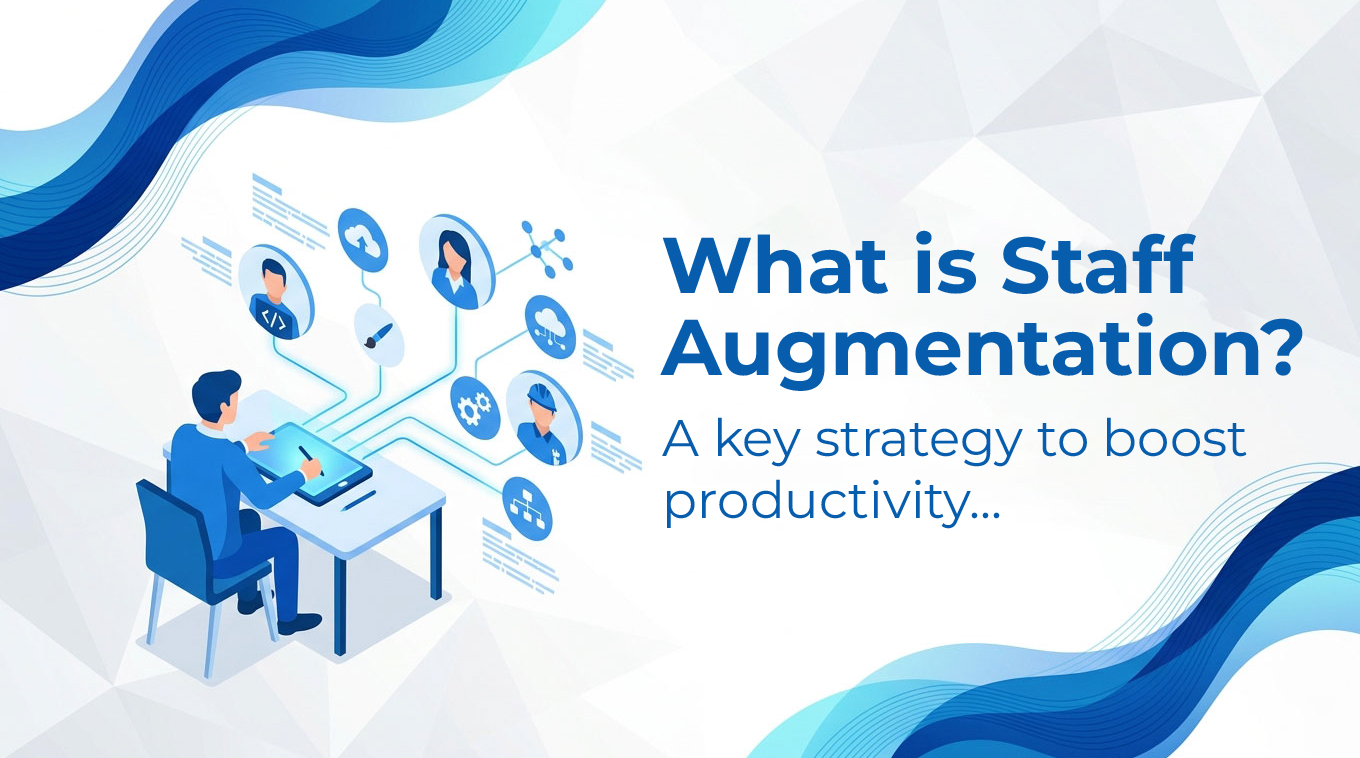
Staff augmentation is a flexible workforce model where you temporarily add external professionals to your existing team to fill skill gaps, handle short-term projects, or scale capacity quickly. The external talent works directly under your management, uses your tools, follows your processes, and reports to your leadership, just like internal employees.
The key distinction matters. You keep full control over the roadmap, project direction, and daily tasks. The staffing partner handles sourcing, vetting, contracts, payroll, and administrative overhead. You get the people, they handle the logistics.
Think of it as extending your team rather than replacing it. A fintech startup needing a senior React developer for three months does not go through a full hiring cycle. A healthcare company rolling out a new EHR system does not hire five permanent engineers for a nine-month project. Both bring in augmented talent, ship the work, then scale down when the initiative ends.
The model traces its roots to IT and engineering, where specialized skills move faster than traditional hiring can keep up. Today it covers software development, cybersecurity, DevOps, data engineering, AI and ML, cloud architecture, QA testing, and dozens of other technical disciplines.
How Does Staff Augmentation Work? The Step-by-Step Process
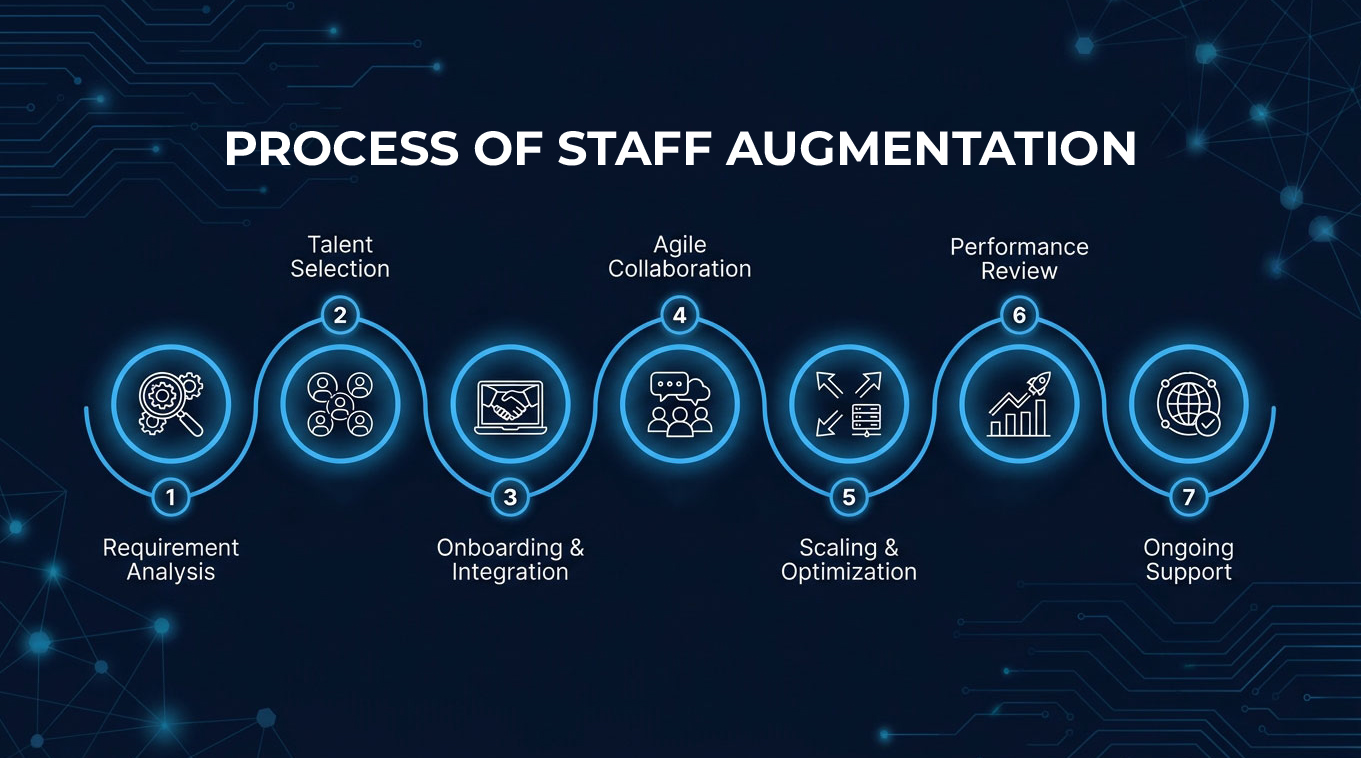
The staff augmentation process is simpler than most companies expect. A good staffing partner can move from first call to productive team member inside two to three weeks. Here is exactly how it flows.
Step 1: Identify Your Needs and Skill Gaps
Start by mapping what is missing. Not every project needs augmentation, and vague requirements produce vague hires. Define the technical skills required, the seniority level, the project duration, the working hours or time zone overlap, and the measurable outcomes you expect.
A sharp brief looks like this: senior Python developer with FastAPI and AWS experience, six months, 4 hours daily overlap with EST, delivering the payment service refactor against defined sprint goals.
Step 2: Choose the Right Engagement Model
Different needs call for different models. Onshore works best when you need in-person collaboration or strict compliance. Nearshore gives you time zone alignment with moderate cost savings. Offshore unlocks the largest talent pool and the strongest cost efficiency, often 40% to 60% below local rates.
You also pick between short-term project-based engagements, long-term dedicated capacity, team-based augmentation where you bring in a cohesive unit rather than individuals, and specialized skill augmentation for niche roles like AI engineers or cloud architects.
Step 3: Select a Staffing Partner
Not every provider delivers the same quality. Evaluate partners on five things: industry specialization, vetting rigor, speed of candidate delivery, track record with similar projects, and contract flexibility including replacement policies and conversion options if you later want to hire someone full-time.
Ask for references. Ask how they handle underperformers. Ask whether they carry a bench of pre-vetted professionals or start recruiting only after you sign.
Step 4: Review and Interview Candidates
A strong provider delivers a shortlist of three to five pre-vetted candidates within a week. Your job is final selection. Review profiles against standardized criteria, test technical proficiency through code samples and scenario-based problems pulled from your actual challenges, and run structured interviews that probe both technical depth and communication skills.
Skipping this step is where engagements fail. Technical fit gets you 50% of the way. Cultural alignment and communication style cover the rest.
Step 5: Contract and Onboarding
Once selected, the provider handles contracts, NDAs, compliance, and payroll. Your side owns onboarding. Grant system access before day one, including repository permissions, CI/CD access, project tools, and communication platforms. Assign an integration buddy from your existing team for day-to-day questions. Share documentation covering architecture decisions, coding standards, and deployment procedures.
Companies with structured onboarding programs see roughly 50% higher productivity from augmented staff compared to ad-hoc approaches.
Step 6: Integration and Active Management
Treat augmented staff as full team members. Include them in stand-ups, planning sessions, code reviews, and Slack channels. The us-versus-them dynamic kills productivity faster than any technical gap. Set clear performance baselines before the engagement starts so you can measure whether output meets expectations.
Step 7: Scale, Extend, or Transition
As the project evolves, scale up or down based on need. Good providers offer contract flexibility, replacement policies for underperformers, and conversion options if you want to bring augmented staff onto payroll permanently. Document everything during the engagement so knowledge transfers cleanly when contracts end.
Types of Staff Augmentation Models
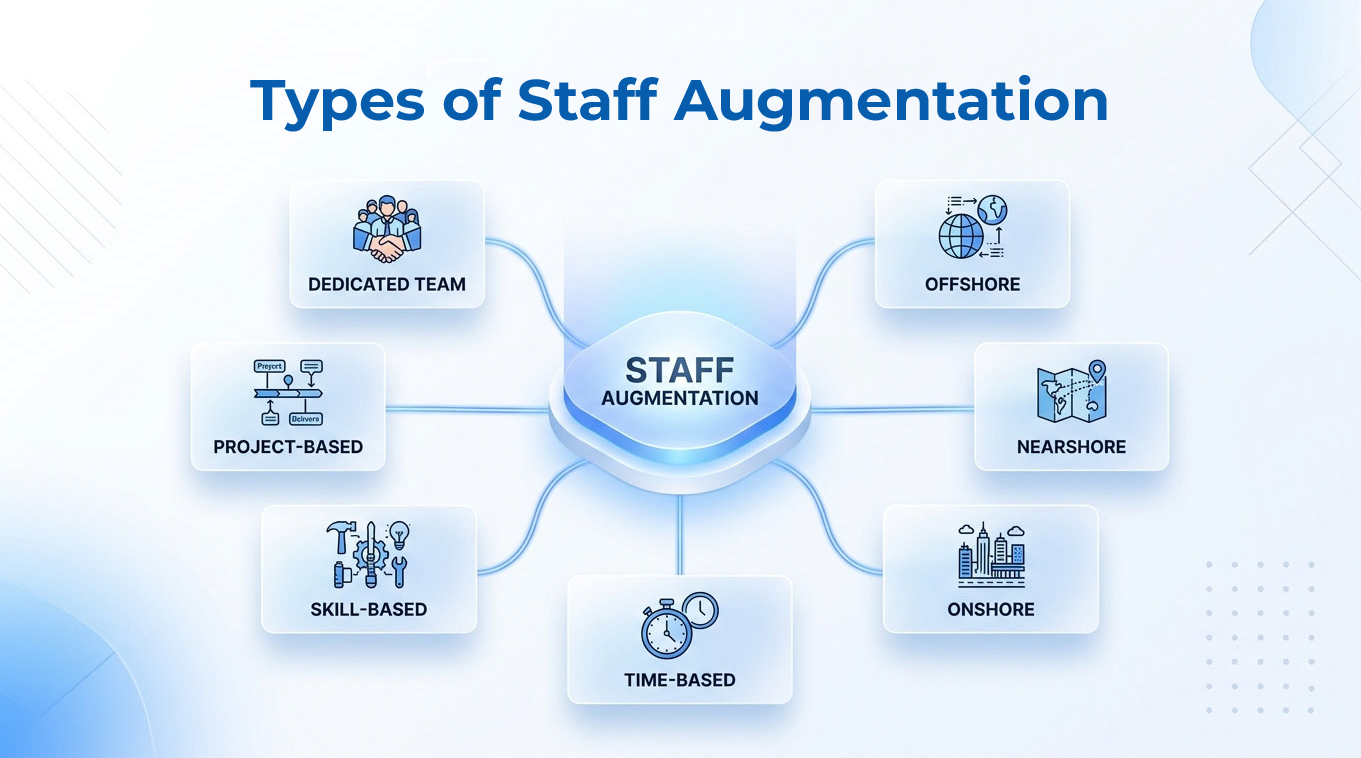
Staff augmentation is not one-size-fits-all. Here are the main models you will encounter.
Short-term augmentation covers sprints, one-off deliverables, or unexpected absences. Engagements typically run from a few weeks to three months. Best for tight deadlines and defined scopes.
Long-term augmentation embeds skilled talent for six months or longer. Common for product development, platform modernization, or ongoing capacity needs where permanent hiring does not make sense.
On-demand augmentation handles sudden needs without advance planning. Seasonal demand, emergency coverage, or rapid scaling fits here. Scope and duration vary widely.
Skill-based augmentation targets specific expertise gaps. You need one cloud architect, one ML engineer, or one senior DevOps lead, not a full team.
Team-based augmentation adds a cohesive group rather than individuals. Useful for accelerating multiple workstreams or replacing an entire capability layer. Common in nearshore arrangements.
Contract-to-hire gives you a trial period before making someone permanent. Reduces hiring risk significantly for roles where long-term fit matters.
Build-Operate-Transfer (BOT) lets a provider build and run your offshore team, then transfer ownership to you after two to three years. Popular for companies establishing permanent offshore presence.
Staff Augmentation vs Outsourcing vs Managed Services
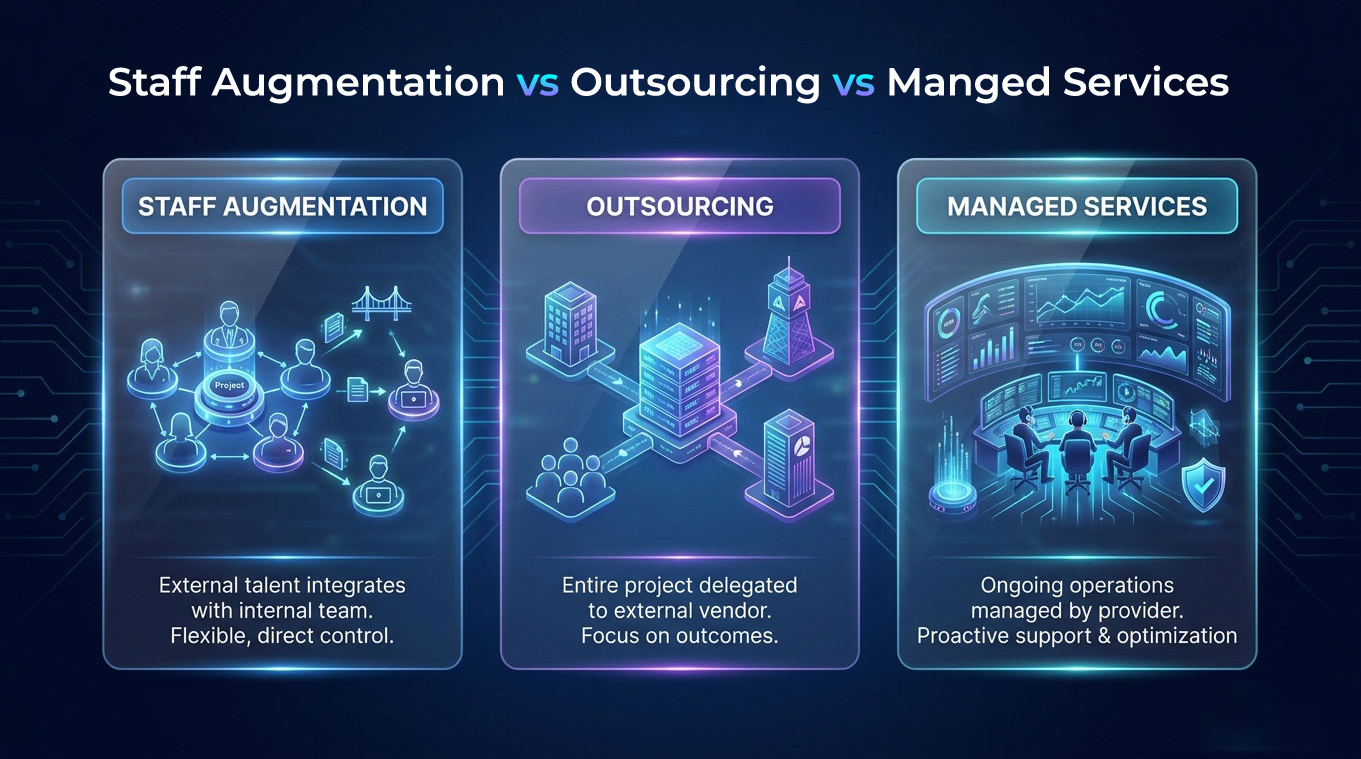
These three models get confused constantly, and the wrong choice wastes budget. Here is how they actually differ.
Staff augmentation extends your team with external talent who work under your management. You own the roadmap, assign tasks, and direct daily work. Pricing is typically hourly or daily. Best for defined skill gaps where you have strong internal leadership.
Outsourcing hands an entire project or function to a vendor who delivers a defined outcome under their own management. You specify requirements, they execute. Pricing is often fixed-scope or milestone-based. Best for clearly scoped projects where you want to offload execution.
Managed services transfers ongoing responsibility for operations or infrastructure to a provider under a Service Level Agreement. Think 24/7 cybersecurity monitoring, cloud infrastructure management, or helpdesk operations. Pricing is typically recurring monthly fees. Best for mature, stable functions you want to stop managing internally.
The simplest way to decide: if you have product leadership and want to stay close to execution, choose augmentation. If you need someone to own delivery of a scoped project, choose outsourcing. If you want predictable uptime on ongoing operations, choose managed services.
Many companies run all three in parallel. Augmented engineers build the new product while a managed services provider handles cloud infrastructure and an outsourcing partner delivers a one-off mobile app.
Key Benefits of Staff Augmentation
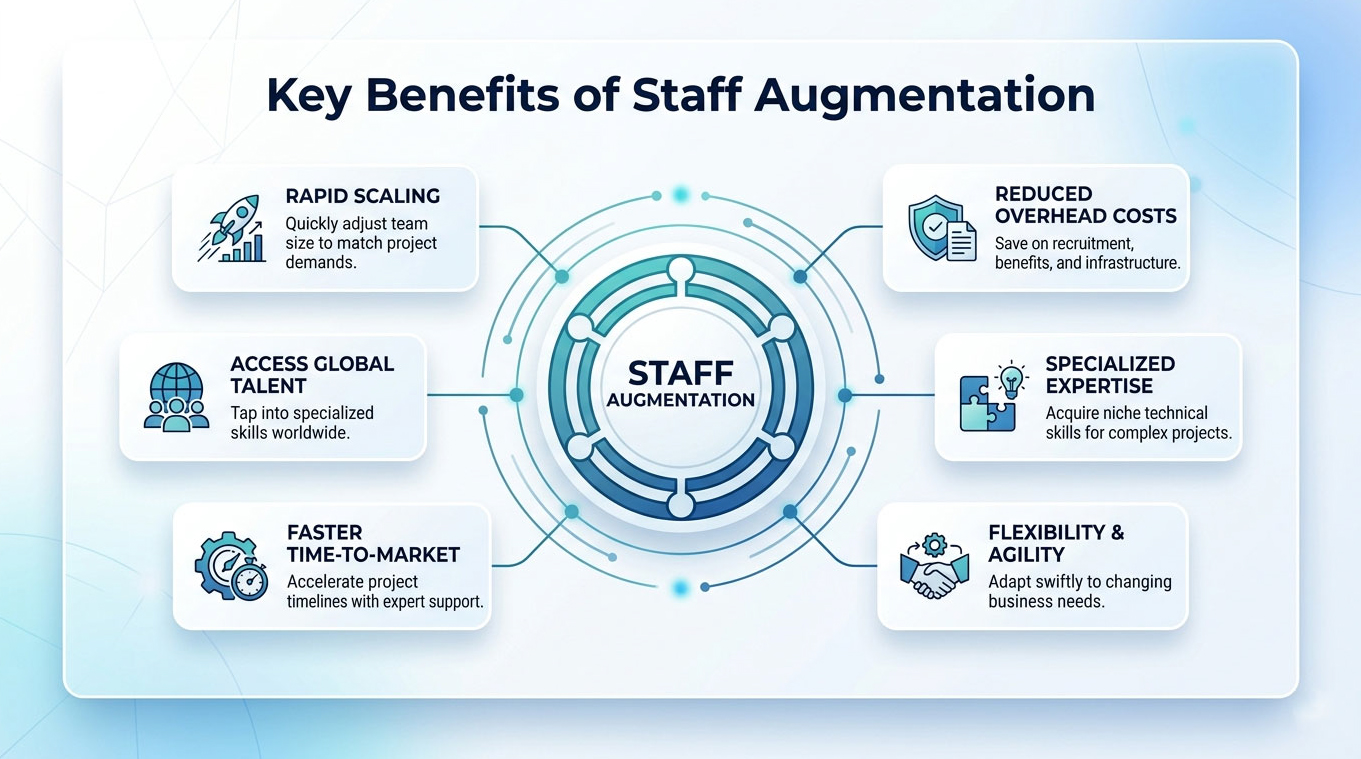
The numbers explain why 61% of tech companies plan to increase their use of staff augmentation in 2026.
Speed matters. Traditional hiring takes 42 to 52 days for technical roles. Staff augmentation drops that to 7 to 10 days because providers pull from pre-vetted talent pools. On critical projects, a month of delay can mean missing a product launch window entirely.
Cost efficiency is real. Companies save 35% to 50% compared to full-time hires when you factor in benefits, equipment, office space, and the roughly 30% overhead load on US salaries. Offshore augmentation can push total labor cost savings to 65% on equivalent roles according to The Hackett Group’s 2025 Global Benchmark Report.
Access to specialized skills that are genuinely hard to hire locally. AI engineers, cloud architects, cybersecurity specialists, and senior DevOps leads are in short supply everywhere. Global augmentation opens access to talent pools you cannot reach through local recruiting.
Scalability without commitment. Ramp up during product launches, ramp down when the project ships. No layoffs, no severance, no hiring freezes hanging over your team.
Reduced hiring risk. A mis-hire on a full-time role costs roughly 80% of their annual salary in lost productivity. Augmented staff come with replacement guarantees and shorter feedback loops, so mistakes cost weeks instead of quarters.
Retained control. Unlike outsourcing, you keep ownership of architecture, priorities, and technical decisions. The augmented engineers fit into your workflow rather than operating in a parallel universe.
Speed to market. Across projects, augmentation typically accelerates delivery timelines by 30% to 50% depending on complexity and team composition.
Common Challenges and How to Solve Them
Staff augmentation is not a silver bullet. These are the real challenges teams face and the ways smart companies handle them.
Integration friction is the most common problem. Augmented staff feel like outsiders, miss context, or get excluded from decisions. Solution: treat them as full team members from day one with equal access to meetings, documentation, and decisions.
Knowledge retention becomes a risk when key project knowledge walks out with contractors. Solution: require documentation as a deliverable, not an afterthought. Architecture decisions, API contracts, deployment procedures, and lessons learned all need to live in your systems.
Time zone gaps can slow distributed teams. Solution: require a minimum overlap window (typically 3 to 5 hours with your core team) and invest in async communication practices.
Data security concerns matter especially in regulated industries. Roughly 47% of companies cite this as a top challenge. Solution: strong NDAs, access controls scoped to what each person actually needs, and regular security reviews. Providers serving finance, healthcare, or government should carry SOC 2, ISO 27001, or similar certifications.
Quality variance across providers is real. Not every staffing firm vets the same way. Solution: test candidates yourself, start with a small engagement before scaling, and require replacement clauses in contracts.
Cultural and communication gaps can reduce productivity on offshore engagements. Solution: prioritize providers who invest in English proficiency testing and cultural alignment, and build in regular video check-ins rather than relying only on chat.
When Should You Use Staff Augmentation?
Staff augmentation works best in specific scenarios:
- Filling a critical skill gap for a defined project or initiative
- Scaling engineering capacity during product launches or peak periods
- Accelerating delivery against aggressive deadlines
- Accessing niche expertise like AI, blockchain, or specialized security work
- Covering parental leave, sabbaticals, or sudden departures
- Testing a role before committing to a permanent hire
- Supporting digital transformation initiatives with finite timelines
- Handling seasonal demand spikes in IT, retail, or logistics
It is a poor fit when you need someone to own delivery with minimal internal oversight, when you lack product leadership to direct the work, when the project requires years of embedded institutional knowledge, or when budget predictability matters more than flexibility. In those cases, outsourcing or managed services are the better call.
The 2026 Staff Augmentation Market at a Glance
The global staff augmentation services market grew from $6.89 billion in 2024 to roughly $7.35 billion in 2025 and is projected to reach $11.94 billion by 2032, growing at 7.11% CAGR.
Broader estimates that include the full staffing industry place the global market at around $132 billion in 2025 with projections of $200 billion by 2028, reflecting how deeply the contingent workforce model has embedded itself in modern business operations.
Regional distribution: North America holds roughly 38% of global market share, Europe 27%, Asia-Pacific 25%, and the Middle East and Africa 10%. North America leads because of high digital maturity and continuous technology upgrades, while Asia-Pacific grows fastest as global companies tap into its talent pools.
Industry adoption trends for 2026:
- 62% of enterprises use staff augmentation to manage dynamic workloads
- 68% prioritize it for workforce flexibility
- 64% are adopting remote staffing models
- 58% favor project-based hiring over traditional contracts
- 46% are integrating AI-driven staffing tools into their talent matching
The software industry accounts for roughly 40% of total IT staff augmentation demand, followed by financial services, healthcare, and manufacturing.
How to Choose the Right Staff Augmentation Partner
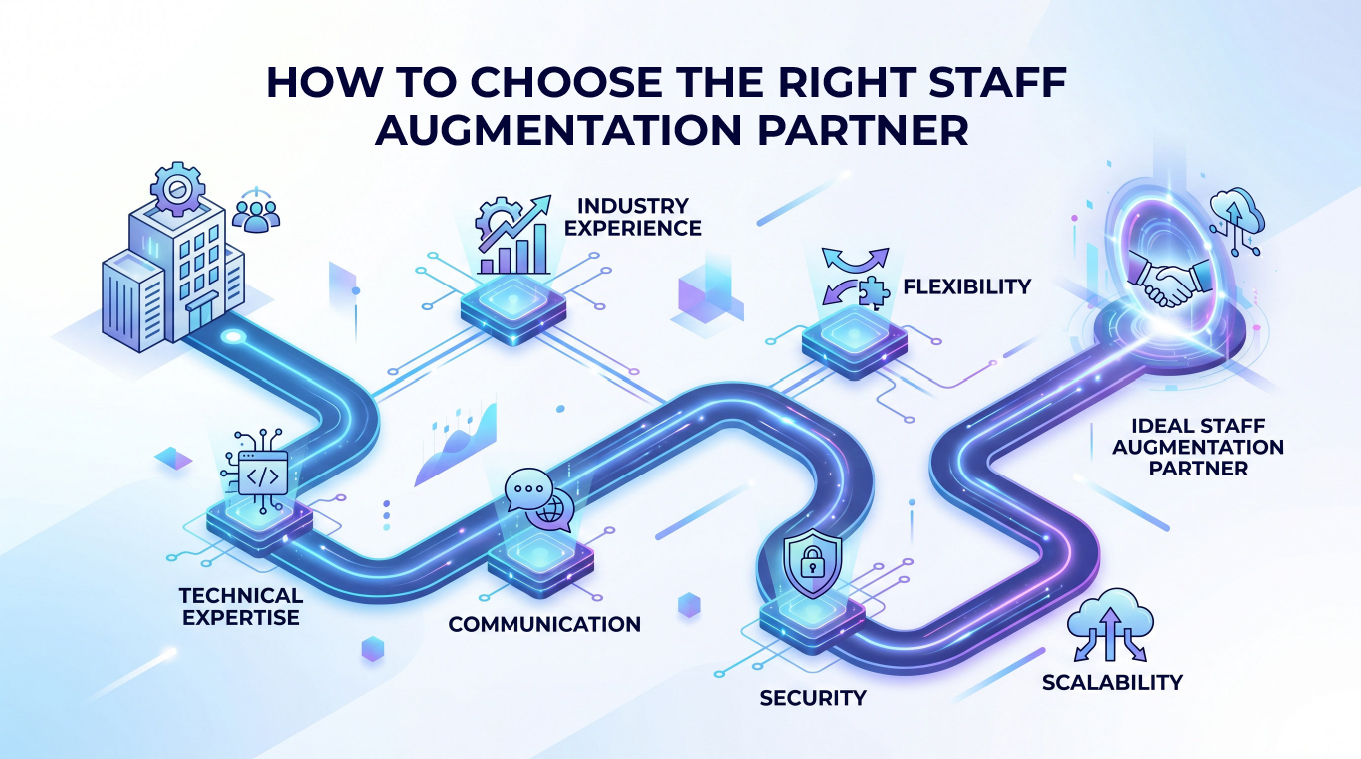
Partner selection determines whether augmentation works or fails. Focus on six factors.
Industry specialization. A provider who has worked extensively in your sector understands your compliance needs, terminology, and typical project structures. Generalist firms often send mismatched candidates.
Vetting process. Ask exactly how they screen. Technical assessments? Code reviews? Cultural interviews? Reference checks? A rigorous process means fewer bad hires on your end.
Speed and bench depth. Can they deliver candidates in a week or do they start recruiting only after you sign? Providers with active benches move faster.
Contract flexibility. Look for replacement policies, notice periods for scaling down, and conversion options for permanent hiring. Rigid contracts cost you when priorities shift.
Transparency on pricing. Avoid providers who hide margins or refuse to break down rate cards. Clear pricing makes budgeting predictable.
Post-placement support. The best providers stay engaged after placement, handling performance issues, scope changes, and transitions. The worst disappear the moment the contract is signed.
Before signing, request three reference calls with clients who used similar roles. Ask about ramp-up time, quality of work, and what happened when things went wrong.
Conclusion
Staff augmentation has moved from a tactical hiring workaround to a core workforce strategy. The data backs it up: faster time-to-hire, 35% to 65% cost savings, access to global talent pools, and measurable speed-to-market gains.
The model works when you match it to the right situation. Defined skill gaps, project-based work, aggressive deadlines, and specialized expertise needs all fit. Vague scope, missing product leadership, and deeply embedded institutional knowledge do not.
Start small if you are new to augmentation. Run one engagement with a reputable provider, measure the results against clear KPIs, and scale from there. The companies winning in 2026 are not the ones hiring fastest. They are the ones building the most flexible, scalable, and specialized teams possible, often by combining internal talent with augmented specialists across the full stack of their operations.
If you are evaluating whether staff augmentation fits your next initiative, start by writing a one-page brief covering the skills, duration, budget, and outcomes you need. That document alone will tell you whether this model is the right call, and it will save you weeks of misaligned conversations with potential partners.
Frequently Asked Questions
What is the main goal of staff augmentation? The primary goal is to quickly add skilled professionals to your existing team to fill specific skill gaps, scale capacity for a project, or access specialized expertise without the time and cost of permanent hiring.
How long does the staff augmentation process take? From first call to onboarded team member, expect 2 to 3 weeks. Traditional hiring for the same role typically takes 6 to 8 weeks minimum.
How much does staff augmentation cost? Rates vary by geography, seniority, and skill. US-based senior developers typically run $100 to $200 per hour, nearshore Latin American talent $50 to $90, and offshore talent in India, Pakistan, or the Philippines $25 to $60. Total cost savings versus full-time US hires average 35% to 50%.
Does staff augmentation work for startups? Yes. Startups benefit most from skill-based and on-demand models because they need flexibility without long-term commitments. A two-person founding team can ship a full product by augmenting with three to five specialists during build phases.
What is the difference between staff augmentation and outsourcing? Staff augmentation extends your team under your management while outsourcing hands an entire project to a vendor who delivers a defined outcome under their own management. Augmentation keeps control with you. Outsourcing transfers it.
Can augmented staff be converted to full-time employees? Most providers include contract-to-hire or conversion options. Fees typically range from zero (after a minimum engagement period) to a buyout fee equivalent to 10% to 25% of annual salary if you convert early.
Is staff augmentation the same as freelancing? No. Freelancers work independently and you manage everything directly. Augmentation involves a staffing partner who handles vetting, contracts, compliance, and payroll, with professionals typically working full-time on your engagement.