ABOUT
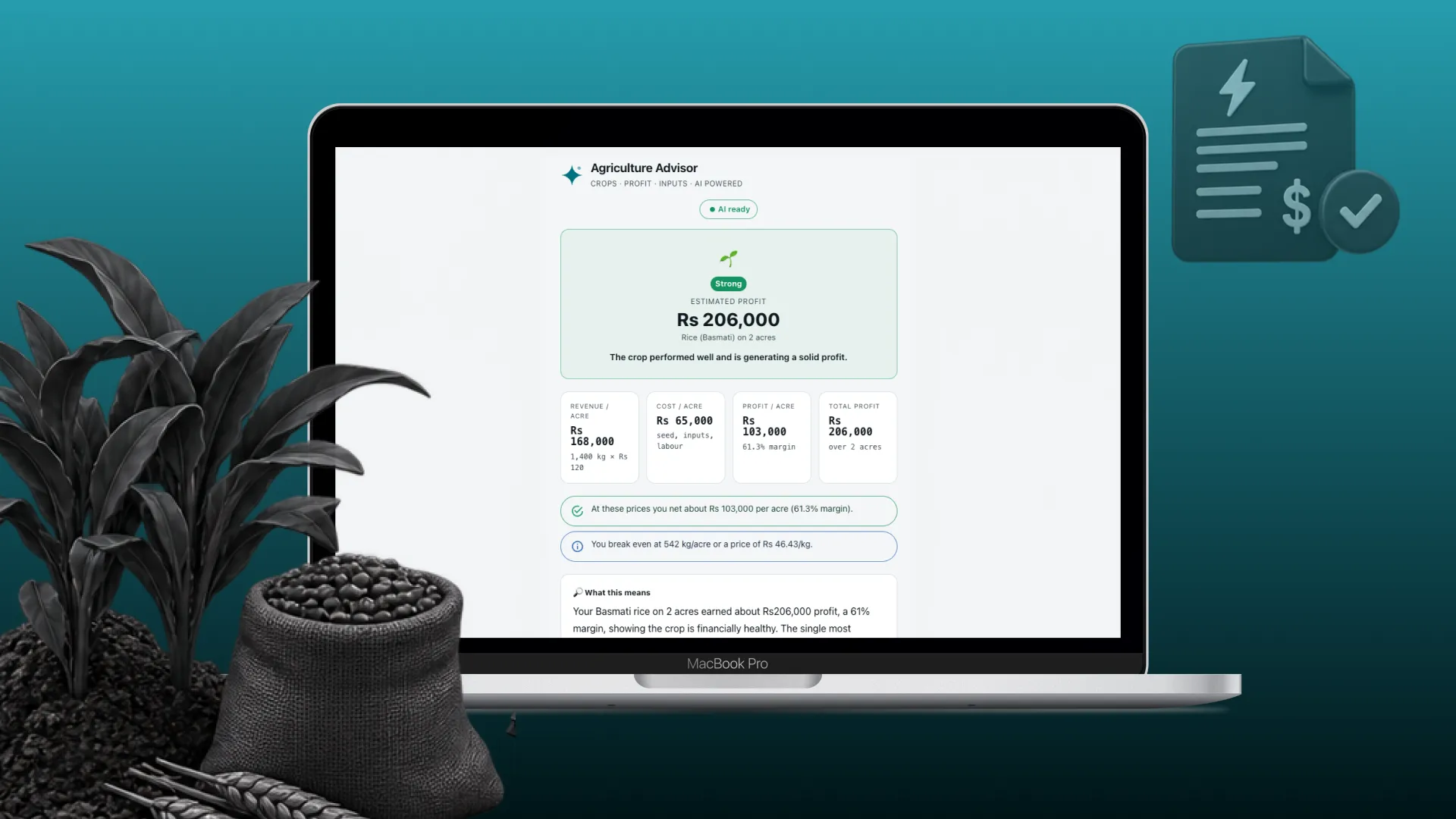
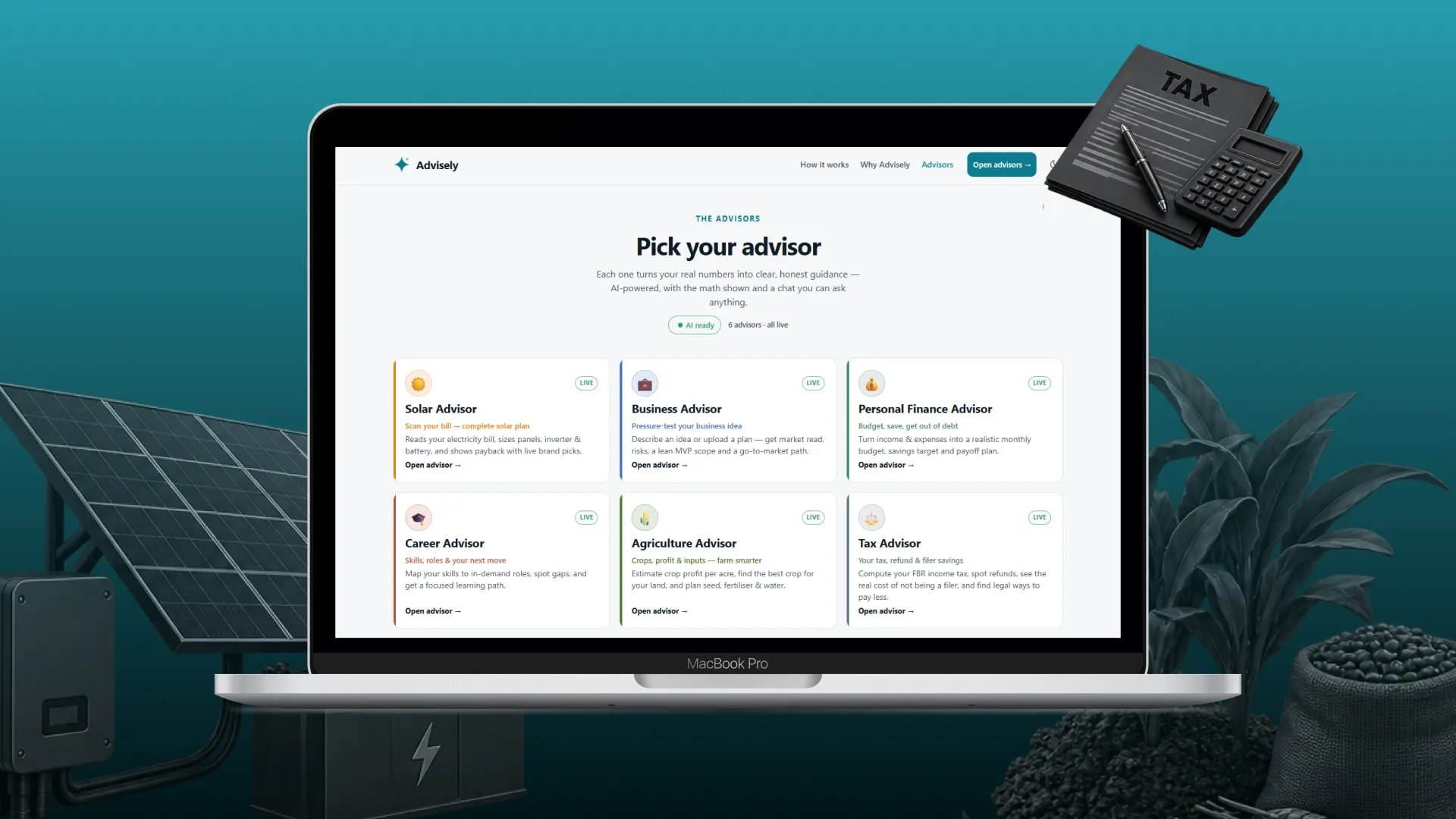
Advisely is a decision-advisor web app that packages six domain advisors behind one consistent experience: the user answers a short form, the application runs transparent calculations, and a language model layers judgement and plain-English explanation on top — without ever inventing the numbers. The advisors cover solar installation, business health, personal finance, career direction, agriculture and tax. The guiding principle is “nothing hidden”: every result screen shows the exact formula, the assumptions used, and whether each value came from the user or a default.
THE PROBLEM
Tools that help people make financial and life decisions usually fail in one of two ways.
Black-box calculators produce a number with no visible working. The user cannot see how it was derived or sanity-check it against their own situation, so either they act on a figure they do not understand, or they ignore the tool entirely.
Pure chatbot advisors fail differently. They are fluent and comfortable to use, but they generate numbers as text, which means they can produce a confident, well-written figure that is simply wrong. Where someone is deciding whether to spend money on a solar installation or how much tax they owe, that is a serious problem rather than a rough edge.
The product needed the approachability of the second without the risk, and the reliability of the first without the opacity.

THE SOLUTION
The product thesis was to split the two jobs and never let them mix. Deterministic code owns every figure a person acts on; the AI owns interpretation, tone and next steps.
Each advisor follows the same layered pattern. A service layer holds the pure maths and is the single source of truth for numbers; a controller orchestrates the sequence; a constants layer holds market and benchmark assumptions in one visible place. The AI is called only after the calculation has finished, and only reads the resulting numbers — it has no route through which to fabricate one.
The Solar Advisor is the clearest expression of this. It answers one practical question — is going solar worth it, and how long until it pays back? — from a single everyday input, the user’s electricity usage or monthly bill. Code converts consumption into a recommended system size and expected generation, then estimates installation cost, the monthly bill offset and the payback period. The AI layer pulls current component pricing where available; when the daily quota is exhausted it falls back transparently to a baseline price and says so on screen.
The same shape carries across the other five: margin, break-even, runway and LTV:CAC for business; budget splits, debt-avalanche ordering and savings projections for personal finance; skill-fit scoring and gap analysis for career; profit per acre and break-even yield for agriculture; and slab-based calculation with effective and marginal rates for tax. Every result screen exposes its formulas inline, and the AI adds context and next steps around them.

THE OUTCOMES
Advisely delivers advice users can check. Because every figure is computed rather than generated, the same inputs always produce the same result, and the “nothing hidden” card lets a sceptical user follow the arithmetic themselves — which is what makes the AI’s commentary worth reading rather than something to second-guess.
The architecture also degrades gracefully: with no AI key or the quota exhausted, the deterministic results still render in full and the user receives generic guidance instead of tailored insight. The product never goes dark because a third party did.
End-to-end testing was run across all six advisors, with every deterministic calculation verified by hand against the on-screen breakdowns; each advisor’s maths reconciled, and the price fallback behaved correctly when the AI quota was exhausted.
The project demonstrates a pattern we apply wherever AI touches numbers people act on: compute what can be computed, and use the model for the judgement and explanation it is genuinely good at.