ABOUT
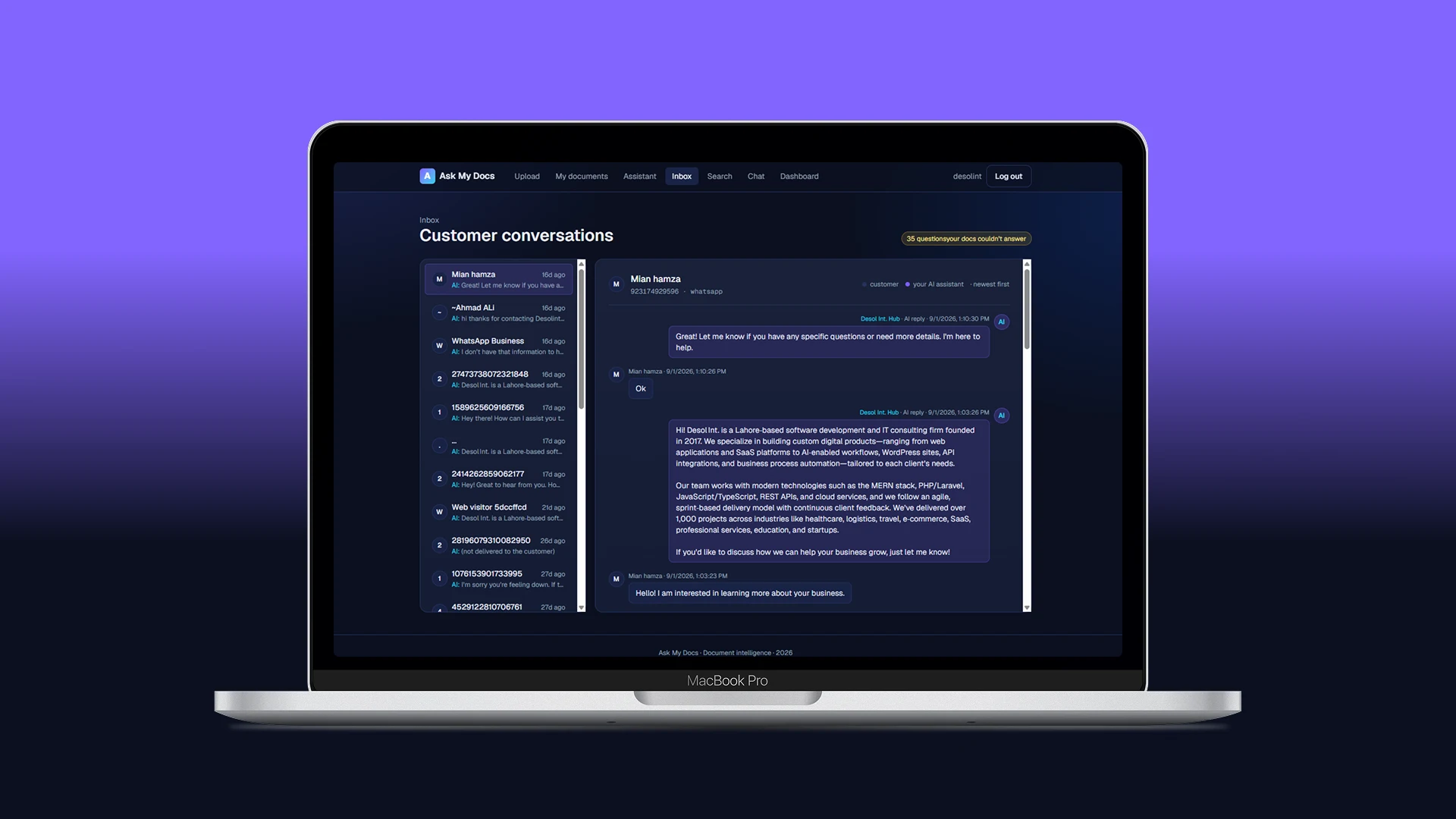
Ask My Docs is a customer-support platform for small and mid-sized businesses, delivered as a web application. A business puts in the material it already has — a price list, a refund policy, an FAQ, a photograph of the loyalty card terms — and gets a public assistant that answers customer questions around the clock, in the customer’s own language, using only that material. Each business gets its own hosted chat page, a WhatsApp connection, and one inbox holding every conversation. We designed and delivered the complete product, live at askmydocs.desolint.com.
THE PROBLEM
Small businesses answer the same handful of questions forever — opening hours, delivery cost, refund window, whether the pastries contain nuts. The answers exist, but they are spread across a price list, a policy document and a note nobody has opened in a year. The customer asks anyway, and someone has to stop what they are doing and reply.
The obvious fix has been worse than the problem. A general-purpose chatbot will state a refund window or a price it was never told, confidently and in the business’s own voice — harmless while brainstorming, disastrous when the person asking is about to buy. Scripted bots avoid inventing, but only answer questions somebody anticipated — which is the work the owner was trying to avoid.

THE SOLUTION
We built Ask My Docs so the knowledge base is whatever the business already wrote, and so the assistant’s failure mode is admitting ignorance rather than filling the gap.
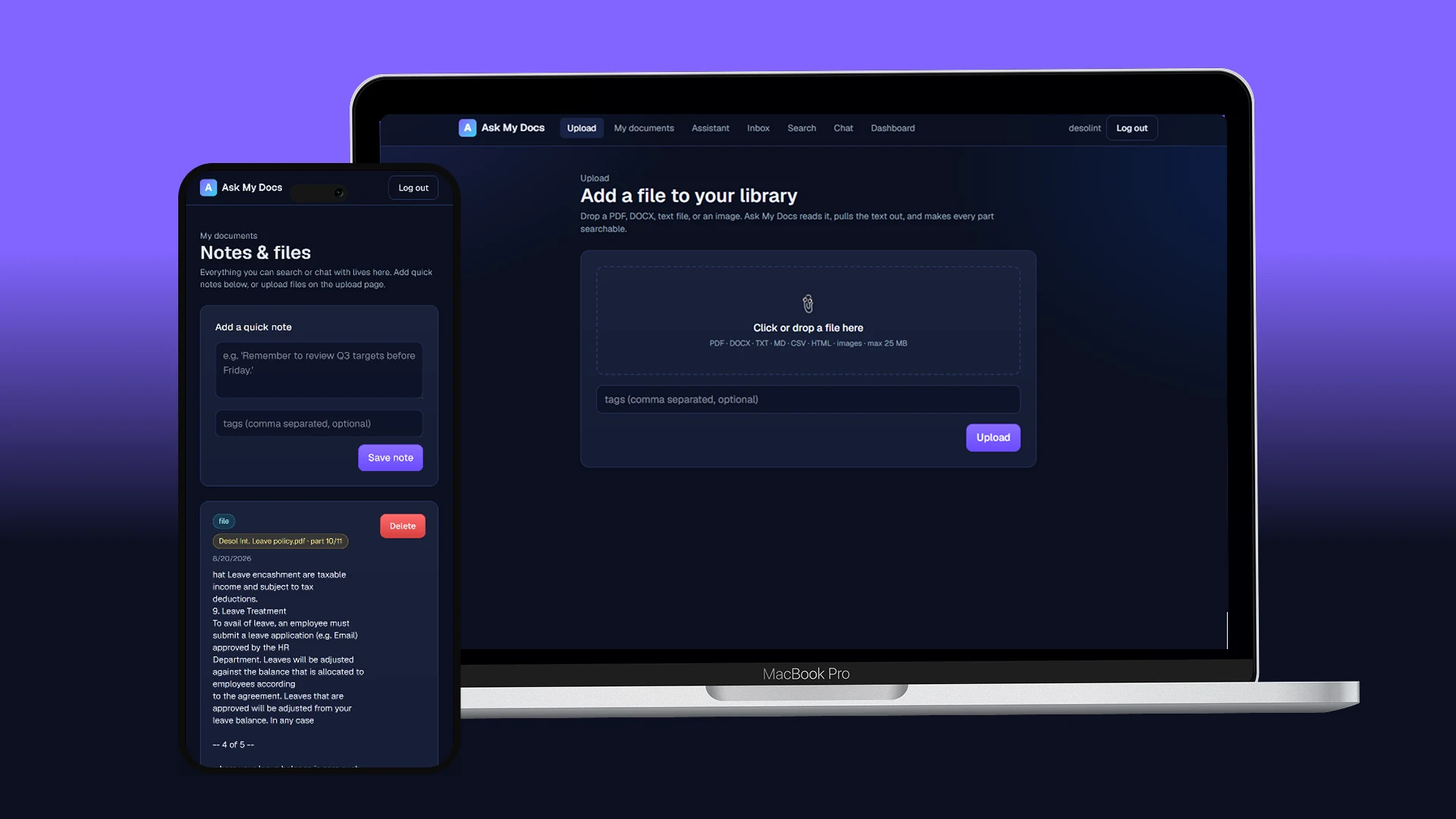
Knowledge in the form it already exists. Files are uploaded — PDF, Word, CSV, Markdown, HTML, plain text — then read, split into passages and indexed. Images take the same route: text inside a photographed price list, a scanned invoice or a screenshot of loyalty terms is pulled out and indexed with everything else. Alongside uploads the owner types short notes, and ten honest notes outperform one large brochure. Anything in the library can be edited or deleted, and answers change at once.
Retrieval by meaning, not keyword. A question is matched against the library semantically, and the candidates are then reranked by a cross-encoder that scores each passage against the question directly. A customer who says they cannot drink cow’s milk reaches a note that only ever mentions oat, soy, almond and coconut.
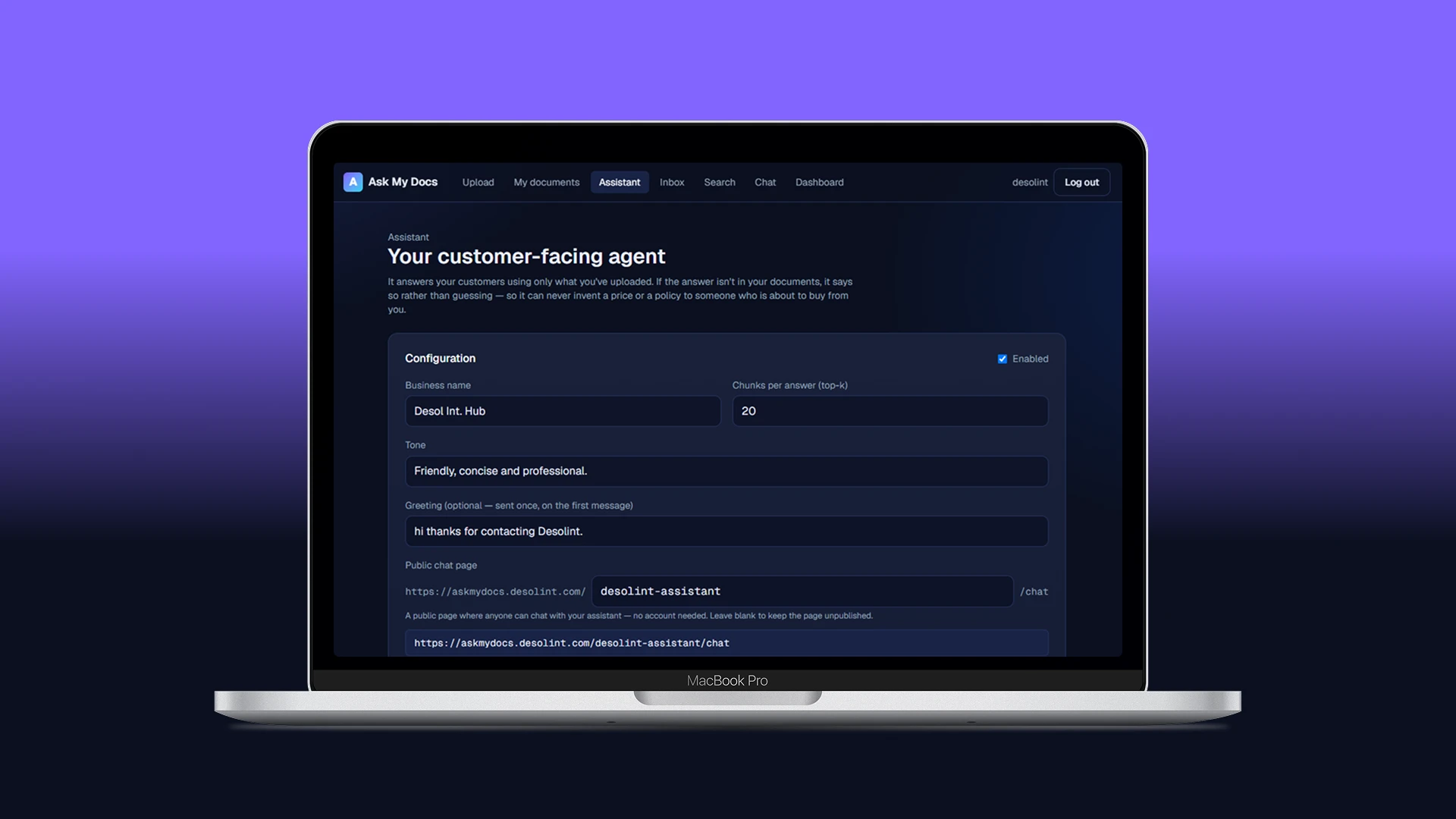
A grounding rule the answer cannot escape. The assistant replies only from retrieved passages. Where the library does not cover the question it sends the fallback line the owner wrote — a handover to a human — rather than guessing. Tone, greeting and fallback are each set in a sentence, and a question in any language is answered in that language from the same English documents.
One inbox behind every channel. The public chat page and WhatsApp Business are live, with Messenger and Instagram to follow; whichever channel a question arrives on, it is answered from the same library and lands in the same inbox. That inbox closes the loop: within a week an owner knows the five questions customers actually ask, adds a note for each, and the assistant answers them from then on.
A private workspace for the owner. A separate chat over the whole library returns numbered citations that expand into the passages used, and a test box runs the same code path a real customer message takes, so a new upload is checked in seconds. Each library is isolated from every other, and customers see answers, never the documents behind them.
THE OUTCOMES
Ask My Docs removes the setup cost that stops small businesses automating support. The demo shipped with the product runs on ten short notes and three files, and answers delivery, allergen, pricing and booking questions across languages from that alone. Most owners are answering real questions within ten minutes of registering.
Two design decisions carry most of that value. Grounding every answer in retrieved passages, with an owner-written fallback when nothing matches, means a wrong answer signals a document that is wrong or out of date — fixable by editing a note. And treating the inbox as the feedback loop turns each unanswered question into the note that answers it next time, so the library improves through use.
The project demonstrates our ability to build a multi-tenant retrieval-augmented product end to end — document and image ingestion, semantic search with reranking, a strictly grounded assistant and multi-channel delivery — designed around what actually stops businesses trusting an AI in front of customers.