
ABOUT
KontextCore is an assistant that answers a team’s questions from their own company documents — policies, handbooks, contracts, standard operating procedures — and shows each person only what they are allowed to see. Companies upload the files they already have, in the formats they already exist in, and employees ask questions in plain language. It supports multiple organisations side by side, which suits groups, franchises and holding companies.

THE PROBLEM
Every company accumulates documents nobody reads. They are written once, filed carefully, then never opened again. So people ask a colleague instead, and the same handful of questions get answered over and over by the people who can least afford the interruption.
An assistant that reads those documents and answers in plain language removes the interruptions. It also creates a problem: the moment more than one team uses it, some answers are not meant for everybody. Salary bands, contracts and team-specific material cannot be exposed to whoever happens to ask.
Finding the answer turns out to be the easy half — anyone can put a chat box in front of a model. The hard part is making certain it never surfaces the wrong document for the wrong person, and that has to be decided early, because retrofitting permissions onto a system that already answers questions is a much larger job than building them in.

THE SOLUTION
We built KontextCore so that document access rules govern what the assistant can read, not merely what it displays.
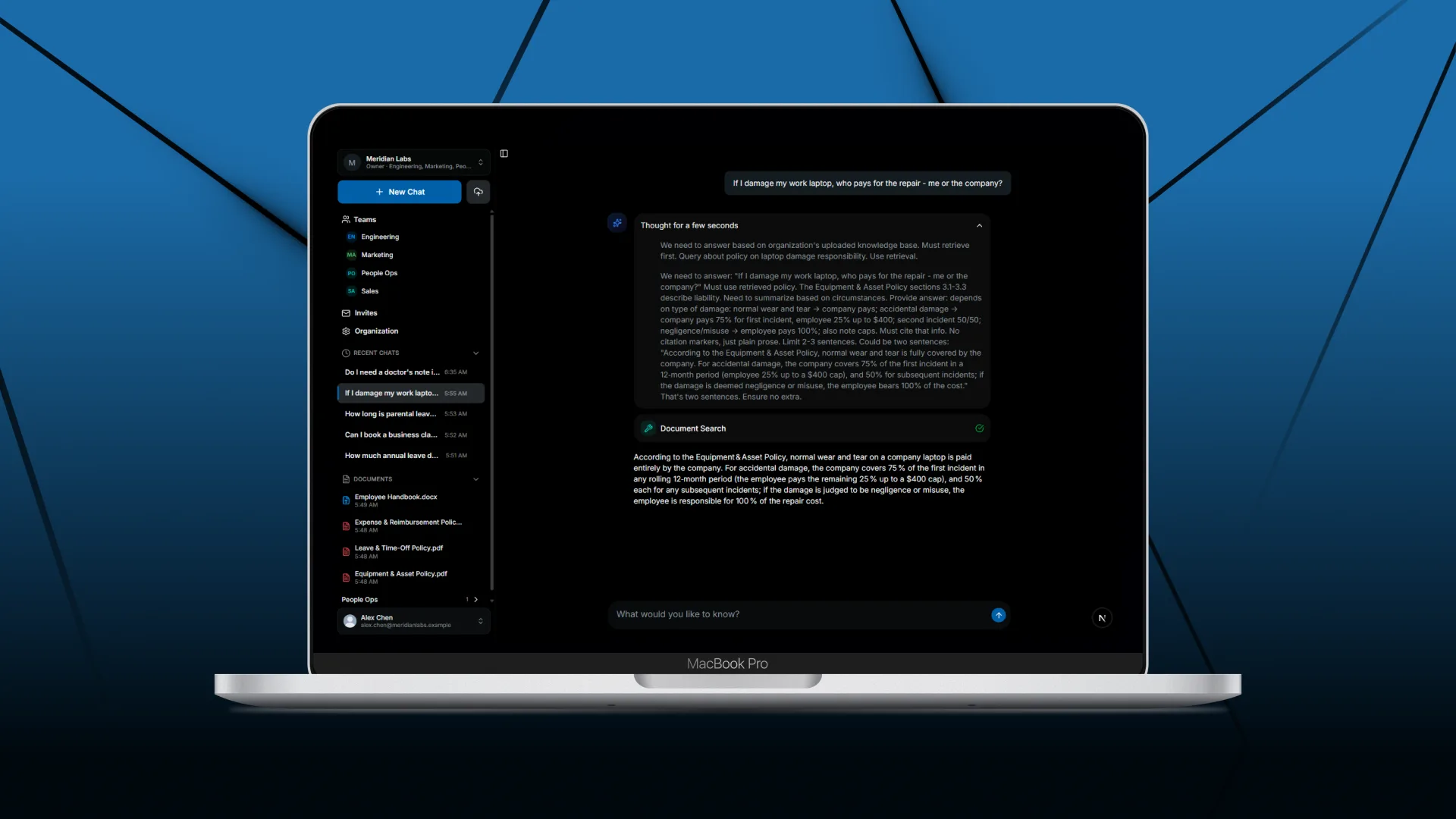
Answers from your own files, with the working shown. Employees ask the way they would ask a colleague — no search syntax, no training session. Responses come from uploaded documents rather than the open internet, and the assistant shows which document it read to get there. Any answer can be opened up to reveal how it was reached, including what was searched for and how it arrived at the wording on screen, which turns a reply a manager would have to take on trust into one they can check.
Documents as they already exist. PDF, Word and PowerPoint files upload without reformatting or cleaning. Processing happens in the background, each file reports an honest status — waiting, processing, ready or failed — where “ready” means genuinely searchable rather than merely uploaded, and deleting a document removes it from what the assistant knows so it cannot resurface later. Tables, figures, formulas, diagrams and other alphabets all display properly.
Permissions the assistant itself obeys. The usual approach puts every file into one pile and searches all of it, which stops being safe the moment documents have different audiences. Here a restricted document is invisible to the assistant, not merely hidden from a list — because a hidden file could still be read while composing an answer. A document is either company-wide or restricted to a single team; an owner sees everything, and everyone else sees companywide documents plus those of teams they belong to. Administrators get no exemption: someone who can add and remove people from a team still cannot read that team’s documents unless they are a member, because running a team and reading its files are two different privileges.
Separation between organisations. Switching between companies is checked on our side, not asserted by the browser, and a request for another company’s resource is answered with “there is no such thing” rather than “you are not allowed” — the second answer confirms the thing exists. Roles, single-use invitations with a seven-day expiry, per-company branding and email or Google sign-in complete the product.
THE OUTCOMES
KontextCore turns filed-and-forgotten documents back into something people use. In testing, an employee asked the sort of question HR fields a dozen times a month — whether a doctor’s note is needed for sick leave — and got a straight answer, then followed up conversationally and surfaced a clause near the end of a leave policy almost nobody reads that far into: illness during annual leave can be reclassified, and the holiday given back. That is exactly the kind of entitlement employees quietly lose. Nothing was scripted, and every answer came from files uploaded minutes earlier.
Because permissions are enforced at the retrieval layer, the assistant can be switched on for everyone at once rather than piloted with a small group while somebody works out what it might say to whom.
The project demonstrates our experience building retrieval-based assistants over private company data, where the engineering that matters is not generating an answer but guaranteeing who is allowed to receive it.
