
ABOUT
MedMind is an AI-powered healthcare platform built for clinics and the doctors who work in them. It combines a web application for patients and doctors with a companion mobile app used at the point of care, both kept in sync in real time. The goal of the project was to remove the administrative weight of clinical documentation so that doctors spend more of a consultation with the patient and less of it with a keyboard, while giving patients a trustworthy place to learn about common conditions.

THE PROBLEM
In most clinics, the record of a consultation begins life as a handwritten prescription. Someone then has to read that paper and type it into a system — patient details, diagnosis, medicines, dosage, frequency, duration, clinical notes. It is slow, it is repetitive, and it is where errors enter the record.
The problem compounds over time. Once records are stored as loose text, finding anything again depends on remembering the right keyword. A doctor who wants to know which of their patients presented with a particular set of symptoms, or who is already on a medicine that interacts badly with a new prescription, has no practical way to ask. Meanwhile, patients looking for basic guidance on conditions like diabetes, hypertension or asthma have nowhere reliable to start before they see a clinician.
What was needed was a system that captured clinical information accurately at the moment it was created, and then made that information genuinely useful afterwards.

THE SOLUTION
We designed MedMind around a single end-to-end flow: the doctor examines the patient, photographs the handwritten prescription with the mobile app, and the image appears instantly on the web dashboard, where AI does the reading.
Reading the prescription. A combination of OCR and AI vision models extracts the patient details, diagnosis, medicines, dosage, frequency, duration and notes from the image — including handwriting — and uses them to populate the consultation form automatically. The doctor reviews, edits and approves what was extracted before anything is saved. The AI does the typing; the clinician keeps the decision.
Making records findable. Approved records are indexed for semantic search using vector search, so a doctor can search in ordinary language — by symptom, diagnosis, medication or treatment history — rather than guessing at the exact words used months earlier.
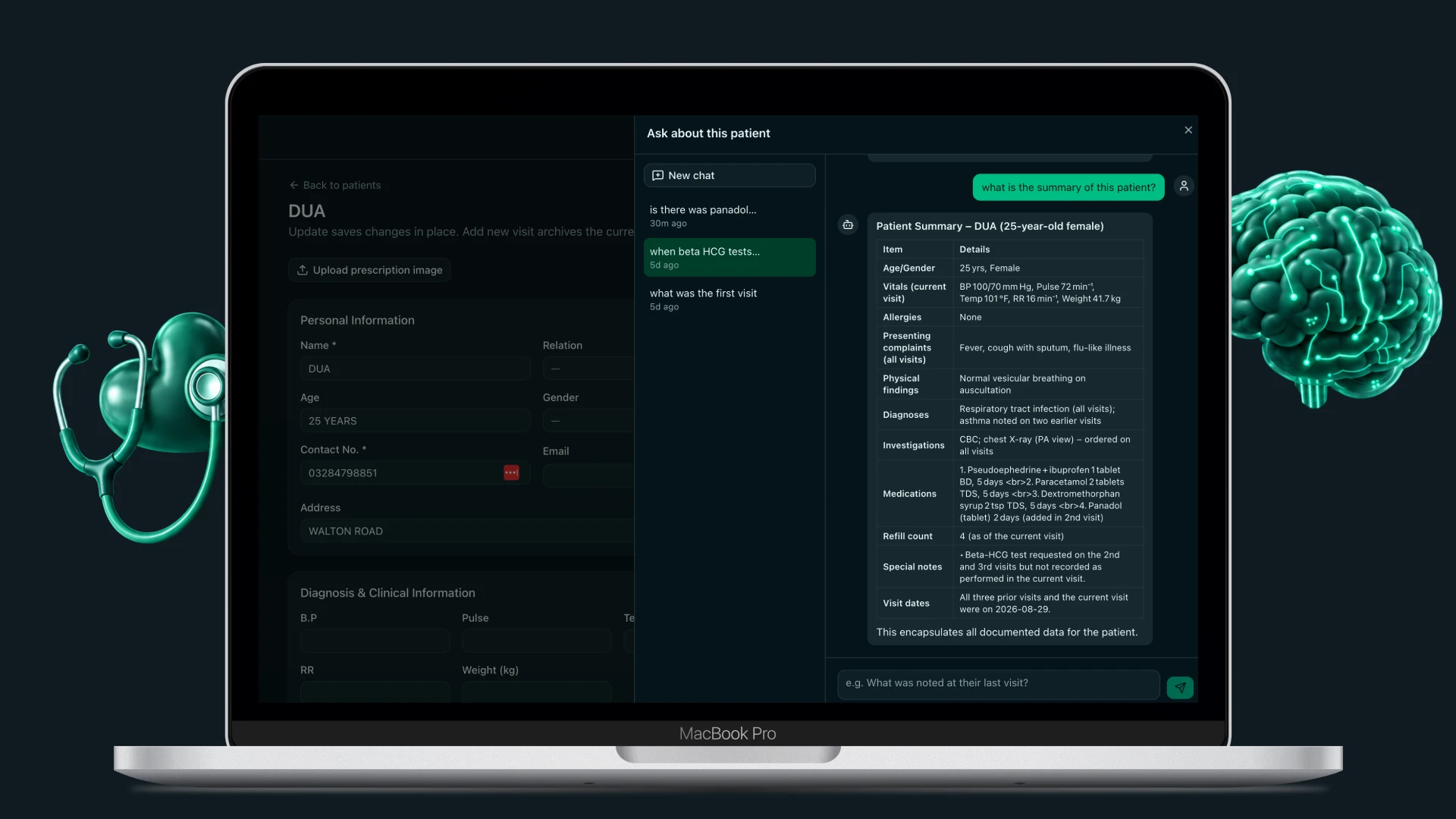
Supporting the consultation. A clinical assistant built on retrieval-augmented generation works from the patient’s own records. It summarises patient history, explains laboratory reports, answers medical questions, suggests generic medicine alternatives, flags duplicate medications and potential drug interactions, and drafts consultation summaries and follow-up notes.
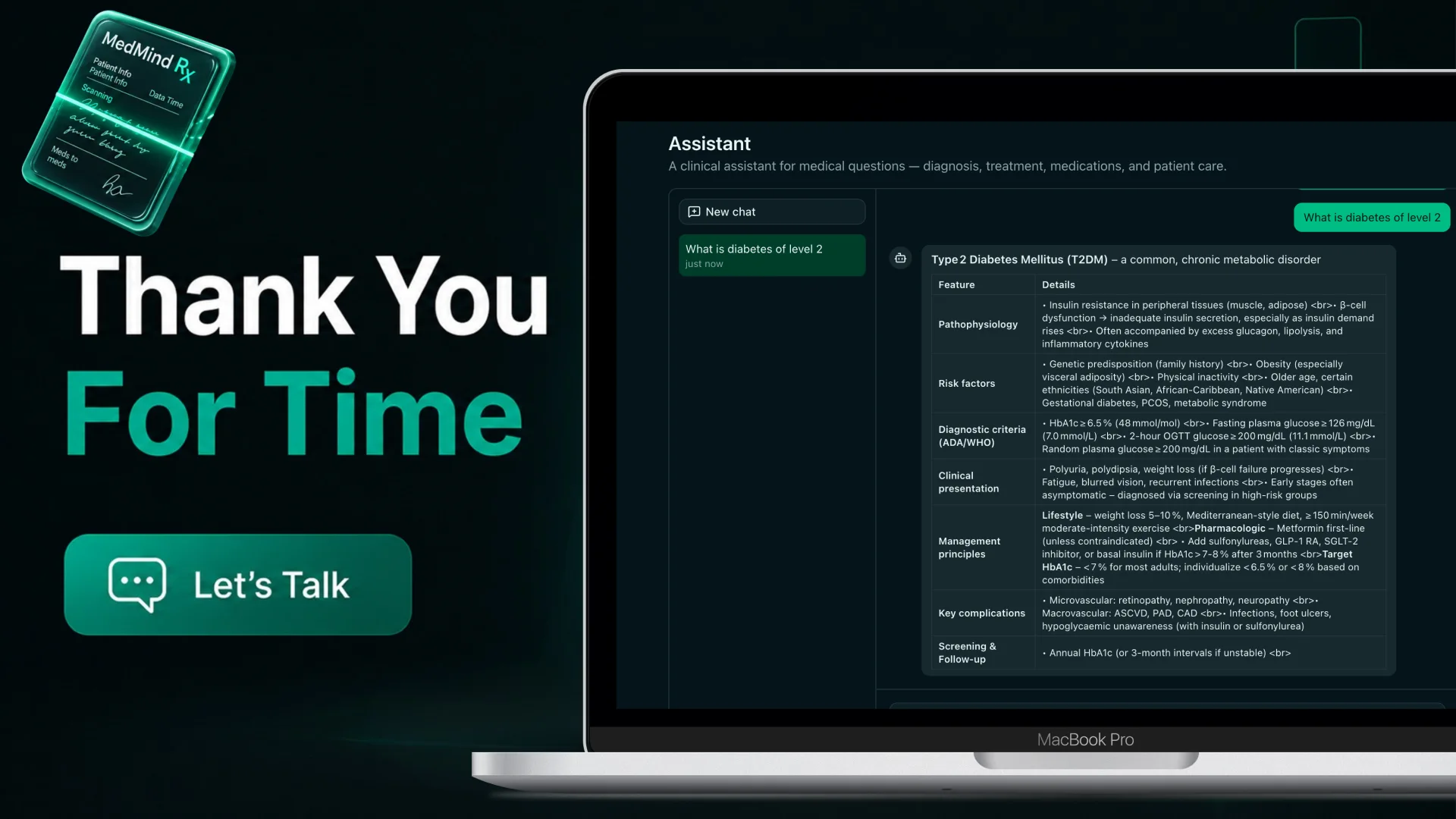
Serving patients directly. The public web portal offers browsable disease categories and an AI medical assistant for general health questions, with educational and preventive-care content that consistently points patients toward a qualified professional for diagnosis and treatment.
THE OUTCOMES
MedMind is designed to replace manual data entry with a review step, so the platform is expected to deliver faster prescription digitisation, reduced manual documentation and more consistent patient records, because every consultation is captured in the same structured shape.
That structure is what makes the rest possible. Semantic search turns an archive into something a doctor can actually interrogate; interaction and duplicatemedication checks catch problems that depend on remembering a patient’s full history; and dashboard analytics are intended to surface consultation trends, disease patterns, frequently prescribed medicines, follow-up rates and clinic workload, together with AI-based operational recommendations.
The aim is a unified healthcare ecosystem that supports more efficient, accurate and data-driven patient care while leaving full clinical control with the doctor. The project demonstrates our ability to combine vision, OCR, retrieval and vector search into one clinical workflow — with human approval built in at the point where it matters, so the technology supports the doctor’s judgement rather than substituting for it.