
ABOUT
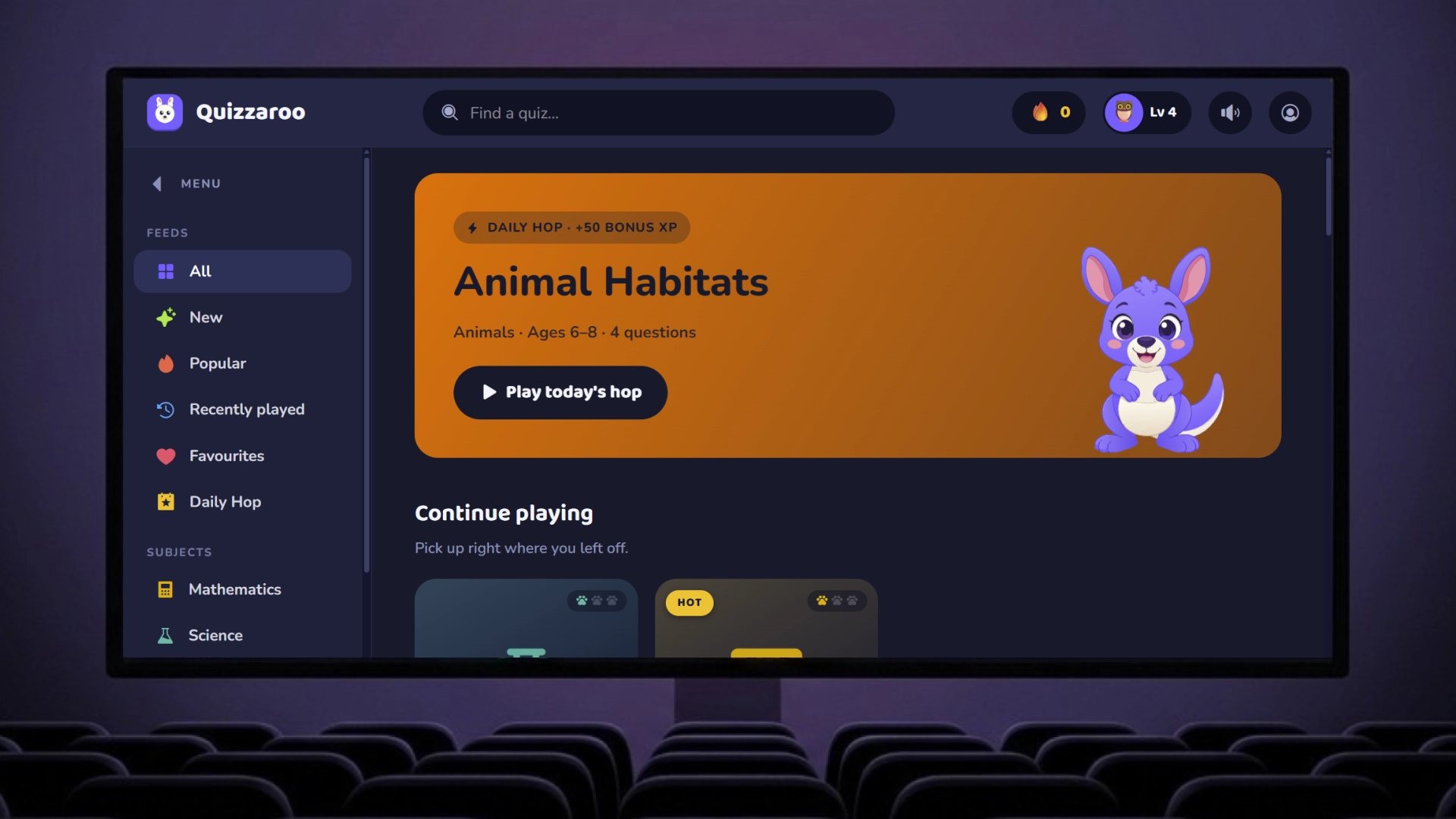
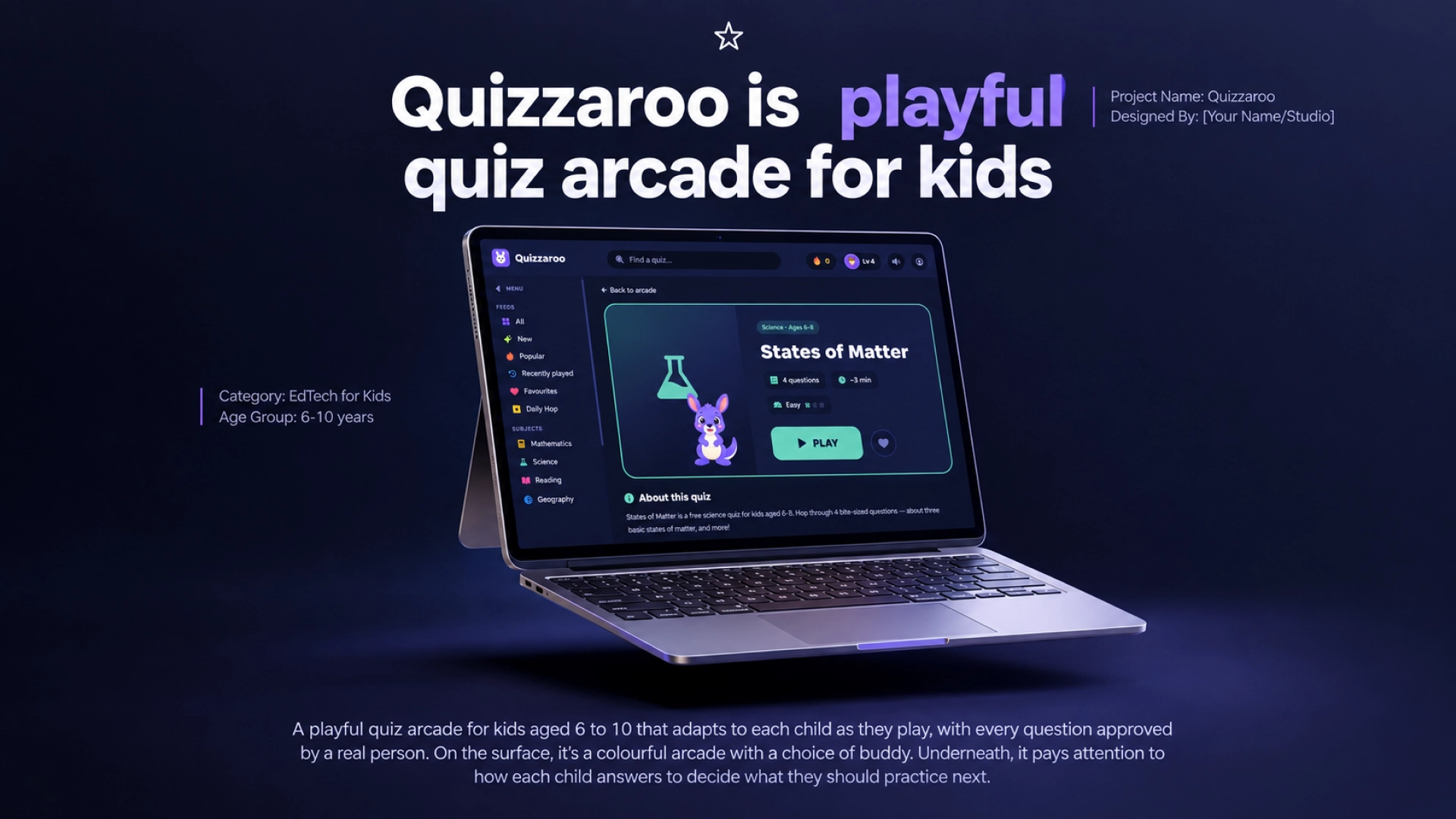
Quizzaroo is a playful quiz arcade for children aged 6 to 10 that adapts to each child as they play. On the surface it is a colourful game where kids pick a buddy, play short quizzes and collect stars and badges. Underneath, it tracks how each child answers and uses that to decide what they practise next. The product is two connected web applications — the family-facing arcade and an internal admin panel — sharing one database, and it is live today with paid family subscriptions.
THE PROBLEM
Most children’s practice apps give every child the same questions in the same order. That single decision creates three problems at once: confident children get bored by material they have already mastered, struggling children get discouraged by questions pitched beyond them, and parents cannot tell whether the time spent taught anything.
Genuinely adapting to each child requires far more questions than a small team can write by hand. If every child follows their own path through the material, the question bank has to be deep enough to keep serving each of them fresh, correctly-pitched questions across many subjects, topics, difficulties and age bands. Generating that volume with AI is the obvious answer — and it carries an obvious risk, because content written for young children cannot be published unreviewed.

THE SOLUTION
We built Quizzaroo so that AI solves the volume problem while a person remains responsible for everything a child sees.
Personalisation that follows the individual child. Every question belongs to a specific topic — Planets inside Space, for example. As a child plays, Quizzaroo tracks which topics they handle well and which need work. Mastered questions are retired and never repeat. Questions they got wrong return on a later day.
Topics they find difficult take a larger share of the next quiz. Two children can open the same quiz and see entirely different questions, because each is practising what they personally need — always within the age band and difficulty limits their parent has set.
AI-assisted content, human-approved. The admin panel lets the team generate draft questions with AI, targeted at an exact topic, difficulty and age group, with optional written guidance. Every draft lands in a review queue where a person edits, approves or rejects it. Nothing written by AI can reach a child until someone has signed off on it. Because both applications share one database, an approved question becomes playable in the arcade immediately.
A game children want to return to. Each quiz is five questions against a gentle timer. Every answer flips over straight away with a short, friendly explanation, so the quiz teaches something even when the answer was wrong. Correct answers earn XP and build combo streaks, quizzes award up to three stars, and a daily quiz gives a reason to come back.
One account per family. Parents manage child profiles, preferences and billing behind a PIN-protected settings area, and each child gets their own profile, buddy and progress. Subscriptions run through Stripe, and a family that cancels keeps access to the end of the period they paid for.

THE OUTCOMES
Quizzaroo delivers practice that fits each child rather than an average of all children, inside the age band and difficulty limits their parent sets once. Retiring mastered questions and resurfacing missed ones means play time is spent on material that is actually still being learned.
The content pipeline is what makes that sustainable. AI drafting lets a small team maintain a question bank deep enough to support per-child adaptation across a wide range of subjects, while the review queue keeps a person in control of every question a child sees — a safeguard the product is built around rather than one bolted on afterwards.
The project demonstrates our ability to use AI for scale where accuracy and appropriateness are non-negotiable, and to design the human review step into the workflow so it is fast enough to actually be used.
